
Birch timber beetle
Trypodendron betulae
Description
How to identify
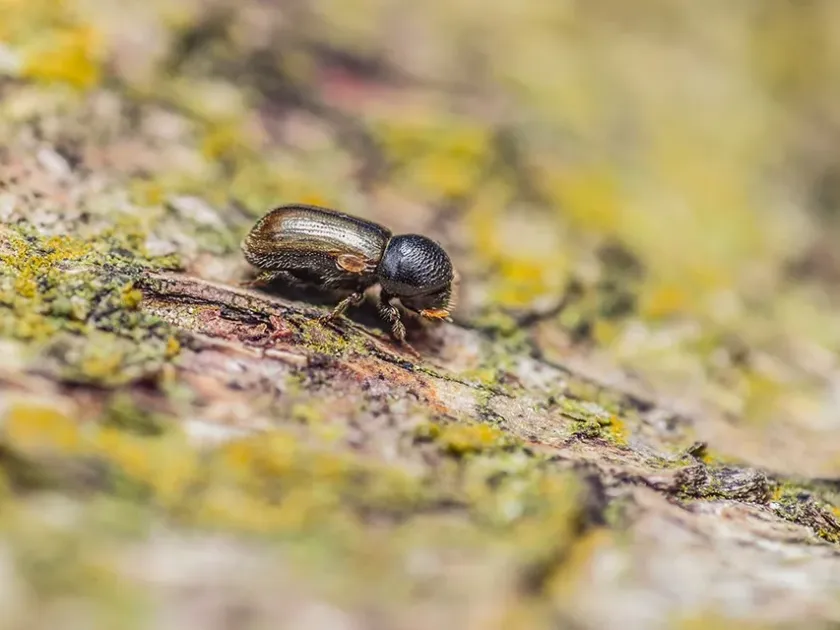
The birch timber beetle (Trypodendron betulae) is a species of ambrosia beetle belonging to the Curculionidae family and the Scolytinae subfamily. These are very small insects, typically measuring between 3 and 4 millimeters in length.
Adult beetles possess a cylindrical body shape, usually dark brown to black in color, which makes them difficult to spot against the rough bark of birch trees.
The surface of the elytra displays fine ridges, a common characteristic of wood-boring beetles that spend the majority of their lifecycle deep within the host material.
Their life cycle occurs entirely inside the wood, which acts as a protective barrier against many environmental stressors and common predators in the forest ecosystem.
Females are responsible for creating galleries inside the trunk, where they introduce symbiotic fungi that serve as the primary food source for their larvae.
What it damages
The primary host for this pest is the birch tree, particularly those that are already stressed, dying, or recently felled timber left unattended in the forest.
While the beetle rarely attacks healthy, vigorous trees, large populations can overwhelm even relatively strong specimens under favorable conditions for the pest.
Both adults and larvae cause structural damage by boring complex galleries deep into the sapwood and heartwood, which compromises the integrity of the timber.
This beetle significantly lowers the commercial value of lumber by creating small, circular holes and introducing dark staining fungi that discolor the wood fibers.
The colonization process accelerates the decay of the affected wood, leading to further degradation caused by the fungal growth introduced by the beetles.
When it appears
The active flight and colonization period typically begins in the spring when average daily temperatures reach levels sufficient for beetle activity.
First signs of infestation are usually observed in late April or May, depending on regional weather patterns and how quickly the forest floor warms up.
The lifecycle is generally univoltine, although warmer climates may allow for a partial second generation, which can significantly increase the damage potential within a season.
Pupation occurs inside the galleries during mid-summer, after which the new generation prepares for the overwintering phase.
Adult beetles overwinter in the forest litter or deeper within the host wood, emerging the following year once temperatures consistently rise.
Signs of infestation
The most visible sign of infestation is the presence of tiny, perfectly round entrance holes on the bark, approximately one to two millimeters in diameter.
Frass, or fine wood dust, often accumulates at the base of the tree or within bark crevices, indicating that beetles have recently bored into the trunk.
Upon closer inspection of the galleries, one can often find dark staining on the walls, caused by the symbiotic fungi cultivated by the beetles.
General signs of tree decline, such as yellowing foliage or premature leaf drop, may indicate that the tree is under heavy attack by wood-boring insects.
Removing a portion of the bark reveals the radial or longitudinal galleries that penetrate deep into the wood, extending perpendicular to the surface.
Control measures
The most effective management strategy involves sanitary logging and the rapid removal of fallen, dead, or weakened trees that act as breeding reservoirs.
Pheromone traps are highly recommended for monitoring beetle populations and reducing their numbers during the peak spring flight period.
Chemical applications using insecticides are generally limited to specific windows of time, strictly before the beetles have successfully penetrated the bark.
Logistical management, such as transporting harvested timber out of the forest before the flight season begins, is critical to preventing fresh infestations.
- Frequent monitoring of forest stands
- Prompt disposal of logging residues
- Use of trap trees to attract and manage populations
Taxonomy
- Latin name
- Trypodendron betulae
- Order
- Coleoptera (beetles)
- Family
- Curculionidae
- EPPO code
- TRYDBE
Discussion
No discussions yet — be the first.