
Hide beetle
Trox scaber
Description
How to identify
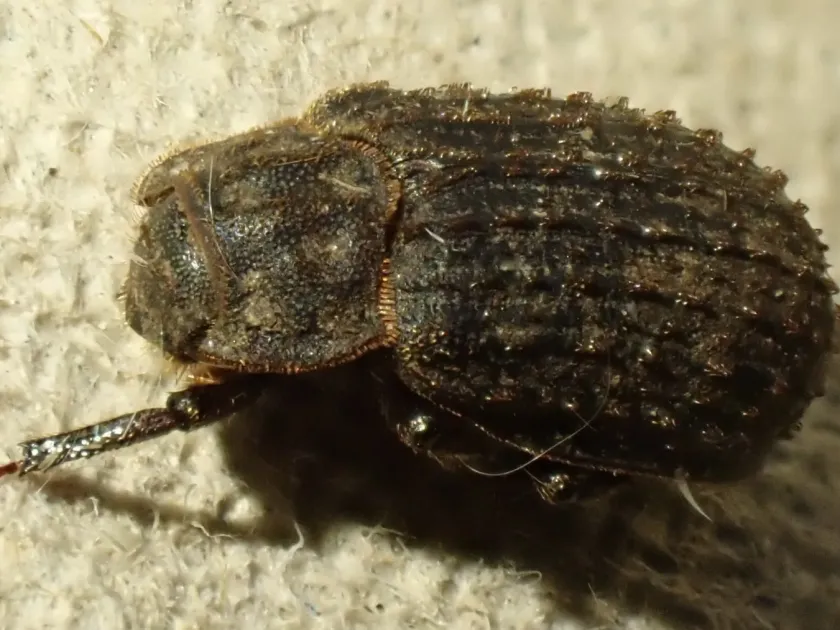
The Hide beetle (Trox scaber) belongs to the Trogidae family of the Coleoptera order. The adult beetle is a small insect, measuring between 5 and 9 mm in length.
Its body features a dull, extremely rough surface covered with tiny setae and tubercles, providing a greyish or dark brown coloration that acts as camouflage.
The head is deeply retracted into the pronotum, and the elytra are decorated with rows of prominent ridges, which help the insect blend into substrates like debris.
The larvae are characterized by strong mandibles and a dense chitinous shell, making them well-adapted to surviving in dry environments with scarce moisture.
Unlike many other stored-product pests, this beetle exhibits high resilience to temperature fluctuations and can survive for long periods under harsh conditions.
What it damages
The primary damage caused by Trox scaber occurs in agricultural storage facilities, such as warehouses and grain silos where organic debris is present.
The pest feeds on dry remains of animal and vegetable origin, often infesting stores where grain is contaminated with dust, debris, or other insect remains.
While the beetle rarely feeds on whole, healthy grain directly, it actively damages packaging, sacks, and infrastructure, contaminating products with its excrement.
In cases of heavy infestation, these beetles can damage leather goods, burlap, and other materials stored in the vicinity of agricultural crops.
Indirect damage involves the creation of decay spots and mold pockets within grain piles due to the accumulation of frass and decomposing beetle carcasses.
When it appears
Hide beetles lead a largely hidden life, becoming active when warehouse temperatures rise to between 18 and 25 degrees Celsius.
In climate-controlled or heated storage facilities, the pest's development can continue year-round without a distinct winter diapause.
The most intensive reproduction occurs during the spring and summer months when higher temperatures facilitate rapid metabolism and larval growth.
Adult beetles are capable of active flight, which allows them to quickly colonize new storage areas and transport hubs where animal feeds are kept.
The developmental cycle from egg to adult can take anywhere from a few months to half a year, depending on microclimate and food availability.
Signs of infestation
The first indicator of an infestation is the sighting of adult beetles on walls, floor surfaces, or directly on the surface of grain batches.
Close inspection of sacks or packaging often reveals characteristic entry or exit holes, indicating the beetles' search for protein-rich debris.
Accumulations of dust-like excrement in warehouse cracks, corners, and joints suggest intense activity of a established population.
A musty or decaying odor in the facility often accompanies an infestation, as insect activity disrupts the ventilation and compaction of the stored grain.
During facility audits, emphasis should be placed on examining hard-to-reach areas where dust and grain debris serve as the primary breeding ground.
Control measures
The primary defense strategy is maintaining strict warehouse hygiene, including regular cleaning to remove dust, debris, and grain residues.
Effective sealing of storage facilities is crucial to prevent adult beetles from migrating into the warehouse during their active flight periods.
In cases of significant population density, fumigation of storage areas using approved insecticides is necessary to eliminate the infestation.
Installing glue traps with lures is highly recommended for monitoring purposes to detect the presence of the pest before an outbreak occurs.
- Maintaining optimal temperature and humidity levels in storage.
- Regular disinfection of empty warehouses before new harvests are stored.
- Using durable, pest-resistant packaging to prevent insect access.
Taxonomy
- Latin name
- Trox scaber
- Order
- Coleoptera (beetles)
- Family
- Trogidae
- EPPO code
- TRXXSC
Discussion
No discussions yet — be the first.