
Trissolcus podisi
Trissolcus podisi
Description
How to identify
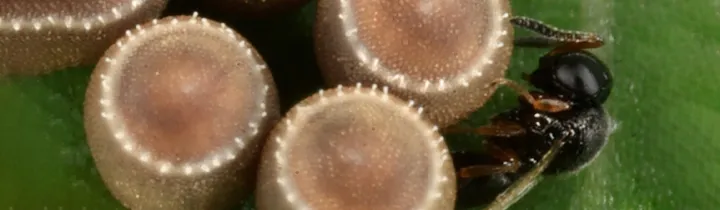
Trissolcus podisi is a small Hymenopteran wasp belonging to the family Scelionidae. It is a highly specialized egg parasitoid that plays a crucial role in agricultural ecosystems by regulating populations of various stink bug species.
The adult wasp is minute, usually measuring about 1 to 2 millimeters in length. Its body is generally dark, often with a metallic sheen, and it possesses well-developed wings for active dispersal in search of host eggs.
They are not plant pests; rather, they are beneficial predatory insects. The female uses its antennae to detect specific kairomones and pheromones released by stink bugs during and after oviposition on host plants.
The entire larval development occurs within a single host egg. The larva consumes the contents of the egg, effectively preventing the development of the pest, and emerges as an adult wasp.
Due to its high specificity and effectiveness, it is considered one of the most important natural control agents for stink bugs in soybean production systems across the Americas.
What it damages
Trissolcus podisi does not cause any direct damage to crops. It is not a phytophagous insect and does not feed on plant tissues, stems, or leaves at any stage of its life cycle.
Its impact is purely positive for the agricultural industry as it functions as a natural enemy of stink bugs (Pentatomidae), which are significant economic pests of legumes and grains.
By parasitizing the eggs of the brown stink bug and other related species, the wasp prevents the emergence of nymphs that would otherwise cause direct damage to the developing seeds and pods.
In many regions, this parasitoid is capable of destroying the vast majority of stink bug egg masses, acting as a natural insecticide that functions autonomously in the field.
Integrating this natural predator into farming practices reduces the need for synthetic chemical applications, contributing to more sustainable and cost-effective crop production.
When it appears
The activity of these wasps typically begins in the spring, coinciding with the arrival and reproductive activity of their stink bug hosts on agricultural fields.
Population peaks are usually observed during the summer months when host egg-laying activity is highest, particularly in soybean crops during the vegetative and reproductive stages.
Trissolcus podisi is multivoltine, meaning it completes multiple generations throughout the growing season, allowing it to closely track and suppress rising pest populations.
They overwinter as fertilized adult females in protected environments, such as leaf litter, soil crevices, or under the bark of nearby trees, waiting for favorable spring temperatures.
Environmental variables such as humidity and temperature influence the developmental rate of the parasitoid, often mirroring the phenology of their hosts.
Signs of infestation
The primary indication of the presence and activity of this wasp is the visual appearance of host eggs in the field. Parasitized eggs often exhibit a darkened or metallic color compared to the pale, healthy eggs.
After the adult wasp emerges from the host egg, it leaves behind a characteristic circular exit hole, which is a definitive sign of successful parasitism.
Active adults can be found patrolling the underside of leaves and stems, searching for fresh stink bug egg clusters, which are their primary reproductive sites.
A reduction in the number of emerging nymphs despite the presence of egg masses on the foliage is a strong indicator of successful parasitoid control in the area.
Field scouting for these parasitoids helps agronomists estimate the level of biological control being provided by nature and determines if further chemical intervention is necessary.
Control measures
The main objective regarding Trissolcus podisi is the conservation of its population. Farmers should implement strategies that minimize the negative impact on this beneficial insect.
Reducing the reliance on broad-spectrum insecticides is essential. Targeted applications or the use of more selective biopesticides help preserve the parasitoid's numbers.
Maintaining ecological corridors and non-cropped field margins provides essential overwintering habitats and supplementary food sources for adult wasps.
Monitoring populations of beneficials alongside pests allows for more informed decision-making, ensuring that natural control mechanisms are utilized to their full potential.
- Avoid prophylactic insecticide use.
- Use selective chemicals that are less toxic to Hymenoptera.
- Preserve field margins and surrounding natural vegetation.
- Implement integrated pest management (IPM) to protect natural enemies.
Taxonomy
- Latin name
- Trissolcus podisi
- Order
- Hymenoptera
- Family
- Scelionidae
- EPPO code
- TRSSPO
Discussion
No discussions yet — be the first.