
Telenomus
Telenomus beneficiens
Description
How to identify
Telenomus (Telenomus beneficiens) belongs to the order Hymenoptera and the family Scelionidae. These are tiny, highly specialized parasitic wasps that act as natural enemies to various agricultural pests.
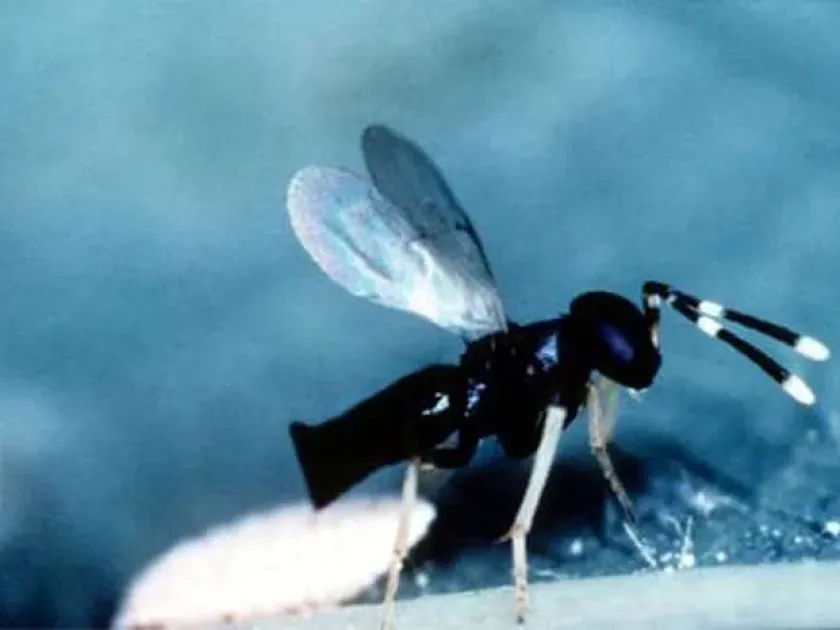
Adults are very small, typically less than 1 mm in length, and have a dark, shiny, hardened body structure. The head is relatively large, and the antennae possess a specific segmentation pattern typical for the genus.
The wings are clear with extremely reduced venation. Because their entire larval stage occurs inside the host's eggs, they are rarely seen by the naked eye during standard field surveys.
The life cycle of this species is perfectly timed with the reproductive cycle of their hosts. The female wasp is highly efficient at locating host egg masses, even in dense crop foliage.
As a specialized egg parasitoid, this insect provides crucial ecosystem services by naturally suppressing the population of harmful species before they hatch.
What it damages
It is critical to note that Telenomus beneficiens is not an agricultural pest. On the contrary, it is a highly beneficial biological control agent that contributes significantly to crop health.
It specializes in parasitizing the eggs of various Lepidopteran pests, most notably stem borers (such as Chilo species) that infest rice, corn, and sugarcane crops.
The parasitoid lays its own eggs inside the eggs of the pest, where the larvae consume the contents, thereby preventing the pest from hatching and causing damage to the plants.
Telenomus does not damage crops in any way. It does not feed on leaves, stems, or roots. Its presence is entirely non-destructive and highly advantageous for the farmer.
The economic impact of this wasp is immense, as it acts as a self-sustaining pest control mechanism that can drastically reduce the need for synthetic chemical insecticides.
When it appears
The seasonal activity of Telenomus begins in the spring, triggered by rising temperatures as the wasps emerge from their overwintering sites.
The timing of adult emergence is closely synchronized with the onset of oviposition by the primary insect pests in the target crops.
Multiple generations occur throughout the growing season, which allows the wasp population to respond rapidly to the fluctuating population density of the host pests.
During the warmer summer months, the developmental rate increases significantly, enabling the population to peak exactly when the pest pressure is highest.
As the season draws to a close in autumn, the wasps enter a state of diapause, surviving the colder months in sheltered locations within or near the fields.
Signs of infestation
Identifying the activity of Telenomus requires microscopic examination of host egg masses. The primary sign of success is the presence of small exit holes in the shells of the eggs.
Infected egg masses often change color, appearing darker or black compared to healthy, unparasitized eggs, indicating the internal development of the wasp larva.
- Darkening of the host egg mass.
- Small, round exit holes on the egg shells.
- A significant reduction in host larvae emergence in the field.
- Empty or consumed egg contents upon microscopic inspection.
Monitoring these indicators allows agronomists to assess the effectiveness of natural biological control and avoid unnecessary pesticide applications.
Control measures
Conservation is the primary management strategy for Telenomus. Because it is a beneficial organism, efforts are focused on providing an environment where these wasps can thrive.
When chemical pest control is deemed necessary, selective insecticides should be chosen to minimize toxicity to beneficial wasps and preserve their populations.
Maintaining non-crop areas, such as wildflower strips or hedgerows, provides essential nectar sources for adult wasps during periods when host eggs are unavailable.
Broad-spectrum insecticide applications should be avoided during peak egg-laying periods to ensure that the natural wasp population can successfully parasitize the pest.
In advanced integrated pest management (IPM) programs, Telenomus can be mass-reared and released in fields to augment natural populations and enhance the efficacy of biological pest control.
Taxonomy
- Latin name
- Telenomus beneficiens
- Order
- Hymenoptera
- Family
- Scelionidae
- EPPO code
- TELNBE
Discussion
No discussions yet — be the first.