
Trissolcus murgantiae
Trissolcus murgantiae
Description
How to identify
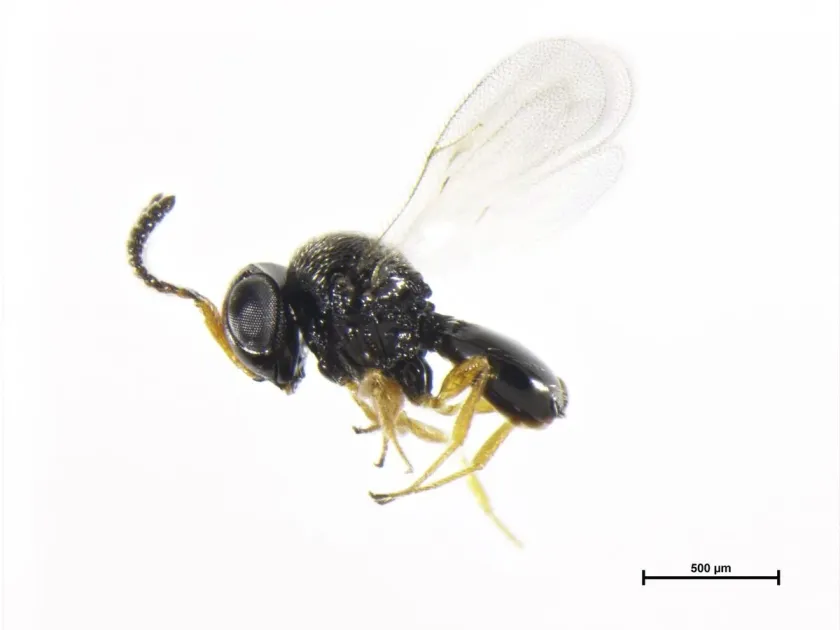
Trissolcus murgantiae is a tiny hymenopteran parasitoid belonging to the family Scelionidae. It is a highly specialized wasp that targets the eggs of shield bugs.
The adult wasp measures approximately 1 to 2 mm in length. Its body is typically black, often exhibiting a slight metallic luster, characteristic of the Scelionidae family.
The antennae of the female are distinctive, consisting of 11 segments, which serve as essential sensory organs for detecting the chemical cues released by host insects during oviposition.
Being an endoparasitoid, the entire larval development of this wasp occurs inside the egg of the host insect, which is a crucial aspect of its biological classification.
Identification often requires specialized entomological equipment, such as a stereo microscope, to observe the specific morphological structures of the wings and antennae.
What it damages
This species does not cause direct damage to crops. In fact, it is considered a beneficial insect because it functions as a biological control agent against the harlequin bug, Murgantia histrionica.
The harlequin bug is a significant pest of cruciferous crops such as cabbage, kale, and broccoli, causing tissue death and fruit deformation through its feeding activities.
Trissolcus murgantiae mitigates this damage by parasitizing the eggs of the bug. The wasp lays its own egg inside the host's egg, effectively killing the developing bug nymph before it can hatch.
From an agricultural standpoint, the wasp plays a vital role in keeping pest populations below the economic injury level, thereby reducing the need for synthetic pesticide applications.
However, the wasp's effectiveness depends on the availability of its specific host and the absence of harmful chemical interventions in the field.
When it appears
The seasonal activity of Trissolcus murgantiae is strictly synchronized with the life cycle of its host, the harlequin bug, typically beginning in late spring.
The insect can complete several generations throughout the growing season, with the total developmental time from egg to adult ranging between 10 to 20 days depending on temperature.
During peak summer, the wasp population reaches its maximum as it tracks the successive generations of the pest across vegetable fields.
As temperatures drop in autumn, the wasps enter a diapause phase, often overwintering in protected sites or within the remnants of host eggs from the final seasonal generation.
Efficient pest management requires understanding this seasonality to ensure that any field treatments do not interfere with the natural population buildup of this beneficial parasitoid.
Signs of infestation
The most reliable sign of parasitism is the discoloration of the host's egg clusters. Parasitized eggs often turn dark grey or black, distinct from the pale or patterned color of healthy eggs.
Close inspection of the egg clusters under magnification may reveal small, circular exit holes. These are created by the adult wasp upon emerging from the host egg.
A high density of empty, darkened egg shells in a cluster is a clear indicator that the population of Trissolcus murgantiae is successfully attacking the pest.
Field observers may also spot adult wasps actively searching for egg clusters on the undersides of leaves during the peak breeding season of the harlequin bug.
Absence of typical nymphal feeding damage despite the presence of adults often suggests the underlying presence of parasitoid activity.
Control measures
Conservation biological control is the primary method for managing this species. The main goal is to protect and encourage the naturally occurring populations of these wasps.
- Limit the use of broad-spectrum insecticides that are toxic to Hymenoptera.
- Plant floral strips or nectar-rich plants near vegetable fields to provide adult wasps with supplemental energy sources.
- Use selective, pest-specific biorational insecticides if control is required.
- Maintain edge habitats that provide overwintering shelter for beneficial insects.
Integrating cultural practices, such as crop rotation and intercropping, helps to disrupt the life cycle of the host bug while allowing the parasitoid to thrive.
Monitoring programs using pheromone traps for the host bugs can help determine if the parasitoid population is sufficient to manage the pest pressure naturally.
Educating growers on the importance of identifying and protecting these small wasps is essential for developing sustainable and effective agricultural practices.
Taxonomy
- Latin name
- Trissolcus murgantiae
- Order
- Hymenoptera
- Family
- Scelionidae
- EPPO code
- TRSSMU
Discussion
No discussions yet — be the first.