
Trissolcus mitsukurii
Trissolcus mitsukurii
Description
How to identify
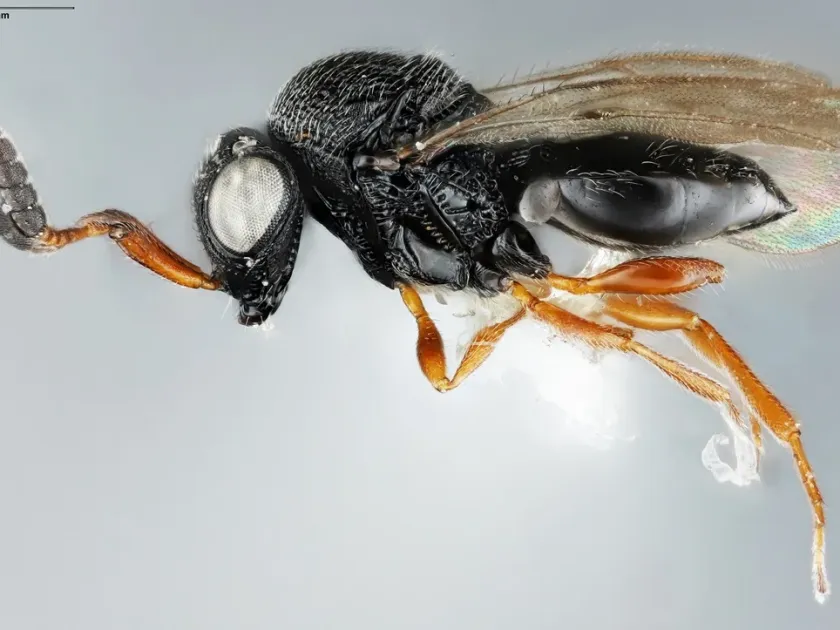
Trissolcus mitsukurii is a minute parasitic wasp belonging to the family Scelionidae. Adults are typically 1 to 2 mm in length, making them difficult to detect with the naked eye in agricultural settings.
The insect possesses a robust, black or dark-brown body with well-developed wings, adapted for active flight and searching for host egg masses within dense canopy vegetation.
As members of the Hymenoptera order, they exhibit specialized antennal and wing venation patterns characteristic of the Trissolcus genus, which are essential for precise taxonomical identification.
Field identification usually requires the use of sticky traps or sweeping nets to collect samples, as these wasps are highly mobile and elusive when searching for hosts.
Detailed taxonomic classification often necessitates laboratory examination, including micro-morphological analysis of reproductive organs to distinguish the species from other closely related wasps.
What it damages
It is crucial to note that Trissolcus mitsukurii is not a plant pest; rather, it is a highly effective beneficial insect, specifically an egg parasitoid that targets stink bugs (Pentatomidae).
The primary hosts include invasive species such as the brown marmorated stink bug (Halyomorpha halys), which causes significant economic damage to fruits, vegetables, and field crops.
The female wasp deposits her eggs inside the eggs of the stink bug. The developing wasp larva consumes the host embryo, effectively preventing the stink bug from hatching and causing damage to plants.
By limiting the reproductive success of stink bug populations, Trissolcus mitsukurii serves as a vital component of integrated pest management strategies in global agriculture.
Its high host specificity allows for targeted control, making it a sustainable alternative to chemical pesticide application for managing stink bug infestations.
When it appears
The seasonal activity of Trissolcus mitsukurii is highly synchronized with the life cycle of its target stink bug hosts, beginning in early spring as temperatures rise.
In most temperate regions, the parasitoid can produce multiple generations per growing season, ensuring continued pressure on consecutive waves of stink bug egg deposition.
Adults typically overwinter in protected microhabitats, such as leaf litter, tree bark fissures, or organic debris, emerging when environmental conditions become suitable for host finding.
Peak emergence and activity of the wasp usually coincide with the primary oviposition periods of agricultural pests, optimizing the natural regulation of host density.
Understanding the phenology of both the host and the parasitoid is essential for timing the release of biocontrol agents or scheduling necessary agricultural operations to minimize harm.
Signs of infestation
The most visible indicator of Trissolcus mitsukurii activity is the distinct change in the appearance of stink bug egg clusters, which turn dark gray or black following successful parasitization.
Small, circular emergence holes on the surface of the stink bug eggs indicate that the parasitoid has completed its development and successfully exited the host egg.
A reduction in the number of hatched stink bug nymphs in infested areas, despite the presence of egg batches, often signals high parasitism rates by Trissolcus mitsukurii.
Laboratory confirmation of parasitism is achieved by collecting and incubating egg masses in controlled conditions and observing the subsequent emergence of wasps rather than stink bug nymphs.
Regular monitoring of crop fields for darkened or perforated egg masses allows agronomists to assess the effectiveness of the existing natural enemy population.
Control measures
As Trissolcus mitsukurii is a beneficial species, management strategies focus on conservation biological control to protect and enhance its population within agroecosystems.
Broad-spectrum insecticide use should be minimized or restricted during critical periods of wasp activity to prevent non-target mortality and preserve the natural regulation of pests.
- Use of selective pesticides that are compatible with beneficial parasitoids.
- Integration of floral strips to provide nectar sources for adult wasps.
- Reduced tillage practices to protect overwintering sites for the population.
Augmentative releases of mass-reared Trissolcus mitsukurii are increasingly utilized as a proactive strategy to suppress invasive stink bug populations in high-value orchard and vegetable crops.
Implementing these practices fosters a stable agricultural environment where Trissolcus mitsukurii can effectively contribute to sustainable crop protection and pest mitigation.
Taxonomy
- Latin name
- Trissolcus mitsukurii
- Order
- Hymenoptera
- Family
- Scelionidae
- EPPO code
- TRSSMI
Discussion
No discussions yet — be the first.