
Trissolcus japonicus
Trissolcus japonicus
Description
How to identify
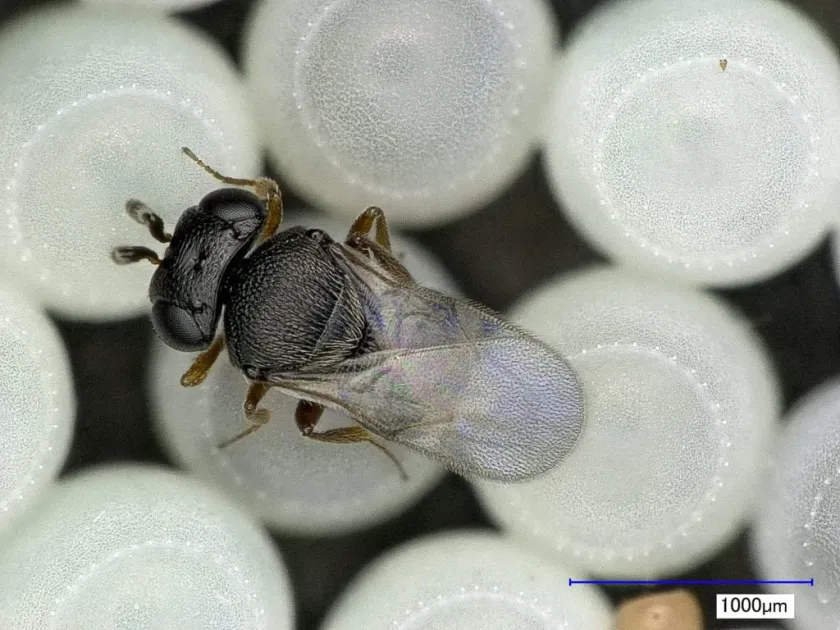
Trissolcus japonicus is a tiny parasitoid wasp belonging to the family Scelionidae, within the order Hymenoptera.
The adult wasps are extremely small, typically measuring between one to two millimeters in length.
They are specialized egg parasitoids that have evolved to locate and parasitize the eggs of various stink bug species.
Because of their specialized behavior, they are highly efficient at searching for and colonizing host egg masses in agricultural settings.
Their morphological characteristics, including dark coloration, are typical for this group of highly evolved hymenopteran parasitoids.
What it damages
It is crucial to emphasize that Trissolcus japonicus is not a plant pest; it is a highly beneficial biological control agent.
The organism provides significant agricultural value by targeting the eggs of the brown marmorated stink bug (Halyomorpha halys).
By laying its eggs inside the eggs of the stink bug, the wasp effectively prevents the development of the pest's offspring.
This parasitic activity results in the total destruction of the stink bug embryo, thereby reducing the population density of the pest.
In modern integrated pest management, this wasp is considered one of the most promising tools for sustainable crop protection.
When it appears
The activity period of Trissolcus japonicus begins in the spring, coinciding with the reproductive cycle of its host species.
Throughout the growing season, the wasp can complete several generations, maintaining continuous pressure on stink bug populations.
The wasps overwinter as fertilized females in protected habitats such as leaf litter, tree bark, or other suitable micro-shelters.
Their emergence is synchronized with the first egg-laying events of the stink bugs, ensuring immediate access to host resources.
As the season progresses, the population density of the wasp fluctuates in response to the availability of pest eggs in the field.
Signs of infestation
The presence and success of Trissolcus japonicus can be identified through specific signs on the foliage of host plants.
- Stink bug eggs parasitized by the wasp exhibit a distinct color change, turning from light green or cream to a dark, metallic black.
- The emergence of the adult wasp creates small, round, and neat exit holes on the surface of the parasitized eggs.
- A lack of hatching stink bug nymphs from observed egg masses indicates successful parasitism by the wasp.
- Field monitoring often involves collecting egg masses to verify the presence of parasitized dark-colored eggs.
- The overall decline in stink bug pressure in fruit orchards and vegetable farms serves as a functional sign of the parasitoid's impact.
Control measures
Effective management strategies focus on conserving and encouraging the existing populations of this beneficial wasp.
Reducing the broad-spectrum insecticide usage is essential to prevent the accidental killing of the parasitoid population.
When chemical control is necessary, selecting products that are less harmful to beneficial insects is highly recommended.
Large-scale augmentative biological control involves the laboratory rearing and strategic release of the wasps in infested agricultural areas.
Maintaining floral diversity and non-crop areas near production fields provides necessary habitat for the survival of the wasp during the off-season.
Taxonomy
- Latin name
- Trissolcus japonicus
- Order
- Hymenoptera
- Family
- Scelionidae
- EPPO code
- TRSSJP
Discussion
No discussions yet — be the first.