
Trissolcus euchisti
Trissolcus euchisti
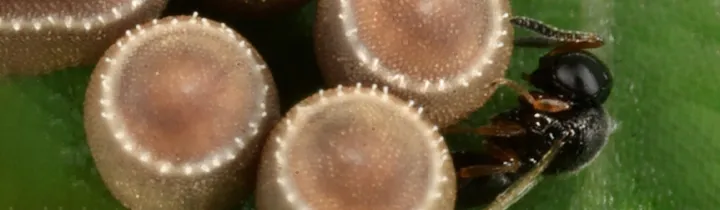
Description
How to identify
Trissolcus euchisti is a highly specialized micro-wasp belonging to the family Scelionidae, order Hymenoptera. It is a well-known egg parasitoid that plays a crucial role in regulating insect populations in various ecosystems.
The adult insect is extremely small, typically black, and possesses a robust body structure. Its most distinct feature is its ability to locate host eggs using chemoreception.
As a parasitoid, it is specifically adapted to locate the egg masses of pentatomid bugs, commonly referred to as stink bugs, which are major agricultural pests.
Identification in the field requires specialized entomological training, as the wasp is barely visible to the naked eye and is often confused with other small parasitic Hymenoptera.
Despite its microscopic size, it is a formidable biological control agent, capable of finding eggs deposited in hidden locations under plant leaves.
What it damages
This species does not cause any direct damage to crops. It is not a phytophagous insect and does not feed on plant tissues, juices, or roots.
The status of Trissolcus euchisti as a "pest" is a misconception; in reality, it is a highly beneficial insect that serves as a natural enemy to stink bugs.
By parasitizing the eggs of stink bugs, this wasp effectively stops the development of the next generation of pests, protecting crops such as corn, soybeans, and fruits.
The only negative impact associated with its presence might be the reduction of other beneficial insect populations if broad-spectrum pesticides are misused in the field.
Agro-ecosystems benefit significantly from the presence of this wasp, as it reduces the reliance on synthetic chemicals for pest control.
When it appears
The seasonal activity of Trissolcus euchisti is tightly synchronized with the life cycle of its hosts, which are most active during the spring and summer months.
As temperatures rise and stink bugs begin their egg-laying phase, the wasps emerge to locate and parasitize the freshly laid eggs.
The insect typically completes multiple generations throughout the growing season, ensuring continuous control of pest populations.
Peak activity is observed in mid-to-late summer, coinciding with the highest density of host egg masses on leaves and stems.
The species survives the winter by entering a state of diapause, hiding within plant debris or inside host egg remnants until the following spring.
Signs of infestation
The most visible sign of Trissolcus euchisti activity is the alteration of host eggs. Stink bug eggs normally appear light in color but turn dark or black when parasitized.
Upon close inspection of the egg masses, one can find small circular emergence holes where the adult wasp has exited the host egg.
A failure in the hatching of stink bug egg masses, combined with the presence of dark, parasitized eggs, is a clear indicator of successful control by the wasp.
Monitoring the field for these specific signs allows farmers to evaluate the effectiveness of natural biological control without applying chemical sprays.
Using magnification tools on collected egg masses can reveal high parasitism rates, which is a positive sign for the agricultural environment.
Control measures
To support populations of Trissolcus euchisti, farmers should avoid the use of broad-spectrum insecticides, especially organophosphates, during the peak egg-laying period of stink bugs.
Implementing Integrated Pest Management (IPM) practices is essential. This includes using selective, pest-specific control methods that do not harm the parasitoid wasps.
Preserving natural habitats, such as field edges, flowering strips, and undisturbed crop residues, provides necessary refuges for these beneficial insects.
Strategic tillage management can also help, as excessive soil disruption may destroy the overwintering sites of the wasp.
- Focus on biological control agents.
- Implement precision application of pesticides.
- Maintain biodiversity in and around the field.
- Use monitoring traps to track host activity.
Taxonomy
- Latin name
- Trissolcus euchisti
- Order
- Hymenoptera
- Family
- Scelionidae
- EPPO code
- TRSSEU
Discussion
No discussions yet — be the first.