
Trissolcus bennisi
Trissolcus bennisi
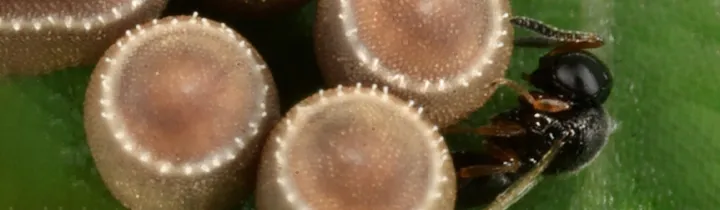
Description
How to identify
Trissolcus bennisi is a specialized member of the Hymenoptera order, belonging to the Scelionidae family. As a tiny egg parasitoid, it plays a vital ecological role by regulating the populations of various insect species that are considered agricultural pests.
Adult individuals are extremely small, often overlooked in the field due to their size. They possess highly developed sensory organs that enable them to detect chemical volatiles emitted by host insects during oviposition.
The life cycle of this species is perfectly synchronized with its hosts. The female searches for host eggs, inserts its ovipositor, and lays its own eggs inside, effectively terminating the development of the pest embryo.
While identification requires microscopic examination, field agronomists recognize the presence of these wasps through the characteristic emergence holes left on parasitized host eggs.
Scientific interest in this species lies in its high searching efficiency, which allows it to locate even sparse populations of host pests, maintaining a balance in the agroecosystem.
What it damages
Trissolcus bennisi does not cause mechanical damage to crops. It is strictly an entomophagous insect, meaning its impact on the plant is entirely indirect and positive, as it eliminates potential pests before they can hatch and feed on the crops.
The primary hosts are various shield bugs that damage cereals, legumes, and vegetable crops. By parasitizing their eggs, this wasp significantly reduces the future density of pest populations.
However, the agricultural concern arises when broad-spectrum pesticide applications accidentally eliminate these beneficial wasps, creating a vacuum that leads to secondary pest outbreaks.
Therefore, classifying it as a "pest" is scientifically inaccurate. It is a natural biological control agent, and its protection is essential for sustainable agriculture and reducing chemical dependency.
Agro-ecological management focuses on preserving this species to ensure that natural suppression of shield bug populations remains effective throughout the growing season.
When it appears
The activity of Trissolcus bennisi is strongly correlated with the presence of host eggs. During the growing season, they produce multiple generations, with their population peaking alongside the pest infestation cycles.
Temperature and humidity are the main abiotic factors influencing their emergence and search capacity. Optimal conditions allow for rapid reproduction and dispersal across agricultural fields.
Overwintering typically occurs as adults or pupae in protected habitats. These include forest edges, field margins, and deep within crop residue, where microclimatic conditions remain relatively stable.
Early spring marks the emergence of the first generation. Agronomists tracking pest cycles often correlate the appearance of this parasitoid with the start of the primary shield bug oviposition period.
Regular monitoring using yellow sticky traps or egg card baits can provide insights into the presence and activity levels of these parasitoids within the field borders.
Control measures
Management strategies for Trissolcus bennisi revolve around conservation biological control. The goal is to minimize the mortality of these beneficial insects caused by agricultural practices.
Farmers are advised to switch to integrated pest management (IPM) practices, prioritizing selective insecticides that spare natural enemies while targeting the actual pests.
Establishing perennial flowering buffer zones around crop fields provides the necessary nectar and shelter for adult parasitoids, increasing their survival rates during periods of low host density.
Conservation of field margins and reduced-tillage practices help preserve overwintering sites, ensuring a stable population of this wasp returns to the fields each season.
- Implement Integrated Pest Management (IPM).
- Use selective, target-specific pesticides only.
- Preserve native vegetation around field edges.
Taxonomy
- Latin name
- Trissolcus bennisi
- Order
- Hymenoptera
- Family
- Scelionidae
- EPPO code
- TRSSBE
Discussion
No discussions yet — be the first.