
Trissolcus basalis
Trissolcus basalis
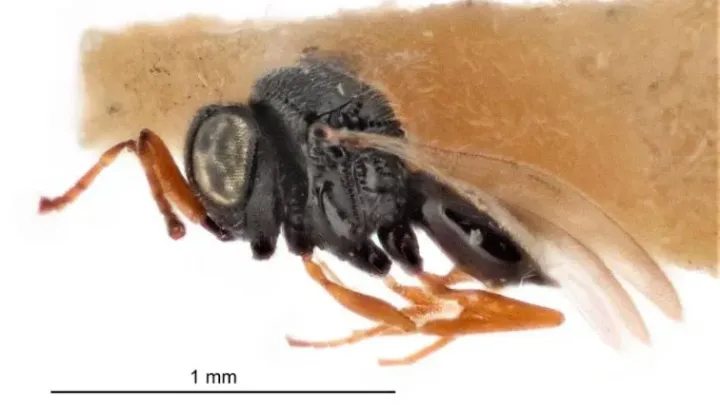
Description
How to identify
Trissolcus basalis is a tiny Hymenopteran wasp belonging to the family Scelionidae. Adults are very small, usually between 1 to 2 mm in length, and are typically black in color.
This species is classified as an egg parasitoid. Its morphology is characteristic of parasitic wasps, featuring well-developed wings for flight and sensitive antennae used by females to locate host eggs.
Females exhibit high searching efficiency and are capable of locating the egg masses of various pentatomid bugs by responding to chemical cues known as kairomones.
Systematically, it is a well-known beneficial insect used globally in integrated pest management (IPM) programs to regulate populations of phytophagous bugs.
The biology of the species is intimately linked to the developmental cycle of its hosts, allowing for synchronized emergence and efficient exploitation of pest egg clusters.
What it damages
It is important to clarify: Trissolcus basalis is not a plant pest. It is a highly beneficial parasitoid that feeds on the eggs of destructive stink bugs.
The primary host for this wasp is the Southern Green Stink Bug (Nezara viridula), a major pest that causes significant damage to various crops, including legumes and vegetables.
The wasp attacks egg masses by inserting its own egg into the host egg. The developing wasp larva consumes the internal contents of the stink bug egg, effectively preventing the pest larva from hatching.
Crops that benefit from the presence of this wasp include soybeans, tomatoes, beans, corn, and many other vegetable varieties that are prone to stink bug infestations.
By effectively parasitizing the eggs, Trissolcus basalis significantly reduces the population pressure of the pests, serving as a powerful ally in sustainable agriculture.
When it appears
The activity of Trissolcus basalis is highly dependent on the phenology of its hosts. The first adults emerge in the spring, coinciding with the beginning of the stink bug egg-laying period.
Throughout the growing season, this parasitoid can produce multiple generations, ensuring continuous control of the pest population during the warmest months.
Optimal conditions for survival and reproduction include warm temperatures and moderate humidity, which are standard during the main growing season for most agricultural crops.
Overwintering occurs in the adult stage, with mated females seeking refuge in the soil, leaf litter, or other sheltered environments until conditions become suitable again.
The development time from egg to adult is relatively short, usually around 2 to 3 weeks, allowing the population to increase rapidly in response to host availability.
Signs of infestation
The most reliable sign of the presence of this parasitoid is the color change of the stink bug egg masses. Healthy bug eggs are typically light green or cream-colored.
Parasitized eggs gradually turn dark gray or black, indicating that the wasp larva is developing inside. This is a clear indicator of successful biological control.
When examined under magnification, one can see small, circular emergence holes in the eggs, through which the adult wasps have exited after completing their metamorphosis.
Massive presence of darkened egg clusters on the foliage is a positive sign, indicating that natural control mechanisms are effectively managing the pest population.
Growers should monitor for these darkened eggs as a key indicator of effective biological regulation before deciding on any further intervention.
Control measures
Since Trissolcus basalis is a beneficial insect, the goal is not to control the wasp, but to conserve and protect its population within the field environment.
The primary strategy is to minimize the use of broad-spectrum insecticides, especially during the peak egg-laying period of stink bugs, to avoid killing the wasps.
Implementation of Integrated Pest Management (IPM) practices includes the use of selective pesticides that are less harmful to beneficial insects and natural enemies.
Maintaining flower strips or natural vegetation around crop fields provides essential nectar sources for adult wasps, which significantly increases their longevity and search efficiency.
- Avoid indiscriminate calendar-based spraying.
- Utilize selective pest control products.
- Monitor parasitism levels to determine if biological control is sufficient.
Taxonomy
- Latin name
- Trissolcus basalis
- Order
- Hymenoptera
- Family
- Scelionidae
- EPPO code
- TRSSBA
Discussion
No discussions yet — be the first.