
Trissolcus
Trissolcus
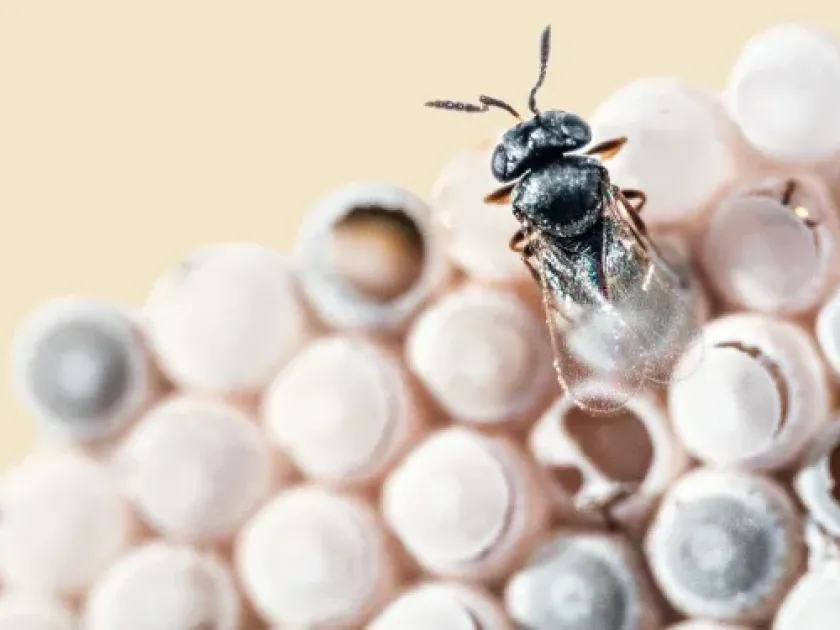
Description
How to identify
Trissolcus is a genus of minute parasitic wasps belonging to the family Scelionidae, renowned for their role as egg parasitoids.
Measuring typically between 1 to 2 millimeters, these wasps are specialized insects that focus their entire life cycle on the eggs of various bug species, particularly Pentatomidae.
Adult Trissolcus are usually dark-colored and equipped with wings, allowing them to actively search agricultural fields for host egg clusters to lay their own eggs inside.
The larva of the wasp develops internally within the host egg, feeding on the contents and effectively preventing the pest from hatching.
The entire metamorphosis from egg to adult occurs inside the host's eggshell, which serves as a protective chamber for the wasp until it reaches maturity and emerges.
What it damages
Trissolcus species are strictly beneficial in agriculture; they do not cause any damage to plants or crops. Instead, they provide essential ecosystem services by controlling pest populations.
By parasitizing the eggs of serious pests like the wheat bug or various stink bugs, they interrupt the life cycle of the pest before it can cause mechanical damage to the foliage or fruit.
Their activity serves as a natural barrier to pest outbreaks, reducing the economic pressure that farmers would otherwise face from extensive damage to yields.
Without these parasitoids, many agricultural regions would suffer from significantly higher densities of harmful bugs, necessitating much larger volumes of chemical intervention.
Agronomists classify these wasps as key elements of integrated pest management (IPM) programs, as their presence is essential for maintaining natural equilibrium in field crops.
When it appears
Trissolcus activity begins in early spring, as temperatures rise and adult wasps emerge from their overwintering sites in soil or debris.
The timing of their seasonal cycle is often highly synchronized with the arrival of the first generation of pest egg clusters in the fields.
During the warmer months, these wasps can complete multiple generations, which allows their population to build up and keep pace with the spread of host species.
As late summer and autumn approach, the wasps prepare for the cold season by finding sheltered overwintering spots, effectively dormant until the following spring.
Temperature and humidity levels significantly influence the development rates, with warmer seasons typically resulting in faster reproduction and larger populations of wasps.
Signs of infestation
The primary indication of Trissolcus activity is the presence of small, circular exit holes on the shells of pest eggs found on crops.
A change in the color of the egg cluster is another visual sign; as the wasp larva develops, the host eggs often darken or change texture compared to healthy, unparasitized eggs.
Monitoring for "empty" eggs that remain attached to the leaf or stem indicates that the parasitoid has successfully completed its life cycle.
Field observation showing low emergence of actual bug nymphs despite the presence of egg clusters suggests that a high level of parasitism is occurring.
Professional monitoring involves collecting representative leaf samples and inspecting them under a microscope to calculate the parasitism rate in the field.
Control measures
The primary management strategy for Trissolcus is the preservation of their population through reduced use of broad-spectrum chemical insecticides.
Adopting IPM strategies that prioritize selective, narrow-spectrum products is critical to ensuring the wasps are not harmed during spraying operations.
- Preserve hedgerows and border vegetation as overwintering refuges for the wasps.
- Synchronize pesticide applications to avoid peak activity periods of the beneficial insect.
- Utilize augmentative biocontrol, where lab-reared wasps are released in fields with high pest pressure.
By maintaining a diverse farm ecosystem, farmers can encourage permanent colonization of Trissolcus, providing long-term, self-sustaining pest control.
Agronomic practices, such as reduced tillage in certain areas, can help protect the wasps' overwintering stages hidden in soil or crop debris, further supporting their population stability.
Taxonomy
- Latin name
- Trissolcus
- Order
- Hymenoptera
- Family
- Scelionidae
- EPPO code
- TRSSSP
Discussion
No discussions yet — be the first.