
Trigoniulus
Trigoniulus
Description
How to identify
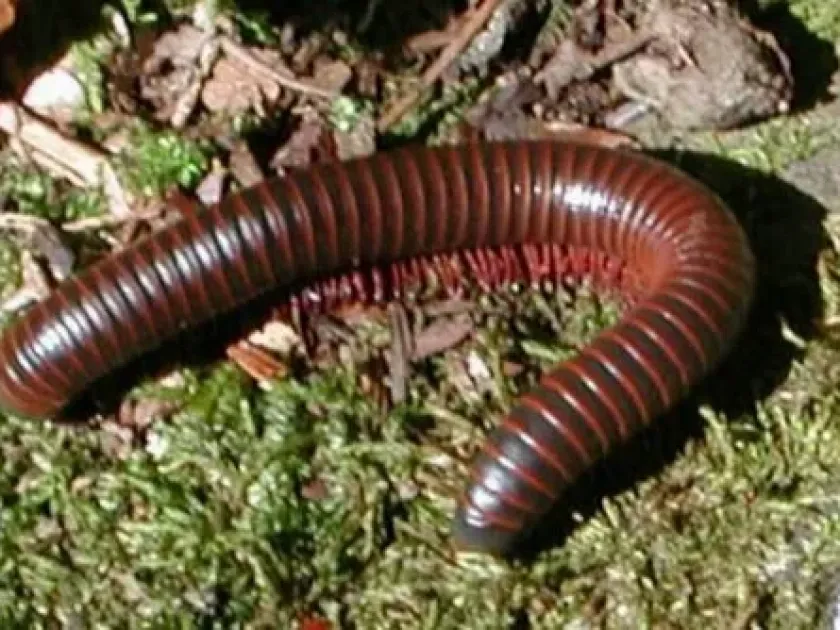
Trigoniulus belongs to the class Diplopoda (millipedes) and the family Pachybolidae. These are relatively large millipedes with a cylindrical, robust body composed of numerous segments.
The color of adults typically ranges from reddish-brown to bright orange or even near-black, depending on the species and habitat. They possess a high number of leg pairs, enabling rapid movement through soil layers.
In natural conditions, they act as decomposers, breaking down organic matter; however, at high population densities, they can switch to feeding on live plant tissues. They are easily recognized by their habit of coiling into a tight spiral when disturbed.
A key identifying feature is the presence of defensive glands that secrete a pungent, potentially toxic substance to deter predators. This biological defense mechanism makes them resistant to many natural enemies.
The development of Trigoniulus occurs through several molting stages, with each molt increasing the number of body segments and leg pairs. The development cycle is heavily dependent on substrate moisture and organic food availability.
What it damages
These millipedes cause damage to a wide range of crops, particularly in humid subtropical conditions and greenhouse environments. Vegetables, seedlings, and young plants are the most susceptible to attack.
The pest prefers succulent tissues, creating deep tunnels in the underground parts of plants, such as roots, tubers, bulbs, and taproots. This disrupts nutrient uptake, eventually leading to plant wilting and death.
Trigoniulus also frequently damages seeds and young sprouts during germination, significantly reducing crop density and causing economic losses for agricultural producers.
In greenhouses, they may attack plant stems that are in direct contact with moist soil, penetrating the vascular system. Damaged tissues are highly prone to secondary infections, including rots and fungal pathogens.
The damage is exacerbated by the pest's nocturnal activity, which complicates the timely detection of outbreaks and the implementation of immediate protective measures.
When it appears
The activity of Trigoniulus is directly correlated with soil moisture levels and ambient temperature. They pose the greatest threat during periods of heavy rain or excessive irrigation.
In tropical and subtropical regions, these pests are active year-round, provided that sufficient soil moisture is maintained. In temperate climates, the damage is most pronounced during the summer and autumn months.
In greenhouse settings, seasonality is largely absent because the artificially maintained microclimate provides ideal conditions for year-round reproduction and feeding.
Periods of mass emergence of juveniles often coincide with the accumulation of decaying plant material in the soil, which serves as a primary food source before they migrate to cultivated crops.
Millipede migration within the soil profile is also seasonally dependent: they move deeper during dry periods and migrate back to the root zone when conditions become wet again.
Signs of infestation
The primary signs of infestation are distinct damage patterns on the underground parts of plants. Roots often exhibit shallow but numerous furrows and excavated cavities.
During soil inspection around affected plants, large numbers of adults or larvae can be observed, especially in the early morning or after irrigation. Finding shed chitinous skins after molting is another reliable indicator.
Severely infested plants show sudden growth stagnation, yellowing leaves, and a general appearance resembling distress from nutrient or water deficiency.
When excavating seedlings, clusters of pests are often found directly at the root crown. Occasionally, damage is accompanied by a specific unpleasant odor emanating from the millipede’s defensive secretions.
In areas where pests congregate, one often observes the development of mold fungi, indicating a compromise in the root epidermis that allows for secondary infection.
Control measures
The foundation of control is based on agrotechnical practices: strict irrigation management, avoiding over-saturation of the soil, and timely removal of plant debris that attracts the pest.
Using traps made from moistened pieces of vegetables (such as potatoes or carrots) placed on the soil surface is effective; these must be collected and destroyed regularly along with the gathered millipedes.
The use of contact and systemic insecticides is justified only during high-population outbreaks. It is recommended to use products based on organophosphates or pyrethroids specifically formulated for soil application.
Biological control methods include the use of entomopathogenic nematodes, which effectively target millipedes in the soil environment without harming cultivated plants.
- Deep tillage of the soil to disrupt pest galleries.
- Implementation of crop rotation and avoidance of incorporating fresh organic matter into the soil just before planting.
- Usage of mulching materials that do not retain excess moisture near the base of the stem.
Taxonomy
- Latin name
- Trigoniulus
- Family
- Trigoniulidae
- EPPO code
- TRGUSP
Discussion
No discussions yet — be the first.