
Common brushtail possum
Trichosurus vulpecula
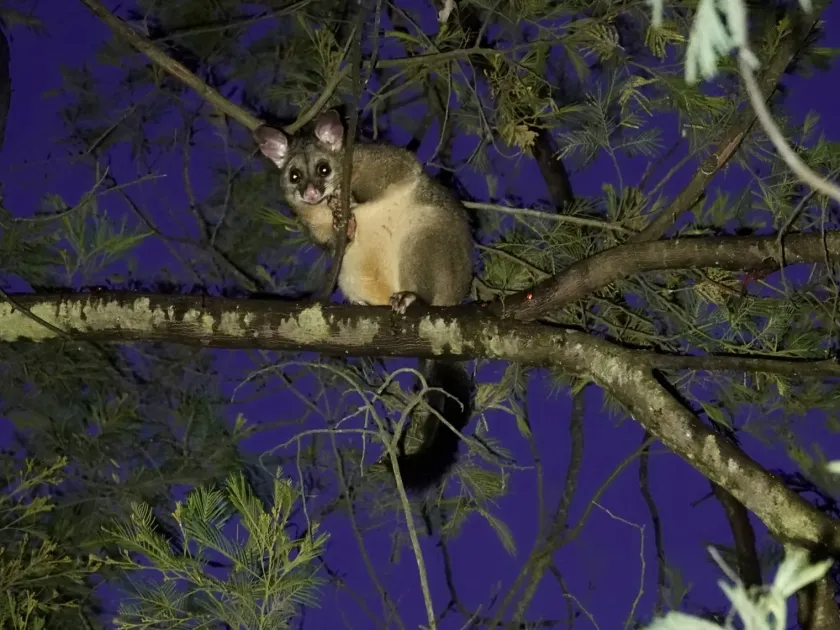
Description
How to identify
The common brushtail possum (Trichosurus vulpecula) belongs to the order Diprotodontia and the family Phalangeridae. It is a nocturnal, arboreal marsupial often mistaken for a large rodent or small cat.
These animals are characterized by their thick, bushy tails and strong, sharp claws that enable them to climb trees and residential structures with ease.
Their fur coat varies in color from silver-gray to brown or even black, which provides excellent camouflage during their nocturnal foraging activities.
While native to Australia, the species has become a significant invasive pest in other parts of the world, most notably in New Zealand, where it impacts both ecosystems and agriculture.
They are highly adaptable creatures, capable of thriving in urban environments, dense forests, and productive horticultural landscapes.
What it damages
Brushtail possums are voracious eaters that target fruit trees, consuming buds, flowers, and ripened fruits like apples, pears, and stone fruits.
Beyond orchards, they frequently damage ornamental shrubs and garden flowers by stripping them of their leaves and new-growth stems.
In vegetable gardens, they can cause total crop failure by grazing on seedlings, leafy greens, and vegetables such as carrots and potatoes.
Forestry is also negatively impacted, as possums feed on tree bark, which often leads to the decline or death of native saplings and broadleaf species.
- Fruit trees (apples, plums, citrus).
- Vegetable crops (lettuce, brassicas).
- Ornamental garden plants and roses.
- Young native forest saplings.
When it appears
Possums are active throughout the year, but their foraging intensity fluctuates based on the seasonal availability of their preferred food sources.
During spring, they prioritize tender buds and fresh floral growth, which can devastate a season's harvest before the fruit even begins to develop.
Summer and autumn see them feeding heavily on maturing fruits and berries, often damaging far more produce than they actually consume.
Winter poses a unique challenge as limited food availability drives them to consume the bark and stems of trees, causing severe structural damage to orchards.
Reproductive cycles also dictate their activity levels, as lactating females require increased nutrient intake to support their offspring.
Signs of infestation
One of the most obvious signs of possum presence is fruit that has been partially eaten, leaving behind distinctive deep gouge marks from their teeth.
Finding droppings on the ground beneath trees is a clear indicator that a possum has been feeding in the canopy above.
Scratches and worn bark on tree trunks indicate that the plant is being used as a primary highway for the animal to access food sources.
Nocturnal noises, such as chattering, clicking, or growling sounds emanating from roofs or trees, are typical indicators of their active movement.
The sudden loss of young shoots in vegetable beds, where the remaining stalk is clearly chewed rather than cut, points to possum activity.
Control measures
Installing metal bands or collars around tree trunks is a highly effective mechanical barrier that prevents possums from climbing into the canopy.
Fencing off vegetable patches with fine-mesh or electrified wire can significantly reduce the risk of crop damage from possums and other wildlife.
Commercial repellents containing predator scents or bittering agents may offer short-term protection but often require frequent reapplication.
Trapping and professional removal remain the standard methods for controlling populations in areas where possums have become a widespread nuisance.
Maintaining a tidy garden by removing fallen fruit and composting organic waste helps minimize the environmental attractants that draw possums to your property.
Taxonomy
- Latin name
- Trichosurus vulpecula
- Family
- Phalangeridae
- EPPO code
- TRQSVU
Discussion
No discussions yet — be the first.