
Trichogrammatoidea cryptophlebiae
Trichogrammatoidea cryptophlebiae
Description
How to identify
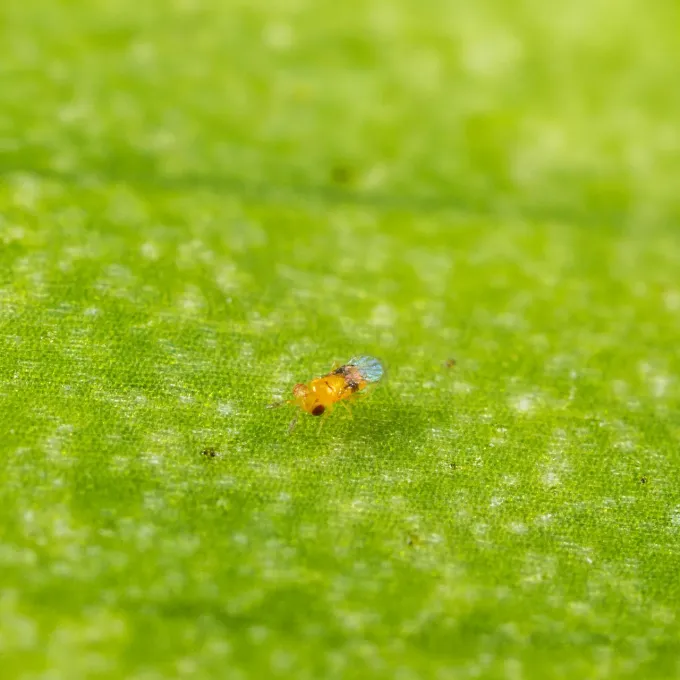
Trichogrammatoidea cryptophlebiae is a minute Hymenopteran parasitoid belonging to the family Trichogrammatidae. It is widely recognized for its role as an egg parasitoid targeting various Lepidopteran species.
The adult wasp is extremely small, and its lifecycle is entirely dependent on finding the eggs of specific host pests to parasitize.
The female wasp exhibits remarkable searching behavior, utilizing chemical cues to locate host eggs deposited on leaves or fruit surfaces.
Once a suitable host egg is found, the wasp inserts its own egg inside, causing the eventual death of the pest embryo and the emergence of a new generation of parasitoids.
This species is highly valued in agriculture as an efficient biological control agent that suppresses pest populations before they cause visible damage to crops.
What it damages
The primary concern regarding pests controlled by this parasitoid involves nut-bearing crops, most notably macadamia nuts.
Lepidopteran larvae penetrate the husks and feed on the developing kernels, leading to significant yield losses and poor nut quality.
When the host population is high, the damage can lead to premature fruit drop and an increase in susceptibility to pathogens.
The economic impact of these pests is high because the damaged fruit often fails to meet the strict quality standards required for the export market.
Management focuses on preventing larvae from ever reaching the vulnerable stage of fruit boring by utilizing the biological control action of T. cryptophlebiae.
Control measures
Biological control through inundative releases is the most common strategy for managing host populations using this wasp.
Integrated Pest Management (IPM) programs prioritize the preservation of natural parasitoid populations by avoiding the misuse of broad-spectrum insecticides.
Monitoring host activity using pheromone traps is essential to ensure that parasitoid releases are timed correctly with the peak egg-laying periods of the pests.
Cultural practices, including the removal and destruction of infested fruit, help reduce the overwintering population of the pests.
- Maintain floral strips to support adult parasitoids.
- Avoid broad-spectrum chemical sprays during peak activity.
- Monitor egg populations regularly to decide on release rates.
Taxonomy
- Latin name
- Trichogrammatoidea cryptophlebiae
- Order
- Hymenoptera
- Family
- Trichogrammatidae
- EPPO code
- TRGDCR
Discussion
No discussions yet — be the first.