
Trichogrammatoidea
Trichogrammatoidea
Description
How to identify
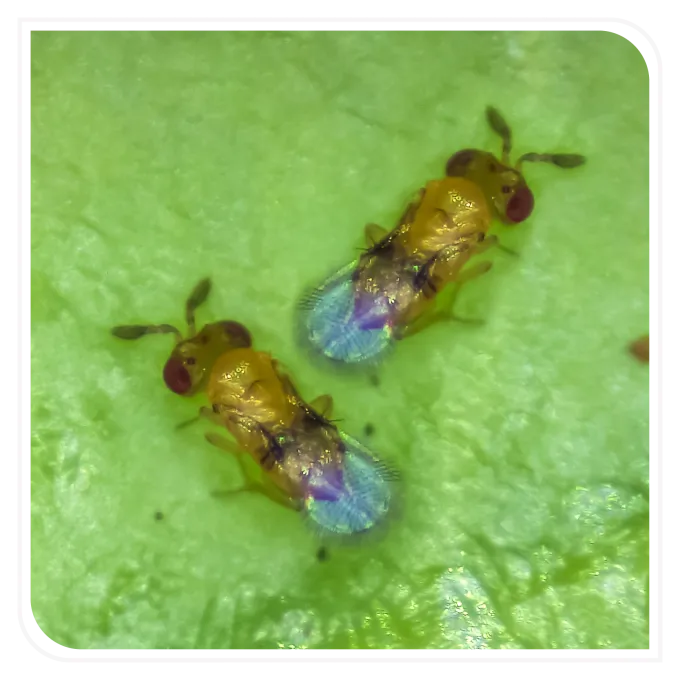
Trichogrammatoidea is a genus of minute parasitic wasps within the family Trichogrammatidae. These insects are well-known in entomology for their role as egg parasitoids in various ecological systems.
Individual wasps are extremely small, typically measuring less than one millimeter in length, which makes them difficult to monitor without specialized magnification tools.
The morphology of the genus includes distinct wing venation and fine hairs on the wing edges, which are diagnostic features for researchers classifying these insects.
They exhibit high searching efficiency, allowing them to locate host eggs hidden on the underside of plant leaves or within crevices in agricultural crops.
The biological success of this group is attributed to their specialized reproductive strategy, where females selectively target the eggs of specific host insects.
What it damages
The primary hosts for these wasps are the eggs of various Lepidopteran species, which include significant pests such as bollworms and other moth species in agriculture.
The wasps lay their own eggs inside the host eggs, effectively preventing the pest larvae from hatching and thus mitigating the potential damage to crops.
While often considered beneficial, their role in specific monoculture systems requires careful management to ensure they do not conflict with other integrated biological control strategies.
Damage to crops is prevented by the wasps themselves, as they interrupt the life cycle of destructive caterpillars that would otherwise consume leaves, fruits, and stems.
The economic impact is observed in crops such as cotton, corn, and vegetables, where the control of larval populations is vital for maintaining high agricultural yields.
When it appears
The seasonal cycle begins as temperatures rise in the spring, allowing the adults to emerge from their overwintering sites in vegetation or soil debris.
Peak activity is typically observed during the mid-summer months, coinciding with the most intense egg-laying periods of the major lepidopteran pest species.
Their life cycle is temperature-dependent, often requiring only 7 to 14 days from egg to adult in warm conditions, allowing for multiple generations per season.
As autumn approaches and temperatures drop, the wasps begin to enter a state of diapause, seeking protected environments to survive the winter months.
Effective management requires tracking the phenology of both the wasps and their hosts to ensure that protection strategies are timed optimally.
Signs of infestation
The most reliable sign of their activity is the discoloration of pest eggs, which often turn black or show a dark, metallic sheen after the parasite has developed.
Under a microscope, one can observe tiny, circular emergence holes in the host eggs, indicating that the adult wasp has successfully exited the shell.
A noticeable decrease in the number of pest caterpillars on the host plants is a clear biological indicator of the effective presence of these egg parasitoids.
Visual surveys in the field involving the collection of leaf samples are necessary to quantify the rate of parasitism and determine the population density.
The absence of live, unparasitized pest eggs in areas with high moth activity usually suggests that the natural population of wasps is functioning effectively.
Control measures
Integrated Pest Management (IPM) practices are essential to protect and encourage the natural populations of Trichogrammatoidea within agricultural environments.
Reducing the use of broad-spectrum insecticides is crucial, as these chemicals often have a negative impact on beneficial insect populations, including parasitic wasps.
Habitat management, such as maintaining flowering field margins, provides essential nectar sources for adult wasps, thereby increasing their longevity and searching capacity.
Cultural practices like crop residue management help reduce the overwintering success of primary pests while protecting the overwintering sites of these beneficial insects.
- Deploy pheromone traps to monitor pest activity patterns.
- Implement selective rather than broad-spectrum pest control products.
- Encourage biodiversity to support stable populations of natural enemies.
Taxonomy
- Latin name
- Trichogrammatoidea
- Order
- Hymenoptera
- Family
- Trichogrammatidae
- EPPO code
- TRGDSP
Discussion
No discussions yet — be the first.