
Trichogramma principium
Trichogramma principium
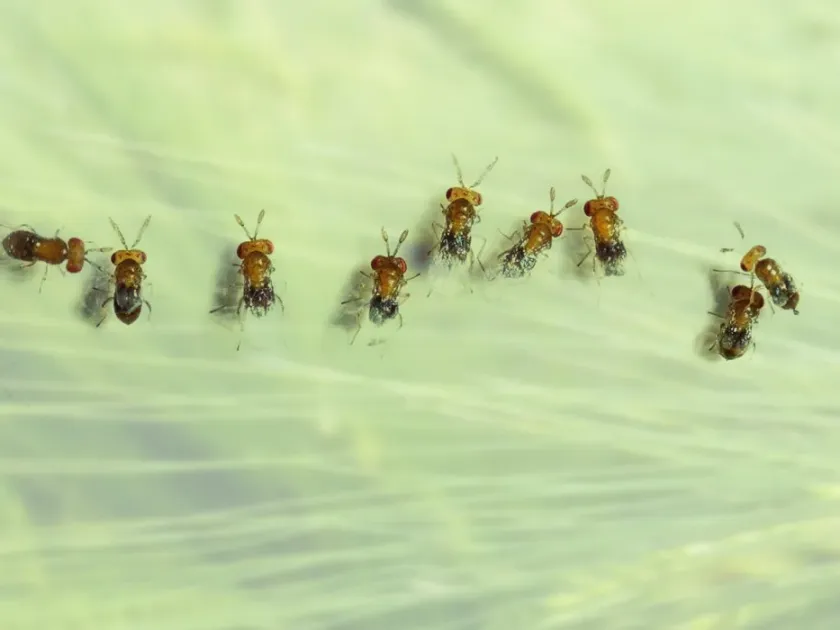
Description
How to identify
Trichogramma principium is a tiny insect belonging to the order Hymenoptera and the family Trichogrammatidae. It is a specialized entomophage often utilized in biological control programs, though it requires precise management to maintain ecological stability within agroecosystems.
Adult individuals are extremely small, typically measuring between 0.5 and 1 millimeter in length. Their bodies are dark, ranging from brown to nearly black, making them difficult to detect without careful observation on leaves or fruit surfaces.
The wings exhibit characteristic hairiness, and the specific wing venation serves as a primary morphological feature for identification under a laboratory microscope. Male antennae display distinct hair structures that differentiate them from females.
The life cycle of this insect is obligately linked to the eggs of lepidopteran pests. Development occurs entirely inside the host egg, progressing through the stages of egg, larva, prepupa, and pupa.
Adults possess high searching capabilities, allowing them to effectively locate pest clusters across various plant strata, including protected areas such as the underside of leaves and stems.
What it damages
The "damage" caused by Trichogramma principium in professional agronomy relates to the disruption of natural pest regulation mechanisms. Unlike phytophagous insects, it does not cause direct damage to plant tissues.
Crops potentially affected by the dynamics of this species include corn, sunflowers, brassicas, and various cereal crops, where the host insects targeted by the trichogramma are commonly found.
Uncontrolled population dynamics can interfere with biological control strategies if the parasite begins to dominate or negatively affects other beneficial entomophages, leading to an imbalance in the agroecosystem.
Failure in the natural regulation of lepidopteran pests, such as cutworms or the meadow moth, can lead to population outbreaks, necessitating costly chemical interventions to save the harvest.
Consistent monitoring is a vital agronomic task, as any unbalanced intervention in the biocenosis may lead to significant economic losses due to the resurgence of primary pests.
When it appears
The flight of adults in the field begins in the spring when average daily temperatures reach 15–18 degrees Celsius, which coincides with the onset of egg-laying by target lepidopteran pests.
The insect actively reproduces throughout the entire growing season, extending from late spring to early autumn. Under favorable conditions, the species can complete up to ten generations per season.
Peak population density usually occurs in mid-summer, when the abundance of host eggs on the crops provides an ideal environment for rapid reproduction and larval development.
Wintering occurs during the diapausing stage inside host eggs that remain in the soil or on crop residues, granting them resilience against low temperatures during the cold season.
Environmental factors such as air humidity and the absence of extreme temperature fluctuations significantly influence the survival rate of the population during the emergence phase in early spring.
Signs of infestation
The most reliable sign of activity is the discoloration of the host pest eggs. After successful parasitization, the eggs turn black or dark, which is a classic indicator of the insect's presence.
Under magnification, one can observe microscopic exit holes on the surface of the egg shell. These holes indicate that the adult trichogramma has successfully completed its development and emerged.
Due to the tiny size of the insects, direct visual detection is difficult, so agronomists typically use yellow sticky traps placed strategically around the field to monitor population levels.
A noticeable decrease in caterpillar populations despite the presence of numerous eggs is often a strong indicator of successful biological activity by the trichogramma population in the area.
- Darkening or blackening of host pest eggs.
- Presence of microscopic exit holes on the shell.
- Detection of adults on yellow sticky traps.
Control measures
To prevent negative impacts on beneficial insects, it is essential to follow a strict spraying schedule, avoiding broad-spectrum insecticides during periods of peak entomophage activity.
Integrated Pest Management (IPM) strategies emphasize the use of selective pesticides that target only the primary pests while preserving the population of beneficial natural enemies.
A critical agronomic measure is the thorough incorporation of crop residues into the soil, which restricts wintering sites and helps regulate the overall pest pressure for the following season.
Regular monitoring using pheromone traps allows for precise timing of necessary applications, minimizing interference with the beneficial biocenosis and ensuring sustainable production.
When chemical protection is required, preference should be given to biological insecticides or bacterial-based agents, which demonstrate lower toxicity to beneficial entomophages compared to traditional chemicals.
Taxonomy
- Latin name
- Trichogramma principium
- Order
- Hymenoptera
- Family
- Trichogrammatidae
- EPPO code
- TRIGPP
Discussion
No discussions yet — be the first.