
Trichogramma perkinsi
Trichogramma perkinsi
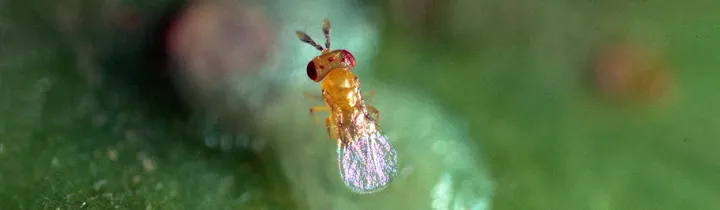
Description
How to identify
Trichogramma perkinsi belongs to the order Hymenoptera and the family Trichogrammatidae. These are minute parasitic wasps, typically measuring less than 1 millimeter in total length.
Their morphological features include a compact body, generally yellowish or brownish, and wings that possess characteristic venation and a distinct marginal fringe of hairs.
Crucially, Trichogramma perkinsi is not a plant pest; it is a highly specialized parasitoid that targets the eggs of various insect species, particularly Lepidoptera.
Field identification is extremely difficult due to their microscopic size; professional identification requires microscopic analysis of male genitalia structures.
These insects are vital components of natural ecosystems, acting as biological regulators of population levels of various potential insect pests.
What it damages
This species does not feed on plant tissues, does not consume plant sap, and does not cause any structural or physiological damage to agricultural crops.
It poses no threat to leaves, stems, roots, or fruit, and it is not a vector for any known plant pathogens, viruses, or bacteria.
Conversely, Trichogramma perkinsi provides significant economic benefits by parasitizing the eggs of agricultural pests, such as moths and butterflies.
By consuming the contents of the host egg during its larval stage, the wasp prevents the development of the destructive pest larva.
The agricultural value of this species lies entirely in its capacity to serve as a biological control agent, reducing the need for chemical pesticide intervention.
When it appears
The activity period of Trichogramma perkinsi is highly dependent on environmental temperature and the availability of suitable host eggs in the crop canopy.
Adult activity typically commences in spring when daily temperatures reach optimal levels for emergence from overwintering sites.
The duration of a single generation cycle is short, often ranging from 7 to 12 days, allowing for multiple generations within one growing season.
High humidity levels and mild temperatures favor their search activity, leading to higher rates of parasitism across the target area.
As temperatures decline in autumn, the wasps enter a state of diapause, surviving the winter within host eggs or in sheltered natural niches.
Signs of infestation
The primary visual indicator of the presence of this parasitoid is the darkening or blackening of the host insect eggs it has successfully colonized.
Close inspection may reveal tiny, clean circular emergence holes in the host eggshells, signaling that an adult wasp has successfully developed and exited.
Agricultural monitoring programs use sentinel eggs (laboratory-reared host eggs on cards) placed in the field to assess the presence and efficacy of local populations.
Lack of crop damage despite the presence of high pest egg counts is a reliable indicator that the parasitoids are effectively managing the pest population.
Since the insects are nearly invisible to the naked eye, monitoring relies more on these secondary signs of activity rather than observing the wasps themselves.
Control measures
The main strategy regarding Trichogramma perkinsi is the implementation of conservation biological control to protect existing populations.
It is essential to avoid the blanket use of broad-spectrum chemical insecticides, which are lethal to beneficial parasitoids.
Integrating agricultural practices that support biodiversity, such as maintaining floral buffers, helps provide nectar sources for adult wasps, increasing their longevity.
If chemical pest control is deemed necessary, growers should select selective pesticides with low toxicity profiles towards beneficial Hymenoptera.
- Minimize usage of broad-spectrum insecticides.
- Promote biodiversity through habitat strips.
- Sync biological releases with peak pest oviposition.
Taxonomy
- Latin name
- Trichogramma perkinsi
- Order
- Hymenoptera
- Family
- Trichogrammatidae
- EPPO code
- TRIGPE
Discussion
No discussions yet — be the first.