
Trichogramma
Trichogramma ostriniae
Description
How to identify
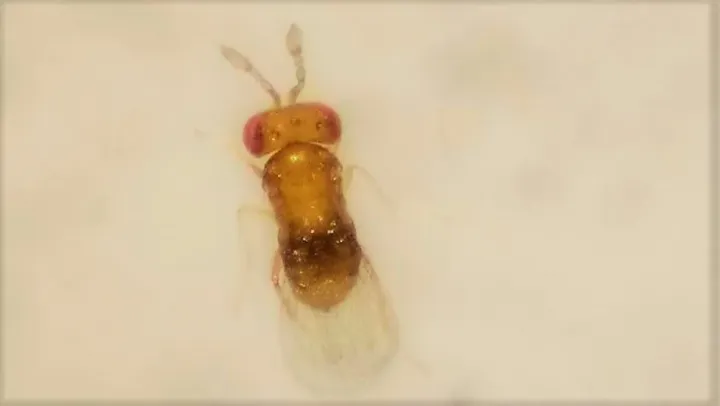
Trichogramma (Trichogramma ostriniae) is a minute parasitic wasp belonging to the order Hymenoptera and the family Trichogrammatidae. These are microscopic insects, measuring only 0.3 to 0.8 millimeters in length, making them virtually invisible to the naked eye under field conditions.
This species is an egg parasitoid, meaning its life cycle is intricately tied to laying its own eggs inside the eggs of other insects. The coloration of adult wasps ranges from pale yellow to dark brown, allowing them to effectively camouflage themselves within various agricultural crops.
The biology of this species is recognized as one of the most effective biological control tools in modern industrial agriculture. The female wasp possesses a highly developed searching behavior, enabling her to locate host egg masses even in dense stands of grain and industrial crops.
An adult's lifespan generally does not exceed 7 to 10 days, during which a female can parasitize a large number of pest eggs. The success of her work is directly dependent on temperature, humidity, and the availability of nectar as a nutritional source.
Artificial mass-rearing of Trichogramma has become a standard in modern agribusiness, where these insects are bred in laboratories on host eggs, such as those of the grain moth, for subsequent field release.
What it damages
It is crucial to understand that Trichogramma ostriniae does not damage plants directly; rather, it acts as a beneficial agent for biological protection. It parasitizes the eggs of lepidopteran pests, most notably the European corn borer, which inflicts catastrophic damage on maize crops.
The pests whose eggs are destroyed by Trichogramma typically damage stems, ears, and leaves of corn, sunflowers, and vegetable crops. The larvae of the borer penetrate plant tissues, causing weakening, cob breakage, and significant yield losses.
The use of Trichogramma allows for the suppression of pest population growth before the larvae can cause physical harm to the plant. This makes this entomophagous insect an indispensable tool in lowering the economic threshold of pest damage.
The host range includes various species of cutworms and moths, making this beneficial insect a universal solution for protecting a wide range of field crops against concealed pests.
Due to its specialization at the egg stage, Trichogramma prevents the emergence of larvae, which are the most destructive life stage and are often difficult to control with conventional contact insecticides.
When it appears
The activity of Trichogramma in the field coincides with the flight period of the main target pests, typically spanning from late spring through mid-summer. Initial releases of the parasitoid are timed to align with the start of the European corn borer's mass egg-laying.
The optimal temperature range for the wasp's activity is between +20 and +30 degrees Celsius. At lower temperatures, the searching and parasitizing activity of the wasp noticeably decreases, requiring careful scheduling of field applications.
The developmental cycle from egg to adult takes only 7 to 10 days under favorable conditions. This allows the population to produce multiple generations throughout a single growing season, providing sustained protection to the crops.
The application season is usually divided into several stages to cover all waves of pest egg-laying. Integration with monitoring systems, such as pheromone traps, allows for precise timing to maximize the efficacy of the biological treatment.
In natural environments, Trichogramma populations can decline due to the impact of broad-spectrum chemical insecticides, which is why biological control requires avoiding aggressive chemical treatments during the active flight periods of the wasps.
Signs of infestation
The primary sign of successful Trichogramma performance in the field is the change in color of the parasitized pest eggs. Within a few days of parasitism, the host egg darkens, turning a characteristic black color, which indicates the successful completion of the wasp's developmental cycle.
When inspecting corn fields, it is necessary to carefully examine the undersides of the leaves, where pests typically deposit their eggs. The presence of blackened egg masses is a direct indicator that the parasitoid population is working effectively.
The absence of stem and cob damage, combined with signs of pest activity in the field, can also indirectly suggest successful biocontrol. When high efficacy is achieved, the parasitism rate of pest eggs can reach 80% to 90%.
Mechanical monitoring, including collecting pest eggs from fields and incubating them in laboratory conditions, allows for an objective assessment of parasitism rates and helps decide if additional releases of the beneficial insect are required.
During visual inspections, it is important to monitor crop health over time: if the pest population is halted at an early stage, the crop develops without the stress typically induced by lepidopteran larvae.
Control measures
Protection strategies using Trichogramma ostriniae are based on regular and timely releases of lab-reared insects. It is important to strictly follow the recommended application rates per hectare, which are calculated based on the density of the pest population.
Methods of release vary from manual distribution of parasitoid-filled capsules to the use of agricultural aircraft and drones. The use of UAVs allows for a uniform distribution of the parasitoid across large areas, which significantly enhances the method's effectiveness.
- Optimal timing for corn protection releases.
- Adjusting wasp density during high pest pressure.
- Integration of biological methods with agronomic practices like autumn tillage.
- Reduction of pesticide usage during peak wasp activity.
- Creating favorable conditions for the survival of the parasitoid in the field.
To increase the survival rate of Trichogramma, it is recommended to maintain field margins with flowering nectar-rich plants, which provide the wasps with additional sustenance.
Effective pest control is impossible without a comprehensive approach where biological methods are combined with proper crop rotation and the use of pest-resistant crop varieties.
Taxonomy
- Latin name
- Trichogramma ostriniae
- Order
- Hymenoptera
- Family
- Trichogrammatidae
- EPPO code
- TRIGOS
Discussion
No discussions yet — be the first.