
Trichogramma nubilale
Trichogramma nubilale
Description
How to identify
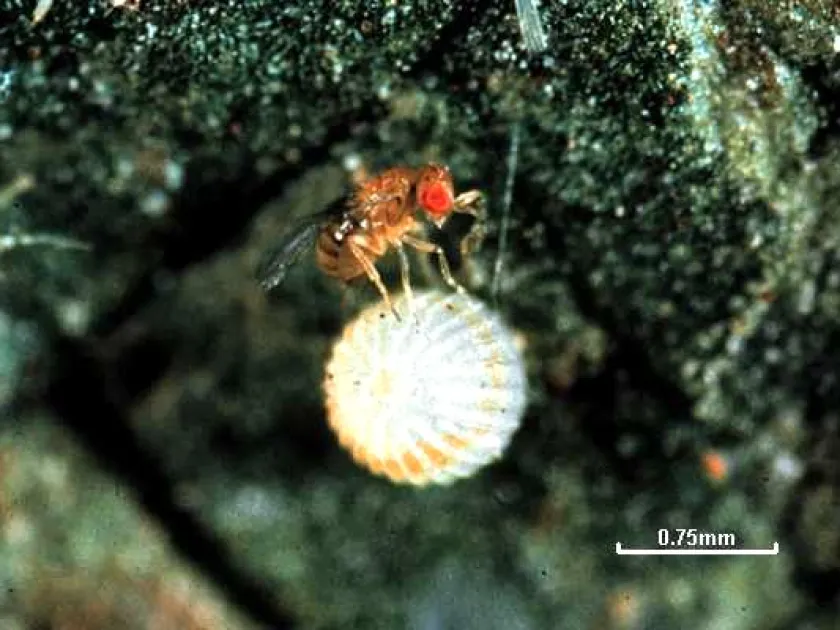
Trichogramma nubilale is a minute parasitic wasp belonging to the family Trichogrammatidae. These insects are microscopic, measuring less than one millimeter in length, and play a crucial role in regulating insect populations in agricultural ecosystems.
The adult form is typically yellowish-brown with specialized wing venation and hairs. They are difficult to detect in the field without using yellow sticky traps or careful observation of egg masses on host plants.
Biological success of this species is attributed to its high sensitivity to kairomones — chemical substances emitted by host moths. This ability allows females to locate host eggs with extreme precision for oviposition.
Their life cycle consists of four distinct stages: egg, larva, pupa, and adult. The entire development takes place inside the egg of the host, consuming the host's content until the adult wasp emerges to continue the cycle.
As a biological control agent, this species is highly valued for its ability to maintain the ecological balance in maize fields and other grain crops.
What it damages
It is critical to distinguish between pests and beneficial organisms; Trichogramma nubilale is not a pest but a beneficial natural enemy. It does not damage agricultural plants because it is a parasitoid that feeds on the eggs of other harmful insects.
The primary host for this species is the European corn borer (Ostrinia nubilalis). By parasitizing the eggs, the wasp prevents the larvae of the borer from hatching, thereby reducing the damage to stalks and cobs.
Economically, the presence of these wasps is highly beneficial as it minimizes the need for chemical insecticides. They provide a sustainable solution for protecting yields in intensive farming systems.
Without sufficient populations of Trichogramma nubilale, corn crops are significantly more vulnerable to extensive damage caused by stem-boring insects, which can lead to major yield losses.
In modern agronomy, understanding the population dynamics of this parasitoid is essential for implementing integrated pest management (IPM) strategies successfully.
When it appears
The seasonal activity of Trichogramma nubilale begins as temperatures rise in the spring, typically when daily averages exceed 15 degrees Celsius. Their activity is synchronized with the emergence of the first generation of moth pests.
The peak activity occurs during the flowering and silk-forming stages of corn, which coincides with the massive egg-laying period of the European corn borer, providing an ideal opportunity for parasitization.
Depending on ambient temperatures, these wasps can complete multiple generations within a single season. The generation time is shortened significantly during hot summer months, allowing for rapid population growth.
As autumn approaches and photoperiod decreases, the insects enter a state of diapause. They successfully overwinter as pupae within the remnants of the eggs of their hosts, often hidden in crop debris.
Environmental conditions, particularly humidity, play a vital role in the survival rate of the overwintering population, which dictates the intensity of the pest control in the following spring.
Control measures
Conservation of this beneficial species is a priority in sustainable agriculture. The control strategy focuses on protecting the parasitoid population rather than eliminating it, while managing the target pest.
The primary method of management is the cautious use of insecticides. Broad-spectrum chemicals must be avoided during the peak oviposition period of the corn borer to prevent the mass mortality of the wasps.
Integrated strategies include the strategic release of laboratory-reared wasps into fields during critical periods, which enhances the efficiency of natural control mechanisms.
Agricultural practices should support biodiversity, including leaving flower margins around fields to provide nectar and supplementary nutrition for the adult wasps.
- Monitoring moth flight using pheromone traps to time wasp releases.
- Selection of pesticide products that are non-toxic to Hymenoptera.
- Preserving natural habitats and field margins for parasitoid refuge.
- Aligning biological releases with thermal units and crop development stages.
Taxonomy
- Latin name
- Trichogramma nubilale
- Order
- Hymenoptera
- Family
- Trichogrammatidae
- EPPO code
- TRIGNU
Discussion
No discussions yet — be the first.