
Trichogramma minutum
Trichogramma minutum
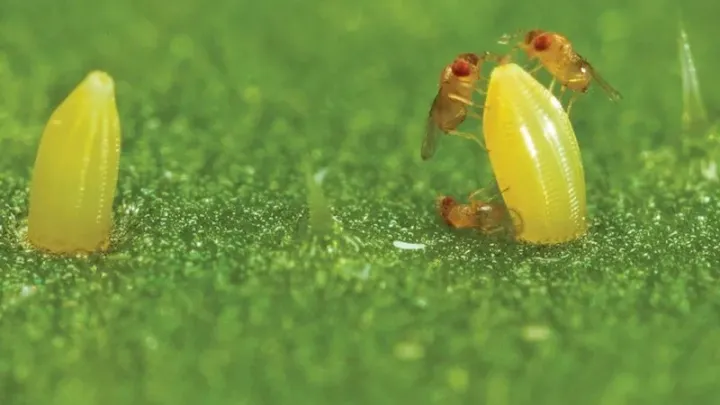
Description
How to identify
Trichogramma minutum is a minute wasp belonging to the family Trichogrammatidae. These insects are microscopic, typically measuring less than one millimeter in length, making them essential allies in the biological control of agricultural pests.
Physically, they appear as tiny dark-colored wasps with wings that possess a specific pattern of veins. Their life cycle is remarkably rapid, often completing from egg to adult in about 7 to 10 days, depending on environmental temperature and humidity.
These wasps are highly efficient hunters, using sophisticated sensory mechanisms to detect chemical signals (kairomones) released by host eggs. Their small size allows them to navigate dense plant foliage to locate and parasitize even isolated eggs of various moths.
The reproduction strategy of Trichogramma minutum is highly effective for population management, as a single female can lay multiple eggs into the host's eggs, ensuring the next generation is ready to continue the cycle of parasitism.
While they are technically insects, they are categorized as beneficial agents in agronomy. Their existence is focused entirely on the reproductive cycle of parasitizing host eggs, which serves to keep pest populations below economic damage thresholds.
What it damages
Trichogramma minutum does not cause any damage to crops; on the contrary, it provides a vital service as a natural enemy. It is a specialized egg parasitoid that targets the eggs of various lepidopteran pests, including leafrollers, loopers, and other moths.
The damage it prevents is significant: by parasitizing the pest eggs, the wasp larvae consume the contents of the host egg, effectively killing the pest before it can hatch into a larva. This prevents crop destruction during the most vulnerable early stages of growth.
This biological control method is a pillar of integrated pest management (IPM) programs worldwide. By reducing the density of pest populations through natural parasitism, it decreases the overall pressure on the agricultural ecosystem.
Farmers benefit from the reduction of larval feeding damage on leaves, stems, and fruits. Preventing the development of the larval stage is the most efficient way to protect the overall yield potential of a farm.
In addition to being an effective control agent, Trichogramma minutum is highly regarded in sustainable and organic farming systems as a chemical-free alternative for maintaining crop health and productivity.
When it appears
The activity of these beneficial wasps is highly seasonal and dictated by climate conditions. They are most active during the spring and summer months when temperatures remain consistently between 20°C and 28°C, which is optimal for their developmental cycle.
Their life cycle timing is naturally synchronized with the emergence of host species. In the field, agronomists monitor the flight of pests using pheromone traps to predict when the Trichogramma wasps should be released for maximum impact.
In greenhouse environments, producers can manipulate environmental conditions to sustain the wasps throughout the entire year, providing a constant defense against invading moth species. This flexibility is a key advantage of utilizing this species.
Environmental factors like heavy rainfall or extreme cold can negatively impact the dispersal and activity of these wasps. Therefore, releases should be planned strategically to avoid adverse weather conditions that might wash them off the plants.
As winter approaches and temperatures drop, the activity of Trichogramma minutum naturally diminishes. Most populations are managed through laboratory-reared stocks specifically designed for seasonal introduction during the peak pest activity period.
Signs of infestation
The primary diagnostic sign of Trichogramma minutum activity is the darkening of host eggs. Once parasitized, the host eggs typically turn black or dark gray, which is a clear indicator that the wasp larvae are developing successfully inside.
Experienced agronomists regularly inspect plant leaves to spot these darkened eggs. This visual confirmation is the most reliable way to monitor the effectiveness of a biocontrol release program without the need for complex testing.
Another sign of successful parasitism is the presence of minute, circular exit holes on the host eggshell. This signifies that the adult Trichogramma has emerged, having completed its life cycle, ready to hunt for further hosts.
In areas where no parasitism occurs, host eggs typically maintain their natural lighter, yellowish, or translucent coloration. A lack of darkened eggs indicates that additional releases of the beneficial wasps may be necessary to maintain control.
Field scouting with the aid of a magnifying glass is essential for identifying these tiny indicators. Regular scouting reports allow farmers to respond rapidly to shifting pest pressures by deploying more Trichogramma wasps where they are needed most.
Control measures
The core control measure involves the systematic release of laboratory-reared Trichogramma minutum. This is usually done in multiple waves during the peak periods of pest oviposition to ensure continuous protection of the crop.
It is crucial to avoid the use of broad-spectrum chemical insecticides, as they are lethal to these beneficial wasps. Agronomists often switch to soft, biorational pesticides that do not interfere with the life cycle of the parasitoids.
The timing of release is critical and depends on the synchronization between the emergence of the host moths and the wasps. Usually, three to four releases spaced a week apart provide the best suppression of pest populations.
Maintaining high humidity and adequate temperatures in controlled environments supports the wasps' survival and efficiency. For open fields, surrounding crops with native nectar-producing plants can help sustain local populations.
- Monitor host activity using pheromone traps prior to release.
- Use professional-grade, high-viability parasitized eggs for release.
- Ensure uniform distribution of wasps across the field or greenhouse.
- Incorporate IPM practices to minimize chemical interference.
Taxonomy
- Latin name
- Trichogramma minutum
- Order
- Hymenoptera
- Family
- Trichogrammatidae
- EPPO code
- TRIGMI
Discussion
No discussions yet — be the first.