
Trichogramma
Trichogramma evanescens
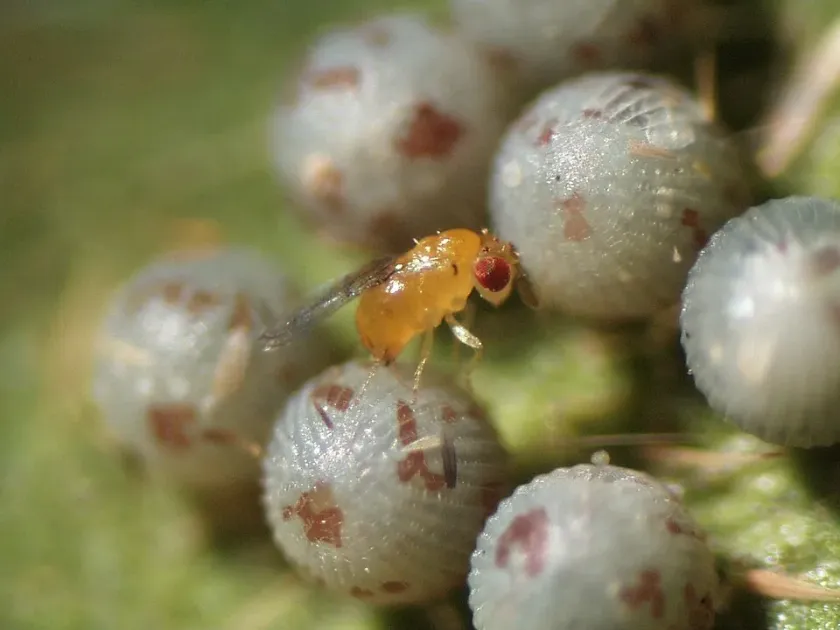
Description
How to identify
It is crucial to clarify that Trichogramma evanescens is not a plant pest. It is a tiny parasitoid wasp, highly valued in agriculture as a beneficial biological control agent.
Belonging to the family Trichogrammatidae (order Hymenoptera), these insects are microscopic, typically measuring less than 1 mm in length, which makes them nearly invisible to the naked eye.
The life cycle of the Trichogramma wasp involves laying its eggs inside the eggs of various host insects, primarily those belonging to the Lepidoptera order.
These wasps are specialized in finding host eggs through chemical cues, demonstrating a remarkable ability to locate pests even in large agricultural fields.
Their role in natural ecosystems is to limit the population of harmful moth species, acting as a crucial component of sustainable agricultural practices.
What it damages
This species does not cause any damage to plants. It does not feed on leaves, stems, fruits, or roots, nor does it transmit plant diseases.
In fact, it is considered a protective ally for farmers, as it actively reduces the number of destructive pests that would otherwise ruin the harvest.
It effectively targets the eggs of numerous agricultural pests, including the European corn borer, various cutworms, and cabbage white butterflies.
By preventing the hatching of larvae, Trichogramma stops the damage at the embryonic stage, providing a preventative form of crop protection.
The use of this species is an environmentally friendly alternative to chemical pesticides, contributing to healthier and more productive crops.
When it appears
The activity of these wasps is temperature-dependent, typically beginning in the spring when ambient temperatures consistently exceed +10°C to +12°C.
The species has a high reproductive rate, completing its life cycle in 7 to 10 days, which allows for multiple generations during a single growing season.
The peak period of activity coincides with the oviposition cycles of major pests, making it the most effective time for biological intervention.
As temperatures drop in autumn, the wasps enter a diapause state as pupae, usually inside the host egg shell, to survive the winter period.
Environmental monitoring is essential, as extreme heat or heavy rain can temporarily suppress the activity and survival of these delicate insects.
Signs of infestation
The presence of Trichogramma activity is most easily detected by observing the physical changes in the eggs of the target pests on the crops.
Signs of successful parasitism include:
- Color shift: The eggs of the host insect turn dark grey or black as the wasp larvae mature inside.
- Exit holes: Tiny, perfectly round holes appear on the shell of the host eggs after the adult wasps have emerged.
- Lack of larval emergence: A significant reduction in the number of caterpillars indicates that the parasitoid has successfully killed the embryo.
Field scouts use these indicators to evaluate the success rate of biocontrol programs and determine if additional releases of the insect are required.
Regular inspection of leaves and crop surfaces during the peak pest season is the standard procedure for verifying effective control.
Control measures
Since Trichogramma evanescens is a beneficial organism, management efforts are focused on conservation and mass-release programs.
To conserve local populations, farmers should avoid using broad-spectrum insecticides that are toxic to parasitoid wasps during critical stages of crop development.
Biological control programs involve the strategic release of laboratory-reared wasps into fields during the periods of maximum pest egg-laying.
Maintaining floral borders and biodiversity around fields provides nectar sources for adult wasps, which can improve their longevity and reproductive success.
An integrated pest management (IPM) approach ensures that biological controls are synchronized with other agronomic practices for maximum efficiency.
Taxonomy
- Latin name
- Trichogramma evanescens
- Order
- Hymenoptera
- Family
- Trichogrammatidae
- EPPO code
- TRIGEV
Discussion
No discussions yet — be the first.