
Trichogramma euproctidis
Trichogramma euproctidis
Description
How to identify
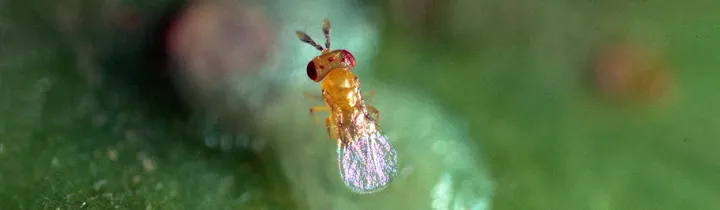
Trichogramma euproctidis is a minute insect belonging to the order Hymenoptera and the family Trichogrammatidae, known for its role as an egg parasitoid.
The adult insects are extremely small, typically measuring between 0.5 and 0.8 mm in length, which makes them difficult to observe without magnification.
Their body color ranges from yellow to brownish-yellow, which is characteristic of the genus Trichogramma, featuring a distinct wing venation pattern.
Morphological identification often relies on examining the antennae and wings, as males and females exhibit slight variations that distinguish them from related species.
As obligate parasitoids, their entire development occurs inside the eggs of other insects, playing a crucial role in maintaining ecological balance in agroecosystems.
What it damages
This species specializes in parasitizing the eggs of various Lepidoptera, which are common pests of orchard trees and agricultural crops.
The beneficial impact of this insect lies in its ability to kill the pest embryo inside the egg before it hatches, preventing larval feeding damage to plants.
The primary host for this specific parasitoid is the goldtail moth (Euproctis chrysorrhoea), which is why the species is named after this moth.
In regions where the population of this parasitoid is significant, it serves as a powerful natural check on the growth of pest populations, reducing crop loss.
The efficiency of Trichogramma euproctidis in reducing pest numbers is highly dependent on environmental conditions and the availability of host eggs in the field.
When it appears
Seasonal activity typically begins in early spring, once temperatures are sufficiently high to initiate the emergence of adults from their overwintering stage.
The species produces multiple generations per season, with the total number of generations determined by the prevailing climate and the abundance of suitable hosts.
Peak emergence of adults usually aligns with the peak egg-laying periods of their hosts, ensuring successful reproduction for the parasitoid.
During the winter, the insect survives in a state of diapause, residing inside the host eggs as pupae until environmental cues trigger their reactivation.
The summer months are marked by the highest levels of biological activity, as warm weather accelerates the developmental cycle from egg to adult.
Signs of infestation
One of the most obvious signs of parasitization is a noticeable darkening or blackening of the host insect's eggs after they have been attacked.
Upon close inspection using a microscope or a powerful hand lens, small, circular exit holes become visible on the surface of the parasitized eggs.
These holes indicate that the adult wasp has successfully completed its metamorphosis and has emerged from the host egg.
If a significant portion of a pest's egg mass exhibits these dark coloration patterns and exit holes, it indicates a high level of natural pest suppression.
Conversely, the lack of emerging larvae from host egg clusters in monitored areas often serves as a primary indicator of successful parasitoid colonization.
Control measures
Maintaining healthy populations of this beneficial insect requires the preservation of natural habitats and the use of hedgerows to provide shelter.
Reducing the frequency and toxicity of broad-spectrum insecticide applications is vital, as these chemicals are highly detrimental to parasitoid survival.
In industrial agriculture, the release of lab-reared Trichogramma is a standard biological control practice during peak pest infestation phases.
Good agricultural practices, such as clearing crop residues and managing weeds, help minimize the overwintering success of harmful pest populations.
Strategic monitoring of pests through traps allows farmers to optimize the timing of biological interventions, ensuring maximum efficacy for crop protection.
Taxonomy
- Latin name
- Trichogramma euproctidis
- Order
- Hymenoptera
- Family
- Trichogrammatidae
- EPPO code
- TRIGEU
Discussion
No discussions yet — be the first.