
Trichogramma dendrolimi
Trichogramma dendrolimi
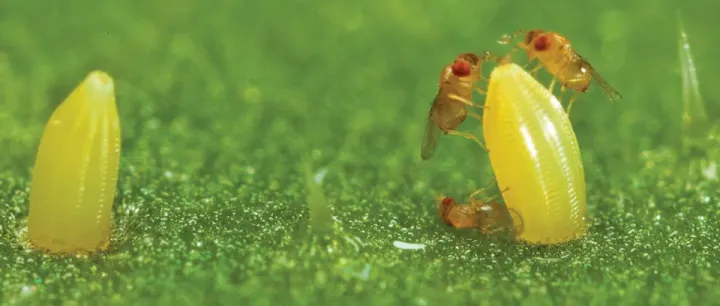
Description
How to identify
Trichogramma dendrolimi is a microscopic parasitoid wasp belonging to the family Trichogrammatidae. These tiny insects typically measure between 0.5 and 1.0 mm in length and are characterized by their yellowish-brown body coloration.
Identification in the field is highly challenging due to their minute size. Precise determination requires laboratory analysis, specifically examining the male genitalia structures under high-magnification microscopy to distinguish them from related species.
The lifecycle of this species is obligatorily linked to the eggs of its hosts. The larval development occurs entirely within the host's egg, where the wasp undergoes all stages of metamorphosis before emerging as an adult.
While often viewed as a beneficial biocontrol agent, it is a complex insect that can influence the dynamics of various lepidopteran populations in agricultural landscapes.
Reproduction is primarily sexual. Females are highly efficient at locating host egg clusters by detecting specific chemical cues and pheromones emitted by adult lepidopterans.
What it damages
The primary hosts of Trichogramma dendrolimi are the eggs of various Lepidoptera (moths and butterflies). This includes numerous significant pests affecting grain, vegetable, and orchard crops, such as cutworms, leafrollers, and borers.
Damage to agricultural systems can occur if the wasp parasitizes non-target, beneficial insect populations, although this is usually outweighed by the substantial reduction in destructive pest numbers.
Parasitism occurs when the female wasp oviposits into the host egg. The developing wasp larva consumes the internal contents of the host egg, effectively killing the embryo of the pest before it can hatch into a caterpillar.
The wasp's impact is most pronounced in agroecosystems with high pest densities. It acts as a natural biological control agent, keeping the population of many moth species below economic injury levels.
The rate of parasitism varies significantly based on environmental conditions and the presence of refuge areas, which influence how successfully the wasp can locate host egg masses.
When it appears
Activity for Trichogramma dendrolimi begins in early spring, once temperatures remain consistently above the threshold required for insect emergence and flight.
The flight period of the adults coincides with the active mating and oviposition periods of their lepidopteran hosts throughout the growing season.
Multiple generations can occur within a single year, allowing the population to synchronize with the successive waves of pest infestations often seen in diverse crop rotations.
Activity peaks during the mid-to-late summer months, corresponding with the reproductive phases of many agricultural pest species that provide a steady supply of eggs for parasitization.
Winter survival is achieved by entering diapause as a pupa inside the host egg, often hidden within plant debris, tree bark, or the surface layer of the soil, ensuring the population persists until the next spring.
Signs of infestation
The most reliable sign of Trichogramma presence is the visible change in the host egg's appearance. As the wasp larva develops, the host egg darkens, eventually turning black.
Upon close inspection with a magnifying lens, tiny circular exit holes become visible on the surface of the host egg, marking where the adult wasp has emerged.
The absence of hatched larvae (caterpillars) in areas where high densities of pest eggs were previously noted is a strong indicator of successful biological control by these wasps.
Monitoring programs often involve examining host eggs during peak oviposition windows to estimate the level of natural parasitism occurring in the field.
In professional agriculture, trap cards containing sentinel eggs are sometimes used to assess the native population density of Trichogramma in a specific geographic area.
Control measures
Effective management focuses on preserving native parasitoid populations by avoiding the use of broad-spectrum insecticides that are toxic to beneficial insects.
The use of selective, biorational pesticides allows for pest control without disrupting the natural biological balance maintained by Trichogramma and other natural enemies.
Cultural practices, such as proper crop residue management and diversified planting, help minimize overwintering sites for both pests and their parasitoids.
Maintaining biological corridors and field margins encourages the survival of these wasps during periods when host eggs are scarce, ensuring a stable population for the next crop cycle.
- Minimize insecticide sprays during critical parasitoid flight windows.
- Adopt integrated pest management (IPM) to prioritize biological controls.
- Plant flowering refuge strips to support adult wasp longevity.
Taxonomy
- Latin name
- Trichogramma dendrolimi
- Order
- Hymenoptera
- Family
- Trichogrammatidae
- EPPO code
- TRIGDE
Discussion
No discussions yet — be the first.