
Trichogramma
Trichogramma
Description
How to identify
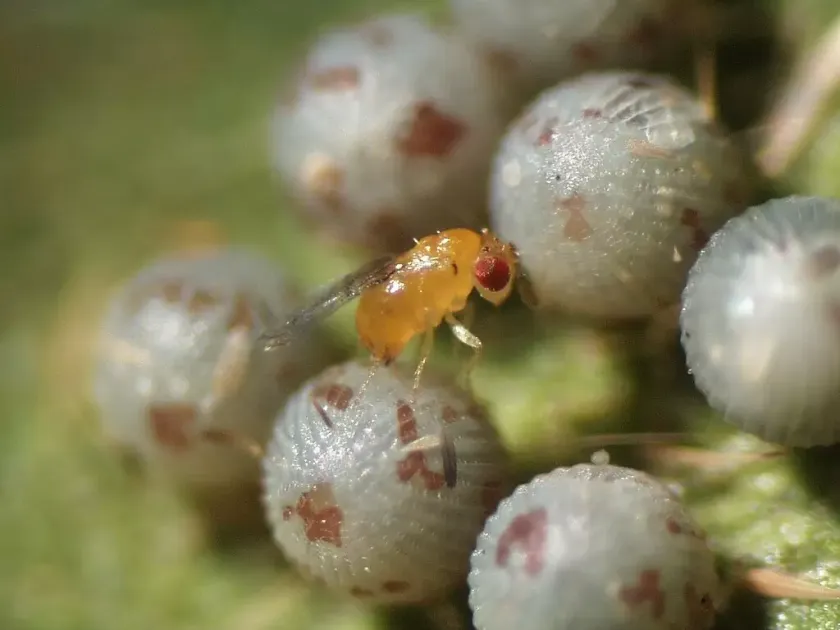
Trichogramma is a genus of minute parasitic wasps in the family Trichogrammatidae. These are among the smallest insects on the planet, with adult body lengths ranging from 0.3 to 0.8 millimeters.
The adult insect has a compact yellow or brown body. They possess well-developed wings covered in tiny hairs, which allow them to move actively while searching for host eggs to parasitize.
It is important to note that while they are sometimes confused with pests, Trichogramma species are highly specialized parasitoids (egg parasitoids). They are valuable beneficial insects used in sustainable agriculture.
Taxonomically, this genus belongs to the superfamily Chalcidoidea. They have evolved as effective regulators of lepidopteran populations in diverse agroecosystems globally.
Identification in the field is difficult due to their microscopic size. Agronomists often use specific traps or microscopic examinations of host eggs to monitor their presence and efficiency.
What it damages
Trichogramma does not damage agricultural crops directly because they do not feed on plant tissues. Their entire lifecycle is dedicated to using the eggs of other insects as a growth medium for their offspring.
They are parasites of eggs of various pests belonging to the order Lepidoptera (moths and butterflies). This includes major economic pests like cutworms, cotton bollworms, cabbage moths, and meadow moths.
Their effectiveness relies on the ability to find fresh host eggs and inject their own eggs into them using an ovipositor. The developing larvae feed on the content of the host egg, killing the pest embryo.
This prevents the pest life cycle from continuing, effectively neutralizing the threat before any larval stage capable of damaging plants can emerge. This makes them a cornerstone of biological control programs.
The economic value of these wasps is significant, as they drastically reduce the need for chemical insecticide applications, helping maintain a more sustainable and healthy agricultural environment.
When it appears
Trichogramma activity is highly dependent on temperature, with the optimal range for development being 20–28 degrees Celsius. They become active when the first mass egg-laying of target pests occurs.
The life cycle of the wasp is very rapid, lasting between 7 and 12 days depending on environmental conditions. This allows for up to 15 generations per season, facilitating quick population growth.
This rapid reproduction rate is vital for managing sudden outbreaks of moth populations in cereal, cotton, or vegetable fields. Agronomists carefully time mass releases to coincide with peak pest activity.
Laboratory-reared Trichogramma are released into fields to augment natural populations. Precise timing is critical, as the wasps are most effective when they have access to freshly laid host eggs.
In the fall, as temperatures drop, development slows significantly. The wasps typically overwinter as pre-pupae inside host eggs that remain in the soil or on plant debris.
Signs of infestation
The primary sign of Trichogramma activity is a change in the color of the pest's eggs. Several days after parasitization, the host eggs turn black or dark brown.
Under magnification, one can observe tiny exit holes on the host egg, representing the points where the adult wasps emerged after completing their development cycle.
If there is no damage to the leaves or fruits despite the presence of pest egg masses on the plants, and the eggs appear darkened or empty, this indicates successful parasitization by Trichogramma.
Inadequate field coverage may lead to only sporadic signs of parasitism. A high level of control is achieved when the release density and timing are correctly optimized for the local pest population.
Field specialists should distinguish between eggs parasitized by Trichogramma and those destroyed by other factors, such as fungal pathogens, which present different visual characteristics.
Control measures
Control of Trichogramma in agriculture involves mass production and strategic field distribution. Industrial rearing is based on using surrogate hosts like the grain moth.
A crucial factor for success is the reduction or elimination of broad-spectrum insecticide use. Chemical sprays are fatal to these beneficial wasps and can lead to secondary pest outbreaks.
Agronomic practices, including crop rotation and maintaining wildflower strips around fields, help conserve local populations of Trichogramma and promote natural regulation of pests.
- Using drones for the precise and uniform release of Trichogramma over large areas.
- Maintaining optimal temperature conditions during transportation and storage of the wasps.
- Using pheromone traps to monitor pest flights and schedule releases accurately.
Integrated Pest Management (IPM) programs that prioritize Trichogramma as a biological tool offer a pathway toward ecologically sound and highly productive crop management strategies.
Taxonomy
- Latin name
- Trichogramma
- Order
- Hymenoptera
- Family
- Trichogrammatidae
- EPPO code
- TRIGSP
Discussion
No discussions yet — be the first.