
Platypodid beetle
Treptoplatypus
Description
How to identify
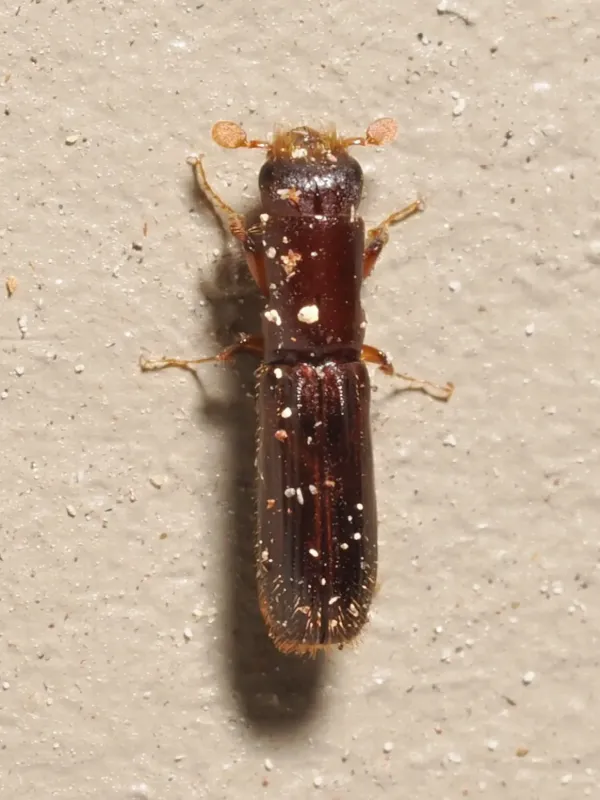
Platypodid beetles belong to the Curculionidae family and the Scolytinae subfamily. They are characterized by an elongated, cylindrical, and strongly flattened body, which distinguishes them from typical bark beetles. Their legs and antennae are specialized for tunneling through dense wood.
Adult beetles are generally dark brown or black. The larvae are legless, white, and possess a well-developed head capsule, which allows them to efficiently consume wood tissue as they carve out galleries within the tree.
The biology of these beetles is inextricably linked with symbiotic fungi, which adults carry in specialized body structures called mycangia. These fungi are introduced into the tunnels and serve as the primary food source for developing larvae.
The life cycle involves complete metamorphosis. Females bore deep into the trunk to construct complex gallery systems where they deposit their eggs. Once larval development is complete, pupation occurs within these channels before the new generation emerges.
Species of the genus Treptoplatypus often target stressed or recently felled trees. However, under conditions of high population density, they can attack apparently healthy hosts, significantly compromising their health and wood quality.
What it damages
These beetles affect a wide range of tree species, primarily hardwoods and conifers. They are particularly destructive in plantations experiencing stress factors such as prolonged drought, fire damage, or mechanical injury.
Beetles penetrate deep into the sapwood and heartwood. This activity disrupts the vascular system of the tree, impeding water and nutrient transport, which can lead to crown dieback or total mortality of the affected tree.
Beyond mechanical damage, the presence of the beetle introduces pathogenic fungi. These fungi cause staining and rot within the wood, which significantly reduces the structural integrity and market value of the timber.
The economic impact is substantial, particularly in the timber industry. Logs infested with platypodids are often rejected or downgraded due to the extensive galleries, commonly referred to as "pinholes," left by the beetles.
The intensity of damage is highly correlated with the beetle population size. In epidemic outbreaks, these insects can cause widespread death in both young timber stands and mature forests, leading to long-term silvicultural losses.
Signs of infestation
One of the most diagnostic signs of infestation is the presence of "frass" — fine, granular wood dust that collects at the base of the trunk or in bark crevices. This is produced by the adults while clearing their entrance tunnels.
Entrance holes are usually small, circular, and clean-cut, reflecting the body shape of the adult beetle. In some species, sap or resin exudation may be visible around these holes as the tree attempts to push the beetles out.
Internal damage manifests as a network of branching tunnels, often discolored to a dark brown or black due to the growth of symbiotic fungi. If the infestation is severe, the foliage may prematurely yellow and drop.
Upon debarking, one can see the specific fungal "mats" that the beetles cultivate within their galleries. This unique symbiotic structure is a definitive indicator of platypodid activity within the timber.
Diagnosis is usually confirmed by extracting wood cores or sections to inspect the internal gallery structure, where both the adult beetles and their larvae can typically be found at various developmental stages.
Control measures
Effective management begins with good forest hygiene, specifically the prompt removal and disposal of slash and deadwood. Removing infested or weakened trees serves as a crucial preventive measure to suppress population buildup.
Pheromone-based trapping systems are highly effective for monitoring local populations. These traps help detect early arrivals and can be used in mass trapping programs to reduce the number of attacking adults without chemical reliance.
Chemical control is generally reserved for high-value timber or decorative trees. Systemic or contact insecticides can be applied to the trunks during the peak flight season to prevent beetles from successfully colonizing the tree.
Biological control efforts, including the use of entomopathogenic fungi or protecting natural predators (such as parasitoid wasps), are integrated into broader forest management strategies to keep populations below economic thresholds.
For the timber industry, rapid extraction and processing of harvested logs are critical. If logs remain in the forest during the beetle's flight season, they must be protected or processed immediately to avoid severe economic loss from deep wood degradation.
Taxonomy
- Latin name
- Treptoplatypus
- Order
- Coleoptera (beetles)
- Family
- Curculionidae
- EPPO code
- TPLTSP
Discussion
No discussions yet — be the first.