
Rough weevil
Trachyphloeus scabriculus
Description
How to identify
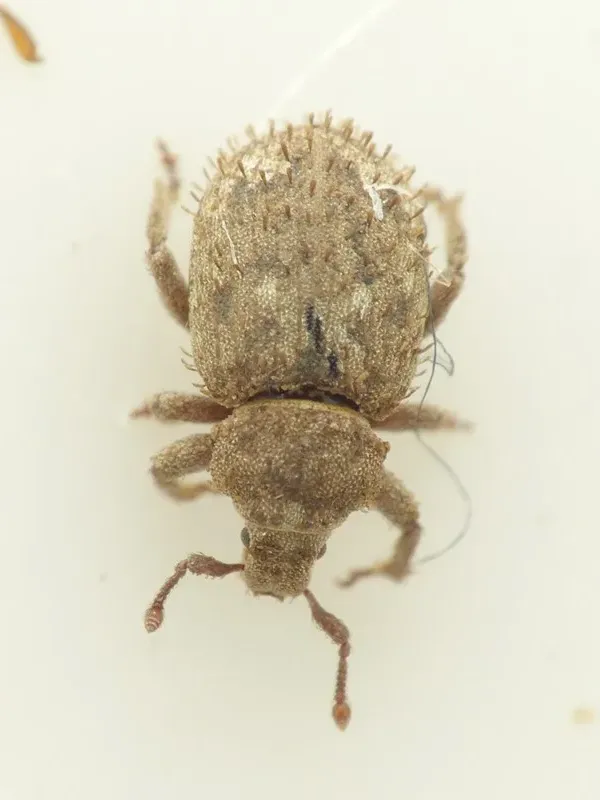
The rough weevil (Trachyphloeus scabriculus) is a small beetle belonging to the Curculionidae family. Measuring approximately 3 to 4 mm in length, it is characterized by its dull, earthy color, which serves as effective camouflage within the soil environment where it spends much of its life.
Morphologically, the beetle features a robust snout and a body covered in dense, roughened scales and setae. These features allow it to navigate through soil crevices and debris, making it difficult to detect during standard field inspections.
The larval stage consists of small, legless, cream-colored grubs with a distinctive dark head capsule. These larvae are soil-dwelling and remain hidden from view, feeding exclusively on the underground parts of host plants, which contributes to their status as a cryptic pest.
Adult rough weevils have poorly developed wings and generally crawl across the soil surface rather than flying. While this limits their rapid spread, it allows them to establish stable, persistent populations within localized patches of cultivated fields.
The life cycle is closely tied to soil conditions, with adults and larvae often residing in the upper soil layers. This life strategy makes the pest highly resistant to sudden changes in weather and allows it to thrive in diverse agricultural settings.
What it damages
This species acts as a polyphage, capable of causing damage to a wide range of agricultural crops, including vegetables, legumes, and various nursery-grown plants. Both adult and larval stages contribute to the overall economic impact on yields.
Adult beetles feed on foliage, typically creating notches along the leaf margins. While these injuries are mostly cosmetic in established crops, they can stress seedlings and young plants, slowing down their initial growth and development.
The most significant damage is caused by the larvae, which feed on the root systems. By consuming fine root hairs and boring into the primary roots, they disrupt the plant's ability to take up water and nutrients, leading to stunting and wilting.
Severe infestations often result in plant death, particularly in young seedlings or newly transplanted crops. In root vegetables, the presence of larval feeding tunnels can lead to tissue degradation and subsequent secondary infections by fungi or bacteria.
Chronic infestation weakens the plant's immune system, making it more susceptible to environmental stresses such as drought or heat. This results in reduced overall plant vigor and lower harvestable yields for the farmer.
When it appears
Adult activity typically begins in early spring, as temperatures rise and the soil thaws. This is the period when overwintered beetles emerge to feed on developing foliage and prepare for mating.
The larval feeding phase peaks during the warmer summer months. During this time, larvae are actively consuming roots, making it the most critical period for field monitoring and the assessment of potential crop damage.
Mid-summer heat may cause adults to move deeper into the soil to escape desiccation. However, the underground larval population continues its development, undisturbed by the conditions on the surface of the field.
A second peak of activity is often observed in the autumn as the new generation of adults emerges. This serves as a secondary window for feeding before the insects seek deeper soil layers for their winter diapause.
Overwintering occurs deep within the soil profile, where the beetles are protected from freezing temperatures. This resilience ensures that the population can persist from year to year, necessitating consistent management efforts.
Signs of infestation
The most common indicator of a rough weevil presence is the characteristic leaf notching along the edges of the foliage. Early morning inspections are the best time to spot adult beetles resting under leaves or near the base of the plant.
Wilting plants that fail to recover during the evening are strong indicators of significant root damage. If such plants are easily pulled from the ground, it confirms that the root system has been severely compromised by larvae.
Excavating soil samples from the root zone to a depth of 20 cm is the most reliable method for identifying the pest. Finding white, legless larvae in the soil around the plant crown provides clear evidence of an active infestation.
In root vegetables, the presence of small, irregular tunnels on the surface of the roots is a definitive sign of feeding activity. This often correlates with stunted growth and a general lack of vigor compared to unaffected plants.
Patchy or uneven crop growth in specific areas of the field often suggests the presence of localized rough weevil populations, warranting a closer look at the soil structure and root health in those areas.
Control measures
Effective management begins with robust crop rotation practices. Avoiding the cultivation of highly susceptible crops in the same field for several consecutive years can significantly disrupt the life cycle of the pest.
Tillage practices, particularly deep autumn plowing, are highly effective at exposing overwintering adults and larvae to predators and unfavorable environmental conditions, thereby reducing the overwintering population.
Chemical control can be achieved through the application of soil-incorporated insecticides at the time of planting. This provides a protective barrier for young, vulnerable root systems during the early stages of crop development.
Biological control agents, such as entomopathogenic nematodes or fungi, can be applied to the soil to target larvae. This is an environmentally sustainable option that works well in damp soil conditions common during the growing season.
Regular field scouting, especially during the spring and autumn, allows for targeted insecticidal treatments. By controlling the adult population before egg-laying begins, farmers can significantly mitigate the risk of severe larval damage.
Taxonomy
- Latin name
- Trachyphloeus scabriculus
- Order
- Coleoptera (beetles)
- Family
- Curculionidae
- EPPO code
- TRAYSC
Discussion
No discussions yet — be the first.