

Description
How to identify
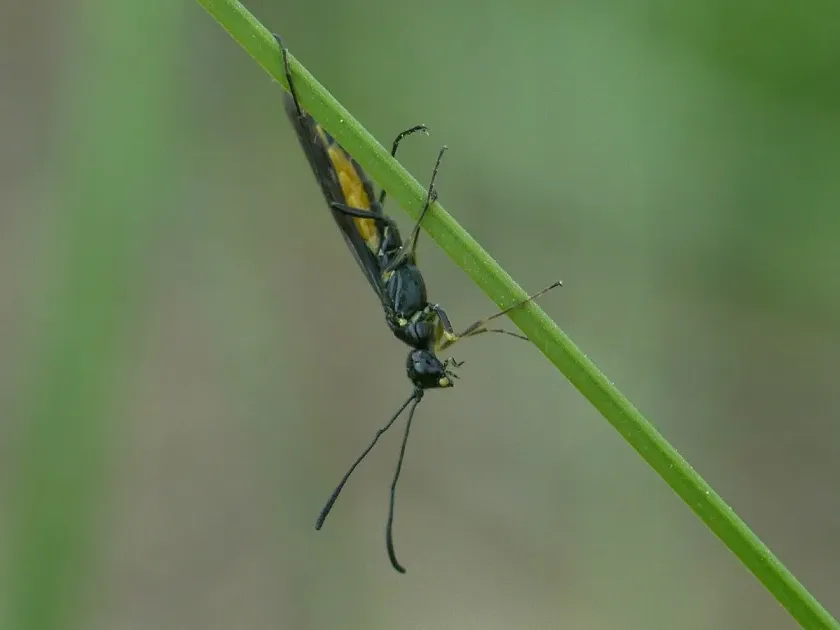
The Black grain stem sawfly (Trachelus tabidus) is a member of the Cephidae family. Adult insects measure approximately 7–9 mm in length and are distinguished by their predominantly black coloration with subtle yellow markings on the legs and abdomen.
The larvae are legless, pale-yellowish, and typically exhibit an S-shaped posture when removed from the stem. They possess a small, distinct projection at the end of the abdomen.
Eggs are deposited by the female into the parenchyma of the cereal stem using a saw-like ovipositor, which allows the insect to create precise incisions in the plant tissue.
The life cycle is univoltine, meaning there is only one generation per year. The insect overwinters as a full-grown larva inside the base of the stem, protected from winter conditions.
Pupation occurs in the spring within the stem base, after which the adult sawflies emerge to begin the breeding cycle on young host crops.
What it damages
The primary damage is caused by larvae mining the interior of cereal stalks, including wheat, barley, and rye. This tunneling disrupts the transport of water and nutrients to the developing ear.
Plants infested with sawfly larvae often show reduced grain weight, poor development, and in severe cases, the grain becomes thin and shriveled.
As the season progresses, the larva descends to the base of the stem and cuts a circular groove around the inside of the stalk, preparing for overwintering.
This internal girdling weakens the structural integrity of the plant, making it highly susceptible to lodging, especially during windy or stormy weather conditions.
Yield losses are significant, as lodged stalks are frequently missed by harvesting equipment, leaving a large portion of the crop on the ground.
Signs of infestation
The earliest signs of infestation are microscopic scars on the stem surface, which indicate the points where the female has inserted her eggs.
Internal damage can be verified by splitting the stem; presence of fine, dark "sawdust-like" frass within the stalk cavity confirms active larval feeding.
Whiteheads or prematurely withered ears in the field, while the rest of the plant appears relatively healthy, are common indicators of stem mining activity.
A high density of perfectly cut stems near the soil surface at harvest time is the definitive sign of a severe Black grain stem sawfly outbreak.
Scouting during the grain-filling stage allows producers to detect early lodging or stem discoloration, indicating the need for immediate harvest.
Control measures
Early harvesting is the most effective agronomic tactic, as it removes the crop before the larvae can complete their stem-girdling activity at the base.
Deep tillage or moldboard plowing after harvest is essential to bury the stubble, which contains the overwintering larvae, preventing adult emergence in the following spring.
Crop rotation helps break the pest cycle; moving away from susceptible cereal hosts to broad-leaved crops significantly reduces population levels in the field.
Chemical control is rarely utilized due to the difficulty of targeting larvae inside the stem, but insecticides can be used if synchronized with the adult flight period.
- Selecting crop varieties with higher stalk strength.
- Controlling grassy weeds that act as alternative hosts.
- Monitoring adult flight using yellow sticky traps.
Content graph
Connections · Black grain stem sawfly
Most often together:
Marketplace
Products · 1
Biology
Taxonomy
- Latin name
- Trachelus tabidus
- Order
- Hymenoptera
- Family
- Cephidae
- EPPO code
- CEPHTA
Community
Discussion
No discussions yet — be the first.