
European oak leafroller
Tortrix viridana
Description
How to identify
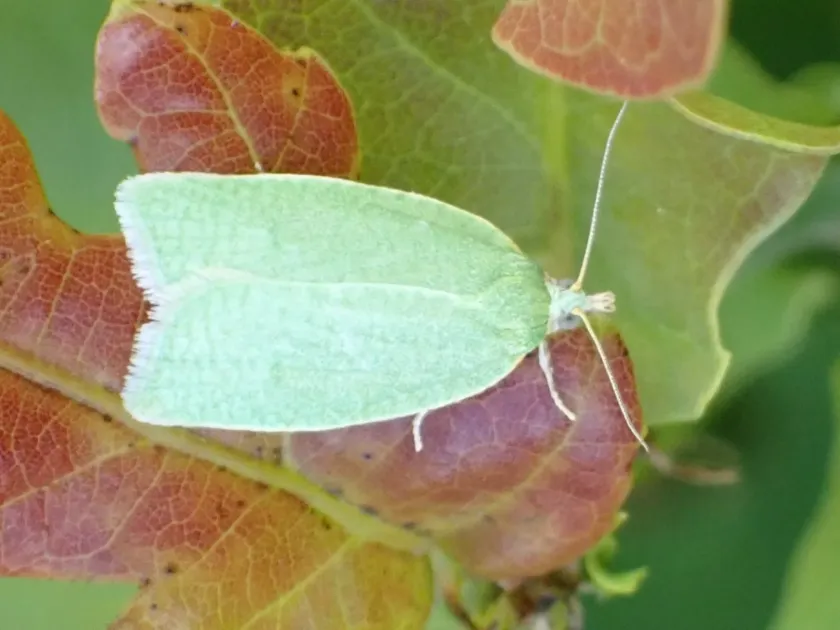
The European oak leafroller (Tortrix viridana) is a moth species belonging to the family Tortricidae. Adult moths have a wingspan of approximately 20–24 mm.
The forewings are bright green, providing excellent camouflage against oak leaves, while the hindwings are greyish-brown with a distinct fringe.
The larvae, or caterpillars, grow up to 18 mm in length. They are typically dark green with a shiny black head and prothoracic shield, which are diagnostic features.
Pupae are 10–12 mm long and initially light brown, gradually turning dark brown or black as the adult moth prepares to emerge.
Eggs are laid in small batches on tree branches, covered with a protective layer of secretion that hardens into a small, grey, disc-like structure.
What it damages
The primary host for this pest is the oak (Quercus), but it can also affect various other hardwood trees during periods of high population density.
In outbreak years, larvae may feed on beech, lime, birch, hornbeam, and even fruit trees like apples, causing significant agricultural and silvicultural damage.
The main impact is the complete defoliation of oak trees, which severely weakens the host and reduces its annual growth rate significantly.
Repeated defoliation over several consecutive years can lead to crown dieback, increased susceptibility to wood-boring insects, and tree mortality.
The physiological stress caused by the pest makes the trees more vulnerable to fungal diseases and secondary pests, leading to forest degradation.
When it appears
The species overwinters in the egg stage, with eggs attached to the bark of branches where they remain dormant until the following spring.
Larval emergence is highly synchronized with the budburst of oak trees, ensuring that the neonate larvae have immediate access to fresh foliage.
The larvae feed actively throughout the spring, from April to June, using silk to roll leaves into protective tubes or structures where they hide.
Pupation occurs within these rolled leaves in late June or early July, lasting approximately two to three weeks before the adult moths emerge.
Adult moths are active in mid-summer, typically mating and laying eggs on the branches to complete the annual life cycle.
Signs of infestation
Early symptoms include damage to expanding buds, which fail to open correctly or show irregular, stunted growth patterns.
As the season progresses, the tree canopy appears scorched or skeletonized, as the larvae consume the leaf tissue while leaving major veins intact.
The presence of rolled or folded leaves, bound together by fine silk threads, is a characteristic indicator of an active infestation.
Large quantities of larval frass (droppings) accumulate on the lower foliage and the ground beneath the canopy during peak feeding periods.
- Canopy thinning and visible foliage loss by early summer.
- Abundance of silk threads connecting leaves together.
- Presence of small adult moths flying in the evening near oak stands.
Control measures
In forestry, chemical insecticides are applied during the early larval stage, coinciding with budburst, to prevent major defoliation.
Biological control using formulations of Bacillus thuringiensis is an effective and environmentally friendly alternative for managing larvae.
Encouraging populations of natural predators, such as insectivorous birds and parasitic wasps, can help keep the leafroller population in check.
Silvicultural practices that maintain tree vigor and prevent forest thinning are essential for reducing the severity of outbreaks.
For ornamental trees or smaller stands, manual removal and destruction of infested leaf bundles can be effective if done before pupation.
Taxonomy
- Latin name
- Tortrix viridana
- Order
- Lepidoptera (butterflies)
- Family
- Tortricidae
- EPPO code
- TORTVI
Discussion
No discussions yet — be the first.