
Lesser pine shoot beetle
Tomicus minor
Description
How to identify
The Lesser pine shoot beetle (Tomicus minor) is a member of the Curculionidae family and the Scolytinae subfamily. These small beetles, measuring approximately 4 mm in length, are characterized by their cylindrical, dark brown to black bodies.
Morphologically, they are distinguished from the Common pine shoot beetle by their pronotal structure and the lack of a prominent tooth-like structure at the apex of the elytra. The apex of the elytra is smooth and rounded, a diagnostic feature for identification.
The larvae are legless, white, with a characteristic brown head capsule. They develop under the bark, creating a distinct gallery pattern that is essential for species confirmation during field inspections of infested trees.
The beetle is secretive, spending most of its life cycle beneath the bark of host trees or inside young shoots. Their small size and cryptic behavior make early detection challenging without regular forest health surveys.
Understanding the specific gallery architecture—transverse maternal tunnels with lateral larval galleries—is critical for foresters to distinguish Tomicus minor from other bark-boring insects occupying similar ecological niches.
What it damages
The primary host for Tomicus minor is the Scots pine (Pinus sylvestris). The beetle prefers trees with thinner bark, often attacking the upper portions of the trunk or younger trees, making it a significant threat to pine plantations.
Damage is twofold: adults cause mechanical injury by tunneling into the pith of young shoots, leading to crown thinning, while larvae consume the cambium and phloem layer beneath the bark of the main stem.
This feeding activity often results in the girdling of the tree, which can lead to rapid decline or death. Furthermore, the loss of young shoots negatively impacts the tree's photosynthetic capacity and structural integrity.
In large-scale infestations, the beetles can cause severe mortality across pine stands. Infested trees often become attractive to secondary wood-boring insects, which accelerates the deterioration process.
Economic damage is substantial, as the quality of the timber is significantly reduced due to beetle galleries, staining from associated fungi, and the premature mortality of the stand.
When it appears
The flight period typically begins in early spring, as soon as temperatures exceed 10–12°C. Adults emerge from their overwintering sites to seek out suitable host trees for breeding.
After mating, females excavate maternal galleries where eggs are laid. Larval development occurs throughout the summer months, with temperatures strongly influencing the speed of maturation.
A second phase of activity occurs in late summer, when the newly emerged young beetles engage in maturation feeding in the crowns of healthy trees, causing the characteristic branch dieback.
Overwintering takes place in the basal bark of pine trees, in the soil, or within the thick layer of forest litter at the base of the tree, providing protection against extreme winter conditions.
While typically univoltine, the life cycle duration can vary based on regional climatic conditions, with warmer climates potentially allowing for overlapping generations or accelerated development.
Signs of infestation
The most visible sign of an infestation is the widespread presence of fallen green shoots on the forest floor, which have been hollowed out and snapped off by the wind.
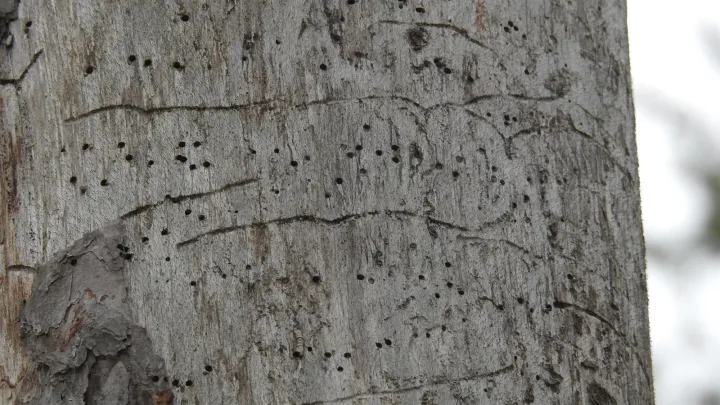
External inspection of the bark reveals small, round entry holes accompanied by fine frass (boring dust). The color of this dust varies from white to reddish-brown depending on the freshness of the attack.
Crown symptoms include gradual yellowing and subsequent reddening of the needles, indicating a severe disruption of the vascular system within the tree trunk.
Peeling back the bark reveals the telltale "butterfly" gallery pattern, where a central horizontal maternal tunnel is intersected by vertical larval galleries, signifying active colonization.
- Excessive boring dust on the bark surface.
- Massive premature drop of fresh pine shoots.
- Progressive crown discoloration and desiccation.
- Presence of unique transverse maternal galleries under the bark.
- Increased woodpecker activity on infested tree trunks.
Control measures
Management focuses on forest hygiene, primarily the removal and proper disposal of infested wood before the young generation of beetles can emerge to attack healthy trees.
The use of trap trees is a highly effective cultural control method; these are felled and left in the forest, then removed once they have attracted and accumulated a significant beetle population.
Strict regulations regarding the transport and storage of timber during the flight period are essential to prevent the spread of the pest to uninfested regions.
Chemical control, while limited to high-value areas or nursery settings, involves the application of registered insecticides during the adult flight peak to protect valuable tree crowns.
Biological control efforts, including the preservation of native predatory birds and parasitic wasps, play a vital role in maintaining the beetle population below economic injury levels.
Taxonomy
- Latin name
- Tomicus minor
- Order
- Coleoptera (beetles)
- Family
- Curculionidae
- EPPO code
- BLASMI
Discussion
No discussions yet — be the first.