
Mediterranean pine engraver
Tomicus destruens
Description
How to identify
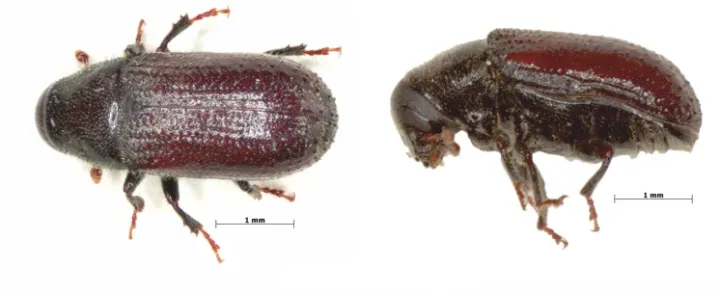
The Mediterranean pine engraver (Tomicus destruens) is a beetle belonging to the Curculionidae family (subfamily Scolytinae). Adults have a cylindrical body measuring 3.5 to 5 mm in length, with a dark brown to black coloration.
A distinctive feature of the species is a smooth depression on the elytra and the specific structure of the pronotum. Larvae are legless, white-colored with a yellowish head, and develop beneath the tree bark.
Systematically, this beetle belongs to the order Coleoptera and family Curculionidae. It is closely related to the common pine shoot beetle but possesses a specific biology adapted to the Mediterranean climate.
Unlike many other bark beetles, this species maintains activity throughout the year if weather conditions allow, making it particularly dangerous to pine ecosystems.
Accurate identification often requires entomological inspection, as the morphological characteristics of adults demand careful examination under magnification.
What it damages
The primary hosts of this pest include various species of the genus Pinus, most notably Aleppo pine, maritime pine, and stone pine.
The beetle attacks both healthy and stressed trees, a behavior that distinguishes it from other bark beetle species that strictly target dying or decaying wood.
Major economic impact occurs during massive population outbreaks, which can lead to the death of entire forest stands and individual ornamental trees.
Damage occurs on both the main trunk and the tree canopy, where adults bore into young shoots for supplemental feeding.
In warmer regions, the species is capable of colonizing and damaging various ornamental conifer species used in landscape design.
When it appears
The life cycle of the pest is highly dependent on regional temperatures and can complete several generations within a single calendar year.
Peak adult activity, associated with the colonization of new trees, is observed from late spring through early summer, when adults emerge from their maternal galleries.
During the autumn and winter months, in the absence of severe frost, the beetle continues slow development or remains active within the tree bark.
The process of supplemental feeding in young shoots can occur almost year-round, ensuring a constant energy source for the beetles.
Synchronization of the developmental cycle allows the population to recover quickly even after brief periods of adverse weather conditions.
Signs of infestation
The first visible sign of infestation is the presence of holes in the bark of the trunk, from which brownish wood dust (boring dust) is expelled.
Attacks on young shoots lead to premature wilting, yellowing, and massive shedding of needles, which is clearly visible when inspecting the crown.
- Formation of resinous pitch tubes on the bark surface.
- Loss of color in needles on affected branches.
- Presence of specific maternal galleries beneath the bark when peeled away.
Mass attacks by these insects often lead to a change in the color of the entire tree crown, which takes on a characteristic reddish-brown hue.
Trees severely infested by the engraver become vulnerable to secondary pests and fungal infections, which further accelerate tree decline.
Control measures
The primary control method involves sanitary logging and immediate removal or destruction of infested trees to prevent the spread of adults to healthy hosts.
The use of pheromone traps assists in population monitoring and the early detection of outbreaks within forest areas.
Maintaining high tree vigor through proper irrigation and sound silvicultural practices reduces the likelihood of successful colonization by the pest.
Chemical protection using systemic insecticides is effective for ornamental plantings but is often limited in large-scale forest management.
Biological control, including the encouragement of natural entomophagous predators, is considered a promising direction for long-term population management.
Taxonomy
- Latin name
- Tomicus destruens
- Order
- Coleoptera (beetles)
- Family
- Curculionidae
- EPPO code
- TOMSDE
Discussion
No discussions yet — be the first.