
Lesser pine shoot beetle
Tomicus brevipilosus
Description
How to identify
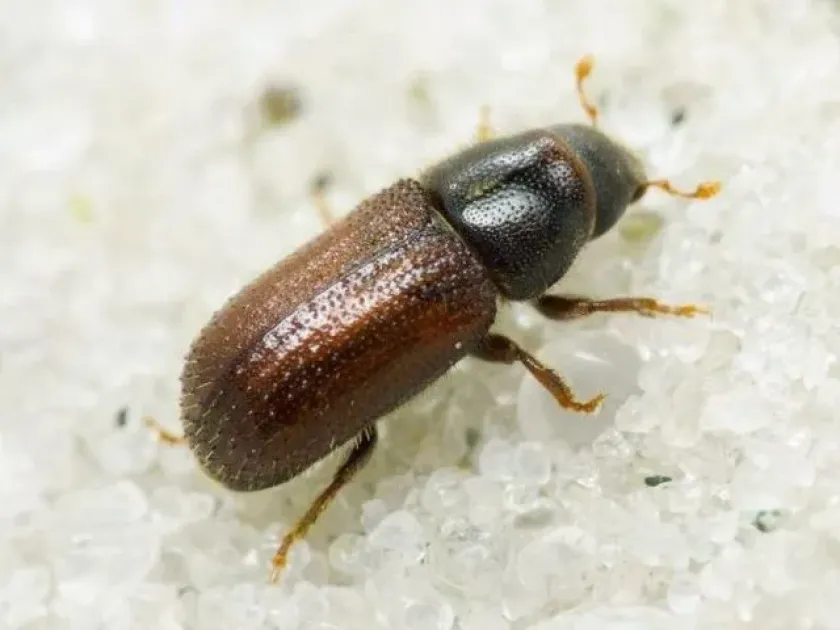
The Lesser pine shoot beetle (Tomicus brevipilosus) is a species of bark beetle belonging to the family Curculionidae. These small insects are typically 3 to 4 mm long and have a cylindrical body shape.
The adult beetle is characterized by its shiny dark brown to black color and sparse, short hairs on the elytra. This pubescence is a key feature that helps differentiate it from related species like the Common pine shoot beetle.
The larvae are white, legless grubs with a distinct brown head. They are primarily found developing underneath the bark of pine trees, where they feed on the cambium layer.
Pupation occurs within small, oval-shaped chambers known as pupal cells, which are carved out by the larvae at the end of their feeding tunnels.
This species is a significant forest pest due to its dual-phase life cycle: developing in the bark of trunks and later feeding on the shoots of healthy young pine trees.
What it damages
The Lesser pine shoot beetle mainly attacks pine trees (Pinus genus). It often targets weakened, stressed, or wind-damaged trees, but can also infest fresh logging residues.
Adult beetles tunnel into the bark to create galleries for egg-laying, which disrupts the transport of water and nutrients, eventually weakening the tree's overall defense systems.
A secondary form of damage occurs when young adults emerge and feed on the current year's pine shoots. They bore into the center of the shoot to consume the succulent pith.
This shoot-feeding behavior causes the affected parts to turn yellow, wither, and eventually break off during windy conditions, leading to stunted growth and disfigured tree crowns.
Severe infestations can lead to high mortality in young stands and predispose trees to secondary attacks by fungi or other wood-boring insects, further endangering the forest ecosystem.
When it appears
The flight of overwintered adults typically begins in early spring when temperatures reach approximately 10-12 degrees Celsius, coinciding with the start of the sap flow in pine trees.
The primary reproductive phase occurs during April and May, as females excavate egg galleries under the bark. Eggs are laid along the gallery walls, followed by the death of the adults.
Larval development takes about 6 to 8 weeks, depending on the ambient temperature. By July, the new generation of adults completes development and emerges from the bark.
These young adults immediately begin their shoot-feeding phase, which continues throughout the summer and autumn months as they prepare for the winter period.
Winter is spent in hibernation, with the beetles seeking shelter in the bark at the base of mature pine trees or within the forest litter near the root collar.
Signs of infestation
The most visible sign of an infestation is the presence of "frass" or boring dust, appearing as piles of fine wood particles at the base of the trunk or on the bark surface.
Upon close inspection, small, perfectly round entry holes are visible on the trunk bark. These marks indicate where the beetles have successfully penetrated to begin their galleries.
Significant yellowing and shedding of young pine needles and shoots during the summer months is a strong indicator of adult feeding activity in the canopy of the forest.
If the bark of an affected tree is peeled back, one can observe the characteristic gallery system, usually arranged vertically, indicating where the brood has developed.
The presence of woodpeckers frequently visiting specific trees can often serve as an early warning sign that the trunk is heavily infested with beetle larvae.
Control measures
Sanitation cutting is the most effective management strategy. Forest managers must promptly remove infested, dead, or storm-damaged trees before the new generation of beetles emerges.
Trap trees are used as a tactical tool, where fresh logs are placed in the forest to attract breeding beetles. Once occupied, these traps are processed or burned to kill the brood.
Proper forest hygiene, including the removal of slash and logging debris, is crucial as these materials act as perfect breeding grounds for the Lesser pine shoot beetle.
In high-value areas like urban parks or nurseries, preventative insecticide sprays can be applied to the trunks before the beetles begin their initial flight in the spring.
Maintaining high stand vigor through selective thinning and ensuring the forest is not overcrowded helps trees maintain a strong resin response, which is their natural defense against bark beetles.
Taxonomy
- Latin name
- Tomicus brevipilosus
- Order
- Coleoptera (beetles)
- Family
- Curculionidae
- EPPO code
- TOMSBR
Discussion
No discussions yet — be the first.