
Pine shoot beetle
Tomicus
Description
How to identify
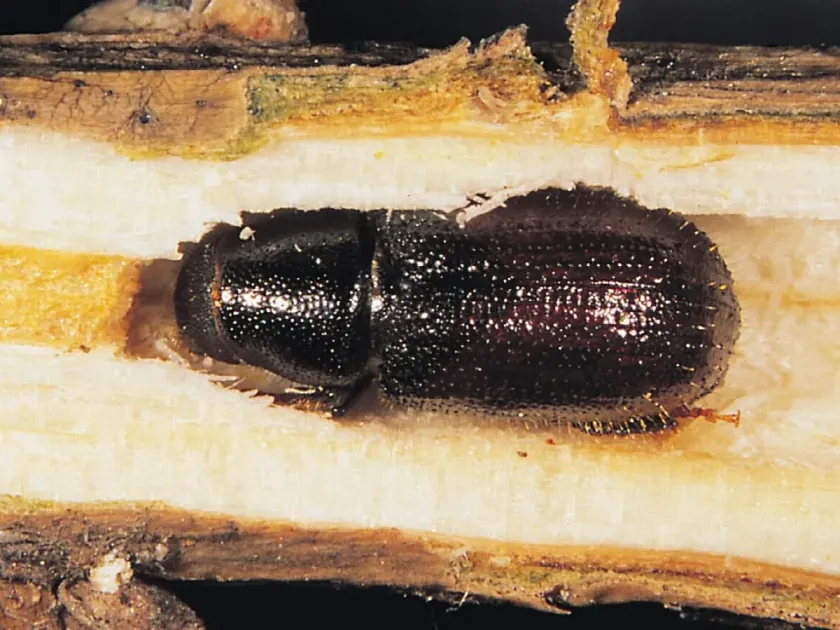
The pine shoot beetle (genus Tomicus) belongs to the Curculionidae family (subfamily Scolytinae). These are small, cylindrical beetles measuring 3–5 mm in length, typically dark brown or black in color.
The hallmark of this genus is their unique feeding behavior. Adult beetles tunnel into the pith of young pine shoots to feed, which serves as a critical growth stage for their physical development.
The life cycle involves the formation of galleries beneath the bark of host trees. The larvae are legless, white-bodied with a yellowish head, and they reside within the cambium and phloem layers of the trunk.
Their elytra possess small serrated pits designed to clear "frass" (bore dust) from their tunnels, which is a key morphological feature used by experts to differentiate them from other bark beetles.
The biology of the pine shoot beetle is opportunistic; they generally seek out stressed, recently felled, or dying trees, although high population densities can trigger mass attacks on healthy, vigorous timber.
What it damages
The primary hosts are pine species, particularly the Scots pine (Pinus sylvestris). They can also infest spruce and larch trees if the population reaches outbreak levels or if specific environmental conditions are met.
Adult beetles cause structural damage to the crown by boring into terminal shoots, causing them to break and fall. This results in significant canopy loss and reduced tree vigor due to the disruption of terminal growth.
Larval feeding beneath the bark creates extensive galleries that sever the tree’s conductive vessels. This interference with nutrient and water transport leads to the rapid decline and physiological collapse of the host tree.
Secondary damage often occurs through the introduction of fungal pathogens and blue-stain fungi via the beetles' entry points, which accelerates the deterioration of the wood quality and tree health.
The cumulative impact of shoot pruning and trunk infestation results in widespread growth reduction and mortality within forest stands, causing substantial economic losses in the timber industry.
When it appears
Activity begins in early spring as temperatures reach approximately 10–12°C. Overwintering adults emerge from their hibernation sites to locate suitable host trees for reproduction.
The breeding phase, including mating and oviposition, typically occurs from April through June. During this time, the beetles aggressively target the main trunks of susceptible trees to establish their galleries.
Summer feeding by the new generation of adults occurs in the crowns of pines. This peak feeding activity often lasts through late summer, resulting in visible damage characterized by the presence of fallen twigs on the forest floor.
As autumn temperatures drop, the beetles cease their feeding activity and transition to overwintering sites, typically in the thick bark at the base of the tree or within the forest litter layer.
Climate warming has a direct impact on the beetle's life cycle; milder winters lead to higher survival rates of the overwintering population, which often results in severe localized outbreaks during the following season.
Signs of infestation
A primary indicator of infestation is the presence of "bore dust" or frass on the trunk surface. These fine particles are discarded by the beetles while constructing their egg-laying tunnels beneath the bark.
Entry holes are often accompanied by small resin mounds on the bark, as the tree attempts to "pitch out" the invading beetles by producing excess resin at the site of entry.
During the summer months, the most striking sign is the abundance of freshly broken green shoots scattered beneath the canopy. These shoots are hollowed out, showing clear evidence of beetle feeding.
As the conductive tissues fail, the tree foliage changes color, shifting from a healthy green to a faded pale, then eventually to yellow and deep red, indicating the advanced stages of infestation.
When the bark is peeled back from an infested tree, one can observe a distinct pattern: a primary vertical egg gallery with lateral larval feeding tunnels branching out, creating a signature engraving.
Control measures
Sanitation harvesting is the most critical management strategy. Removing infested trees before the new generation of beetles emerges prevents the spread of the population and limits future attacks.
Trap trees are widely utilized in forestry. Freshly cut logs are placed strategically in the spring to lure beetles into a single location, after which the infested wood is debarked or destroyed before the offspring emerge.
Chemical control can be employed for high-value trees or in specific forestry zones. Systemic or contact insecticides applied to the bark can create a protective barrier during the critical flight and colonization periods.
Enhancing forest resilience through proper silvicultural practices is essential. Promoting healthy stands with adequate spacing and nutrition ensures trees have the vigor to defend against bark beetle colonization.
- Utilize pheromone traps for early population monitoring.
- Encourage biological control agents, including woodpeckers and parasitic wasps.
- Conduct regular forest health assessments to detect infestation patterns early.
- Ensure rapid disposal of logging slash to eliminate potential breeding sites.
Taxonomy
- Latin name
- Tomicus
- Order
- Coleoptera (beetles)
- Family
- Curculionidae
- EPPO code
- TOMSSP
Discussion
No discussions yet — be the first.