
Bud moth
Tmetocera
Description
How to identify
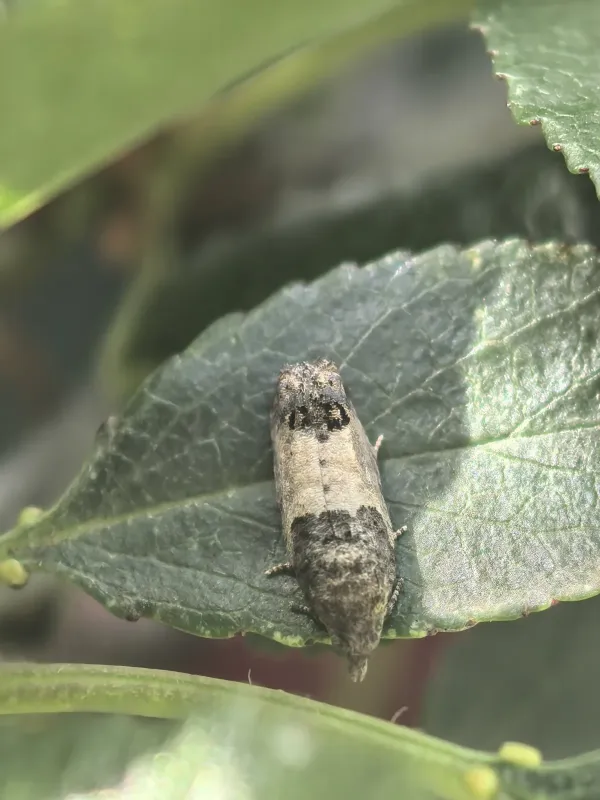
The bud moth (lat. Tmetocera ocellana), belonging to the Tortricidae family, is a significant pest of fruit trees. The adult moth has a wingspan of about 15 mm, with grey forewings featuring a distinctive broad white band, allowing for excellent camouflage against tree bark.
The larvae progress through several developmental stages. Young caterpillars are typically brownish with a dark head, while mature larvae reach 10–12 mm in length, characterized by a shiny, dark-brown plate on the pronotum.
The eggs are tiny, translucent, and oval-shaped. They are laid singly or in small clusters on the upper surfaces of leaves, making them difficult to detect without careful inspection during the egg-laying period.
The pupa is dark brown and develops within curled leaves or bark crevices. The pupal stage lasts approximately two to three weeks, depending heavily on the prevailing weather conditions in the spring.
As nocturnal insects, adult bud moths are rarely seen during the day. Their activity patterns are highly synchronized with the local environment, particularly humidity and temperature levels at night.
What it damages
This pest is a polyphage, meaning it attacks a wide range of pome and stone fruit trees, including apples, pears, cherries, plums, and apricots. It causes substantial damage to developing buds and young foliage.
The larvae are most destructive in early spring when they bore into swelling buds. By consuming the inner parts of the buds, they destroy the developing leaves and flowers, leading to significant yield loss.
In addition to bud destruction, larvae may attack young blossoms, feeding at their base. This damage often results in fruit set failure and the shedding of young fruitlets, impacting total orchard productivity.
During the summer, larvae feed on foliage, skeletonizing the leaves or rolling them into protective tubes bound by silk. This feeding reduces the photosynthetic capacity of the tree, weakening it over time.
Nursery stock is particularly vulnerable to bud moth infestations. Damage to terminal buds can cause distorted growth and branching issues, significantly hindering the development of young trees.
When it appears
Larvae overwinter in the second or third instar stage. They construct small, white silk cocoons tucked into bark crevices, lichen patches, or tree crotches, providing insulation and protection against winter weather.
In the spring, as buds begin to swell and open, the larvae emerge from their winter shelters to feed. This timing makes them highly dependent on the plant's phenology for early-season survival.
The first generation of moths emerges in early summer, typically peaking in June or July. During this time, the adults mate and deposit eggs on the leaves, starting the next generation's life cycle.
The late-summer generation larvae are the ones that prepare for winter. Their numbers can be quite high, making careful management during this phase important for reducing the next year's population.
While the moth typically completes one generation per year, environmental variables can sometimes lead to partial second generations in warmer climates, increasing the pressure on orchard health.
Signs of infestation
The first visible signs of infestation are small piles of excrement and silk webbing around the bud scales in early spring. These signs indicate that larvae are actively feeding inside the buds.
Infected buds often remain closed or show distorted, withered leaves upon opening. A close inspection of these buds will reveal the presence of fine silk threads binding them together.
During the summer months, rolled or webbed leaves are a primary indicator of larval presence. These rolled leaves act as nests where caterpillars feed protected from predators and environmental exposure.
Surface feeding on fruit can also occur. Although rare as a deep-boring pest, larvae may graze on the skin of young fruits, leaving blemishes and scars that degrade the fruit's market value.
In nurseries, look for damaged terminal shoots where growth has ceased or become malformed. The presence of webbing and skeletonized foliage on the tips of branches is a classic diagnostic sign.
Control measures
Cultural control is a foundational strategy. Removing old, loose bark and scraping off lichen helps eliminate the primary overwintering sites for the larvae, reducing the population before spring.
Sanitation through pruning is essential. Removing infested shoots and branches helps destroy larvae. All pruned material should be destroyed immediately, preferably through burning, to prevent the escape of adult moths.
Monitoring is crucial for effective management. Pheromone traps can be used to track the population levels of adult moths, helping growers time their interventions for maximum efficacy.
Biological control agents, such as microbial insecticides based on Bacillus thuringiensis, are effective when applied while the larvae are young and exposed, before they create protective silk nests.
Chemical control requires systemic insecticides applied during critical phenological stages, such as the "green cluster" stage. Prompt application ensures the reduction of the population before they cause irreversible damage.
Taxonomy
- Latin name
- Tmetocera
- Order
- Lepidoptera (butterflies)
- Family
- Tortricidae
- EPPO code
- TMETSP
Discussion
No discussions yet — be the first.