
Melon thrips
Thrips palmi
Description
How to identify
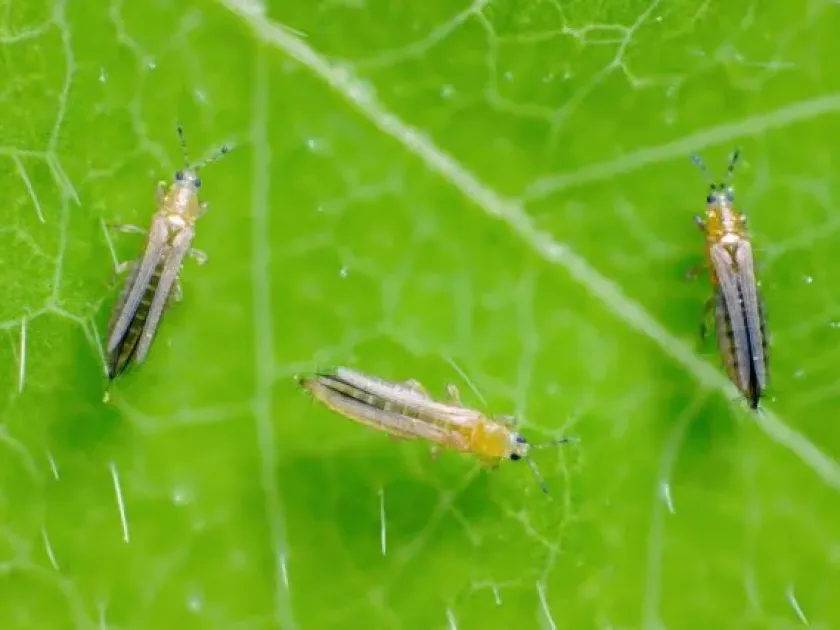
The melon thrips, Thrips palmi, belongs to the order Thysanoptera, family Thripidae. These are tiny insects measuring about 1.0–1.3 mm in length, characterized by a pale yellow body.
Adults possess narrow, fringed wings typical of the species. Larvae resemble adults but lack wings and are generally smaller in size.
This species is a highly polyphagous insect, feeding on a wide variety of plant hosts, and is classified as a significant quarantine pest worldwide.
Due to their microscopic size and preference for hidden areas like leaf axils and flower buds, they are difficult to detect until the population reaches high levels.
Their developmental cycle includes egg, two larval instars, propupa, pupa, and adult stages. Under favorable warm conditions, a generation can complete its development in as little as 15 days.
What it damages
Melon thrips attack a vast range of vegetable crops, including cucumbers, peppers, and eggplants, as well as many ornamental species in greenhouses.
Both adults and larvae feed by piercing plant cells and sucking the sap, which leads to metabolic stress and inhibition of photosynthesis.
They are notorious vectors for tospoviruses, such as the tomato spotted wilt virus (TSWV), which can cause catastrophic yield losses in susceptible crops.
Feeding damage appears as silvery patches, distortion of leaves, stunted growth, and necrosis of stems, effectively rendering the plant unproductive.
Fruits affected by thrips often show scarring, discoloration, or deformation, causing significant economic losses to growers by reducing produce quality.
When it appears
In greenhouses, melon thrips remain active year-round, as the stable environment provides optimal conditions for continuous reproduction.
In tropical and subtropical regions, these pests are active during the entire growing season, with population spikes occurring during hot, dry weather conditions.
Migration typically occurs via contaminated plant material, human clothing, greenhouse equipment, and wind currents in localized areas.
Temperature is the main driver of population growth; temperatures between 25°C and 30°C significantly accelerate the life cycle, leading to rapid outbreaks.
During unfavorable conditions, thrips can survive in the soil or on weed hosts, remaining dormant until temperatures rise and host plants become available.
Signs of infestation
Early signs include silvery-grey stippling or patches on the leaves, particularly on the upper surface, caused by the depletion of chlorophyll during feeding.
Severe infestations result in distorted or curled leaves and stunted terminal shoots, which can often be mistaken for chemical injury or nutrient deficiencies.
Small black spots on the underside of the leaves—which are the excrement of the insects—are a definitive sign of an active thrips colony.
Flowers may fail to set fruit or drop prematurely, and developing fruits often exhibit corky lesions or irregular surface scarring.
Monitoring with yellow or blue sticky traps is essential to detect the presence of adults before they establish high-density populations.
Control measures
Strict quarantine and sanitation are the first lines of defense, ensuring that all incoming plant material is thoroughly inspected and free from infestation.
Integrated Pest Management (IPM) practices, including the removal of weeds and crop debris, help reduce overwintering sites for the pest.
Biological control agents, such as predatory mites (Amblyseius species) and predatory bugs (Orius), are effective tools for suppressing larval populations.
Chemical control requires the rotational use of different insecticide classes to prevent the rapid development of pesticide resistance in the population.
- Implement a regular monitoring schedule using sticky traps.
- Use fine-mesh insect screens on all greenhouse vents.
- Ensure personnel follow proper hygiene protocols between greenhouses.
- Maintain strict isolation of new plant batches.
Taxonomy
- Latin name
- Thrips palmi
- Order
- Thrips
- Family
- Thripidae
- EPPO code
- THRIPL
Discussion
No discussions yet — be the first.