
Coloratus thrips
Thrips coloratus
Description
How to identify
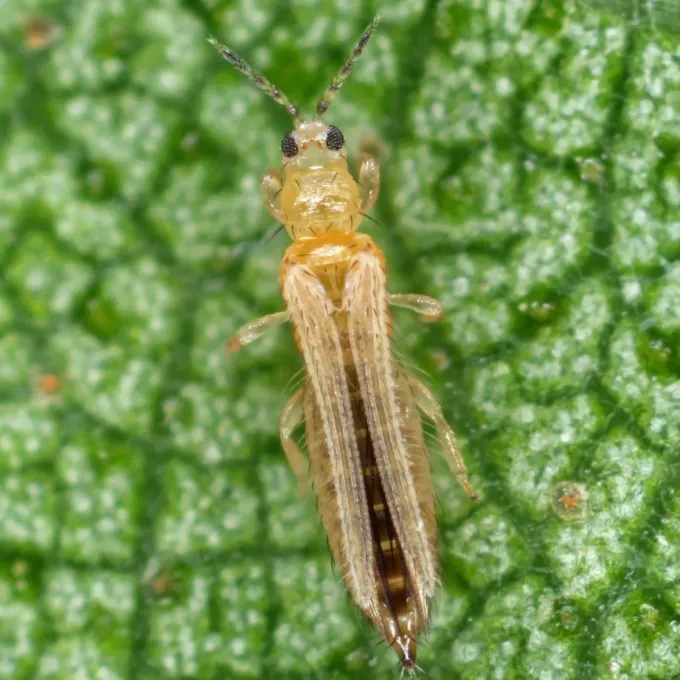
The Coloratus thrips (Thrips coloratus) is a member of the Thysanoptera order and the Thripidae family. These insects are small, typically measuring between 1.0 and 1.2 mm in length.
Adults exhibit a color palette ranging from yellowish-brown to dark brown, which provides excellent camouflage on foliage. They are characterized by narrow wings fringed with fine hairs, typical of their order.
Larvae resemble adults but lack wings and are generally lighter, often translucent in color. They are highly active and tend to inhabit concealed parts of the plant to avoid predators.
Identification often requires expert analysis of microscopic features, such as antennal segment patterns and pronotal setae, which are diagnostic for this specific species.
As a polyphagous pest, it can survive and reproduce on various plant hosts, making it a persistent challenge for both greenhouse and open-field agriculture.
What it damages
This pest affects a wide range of host plants, including vegetable crops like peppers and tomatoes, as well as various ornamental species and berries.
Damage is caused by both adults and larvae feeding on plant tissues, primarily the underside of leaves, flower buds, and developing fruit.
By piercing the epidermis and sucking the sap, the insect leaves necrotic spots, leading to foliage discoloration and wilting. Severe infestations often result in stunted plant growth.
Flower feeding is particularly destructive, causing buds to deform, fail to open, or drop prematurely, which significantly reduces yield and marketable quality.
Beyond physical damage, the Coloratus thrips is known to act as a vector for various plant viruses, posing a systemic threat to crop health and production stability.
When it appears
The population activity increases significantly as temperatures rise, with optimal development occurring when ambient temperatures consistently exceed +20 degrees Celsius.
The life cycle consists of egg, two larval stages, prepupa, pupa, and adult. Under favorable greenhouse conditions, the cycle can complete in as little as two weeks.
In the field, peak populations typically emerge during the mid-summer months, coinciding with the most vigorous phases of crop development.
Overwintering usually occurs as adults in the soil or protected crevices of plant debris and greenhouse structures, facilitating rapid recolonization in the spring.
Hot and dry weather conditions accelerate the reproductive rate, often leading to rapid population explosions that can overwhelm local plant defenses within days.
Signs of infestation
The first visual signs of an infestation include small silvery or bleached streaks appearing on leaves, which gradually expand into larger necrotic patches.
A reliable diagnostic feature is the presence of tiny, dark black spots on the underside of leaves, which are the excrement droplets of the thrips population.
Bud and flower deformation, including discolored or twisted petals, indicates that thrips are actively feeding within the protective layers of the floral organs.
Visible scarring or "silvering" of the fruit skin often appears, rendering the produce unmarketable and susceptible to secondary fungal infections.
- Silvery streaking on leaf surfaces;
- Presence of black fecal spots;
- Deformed buds and flowers;
- Premature fruit or bud drop;
- General plant chlorosis and stunting.
Control measures
Integrated Pest Management (IPM) is the most effective approach, combining cultural practices, biological control, and targeted chemical applications.
Cultural methods include regular weeding to remove host plants and deep soil cultivation after the harvest to disrupt the insect's overwintering sites.
Blue sticky traps are highly recommended for monitoring purposes and to provide a physical barrier to population growth in greenhouse environments.
When chemical intervention is necessary, it is vital to rotate insecticides with different modes of action to prevent the development of resistant populations.
Biological control agents, such as predatory mites (e.g., Amblyseius spp.) or minute pirate bugs (Orius spp.), are effective alternatives that reduce the need for synthetic pesticides.
Taxonomy
- Latin name
- Thrips coloratus
- Order
- Thrips
- Family
- Thripidae
- EPPO code
- THRIJA
Discussion
No discussions yet — be the first.