
False codling moth
Thaumatotibia leucotreta
Description
How to identify
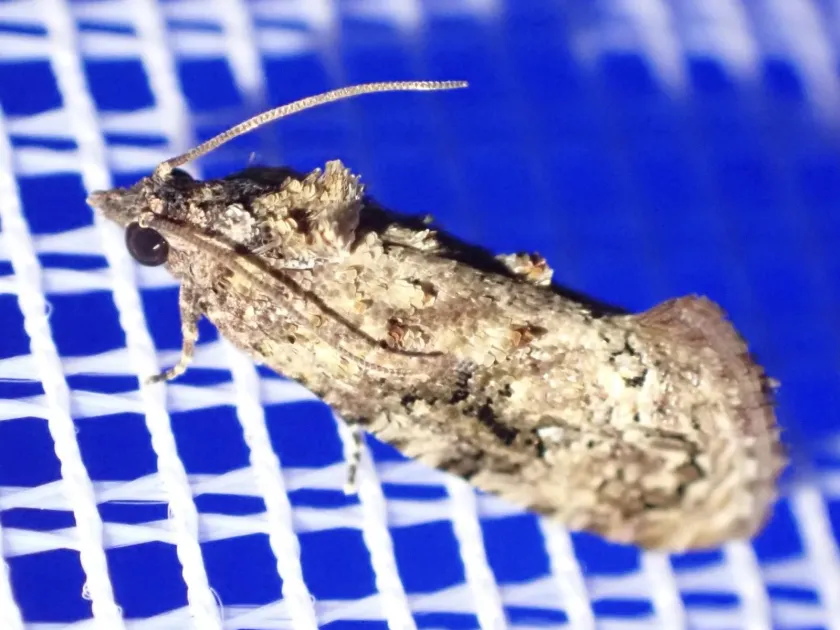
The False Codling Moth (Thaumatotibia leucotreta) is a member of the Tortricidae family. The adult moth has a wingspan of approximately 15–20 mm, with mottled grey-brown coloration, which provides excellent camouflage.
Larvae undergo several developmental stages, evolving from creamy-white to a pinkish or orange hue as they mature. Their heads are usually dark brown or amber-colored, making them distinct from other larvae.
The eggs are laid singly on the surface of developing fruit. Being extremely small and flattened, they are often overlooked by farmers during routine field inspections without magnification.
Pupation typically occurs within a silk cocoon either in the soil or protected crevices of tree bark. Understanding this pupation behavior is crucial for managing the pest's overwintering population.
Reliable identification is best achieved using pheromone traps, which act as a vital diagnostic tool for early warning and monitoring population density in orchards.
What it damages
This pest is highly polyphagous, attacking over 100 plant species. Key economic hosts include citrus fruits, stone fruits (peaches, nectarines), macadamia nuts, avocados, and pomegranates.
Upon hatching, the larvae immediately bore into the fruit. This feeding behavior destroys the internal tissue, resulting in premature fruit drop and direct yield loss for the farmer.
Infested fruits frequently develop secondary infections, such as fungal rots and molds, which spread rapidly from the entrance hole, turning the produce into waste.
The presence of this pest carries significant quarantine implications. Importing countries often reject shipments if even a single larva is detected, causing massive financial losses.
Continuous internal damage makes the fruit unmarketable for fresh consumption, leading to severe economic impacts, especially in high-value fruit export sectors.
When it appears
Thaumatotibia leucotreta development is highly temperature-dependent. In warmer climates, it remains active year-round, potentially completing multiple overlapping generations per year.
The life cycle from egg to adult takes approximately one to two months depending on heat units. Peak flight activity usually coincides with the fruit ripening period, which is the most critical time for protection.
Populations are generally highest during the warm summer months. Because generations overlap, all life stages can be found simultaneously in the orchard throughout the season.
Overwintering occurs as larvae within fruit residues or as pupae in the soil. This ability to survive in various environments makes it a persistent challenge in established orchards.
Regular monitoring starting from early spring helps determine the biofix date, allowing for precisely timed management interventions based on the local climate and pest pressure.
Signs of infestation
The most prominent sign is a small entry hole on the fruit surface. In some species, such as citrus, this may be accompanied by gumming or darkening of the fruit peel.
Internally, the fruit shows clear evidence of feeding tunnels packed with larval frass. The texture of the fruit pulp often becomes soft and pulpy as decay sets in.
Premature fruit yellowing or reddening is a common indicator of infestation. If a tree shows an unusual rate of fruit drop, the fallen produce should be inspected immediately.
Close inspection of the fruit surface may reveal tiny, flattened, translucent eggs, although these are difficult to see without specialized field equipment or training.
Rotting at the point of entry is a major diagnostic feature. If an orchardist notices early fruit drop combined with localized soft spots, immediate action against the moth is required.
Control measures
Stringent quarantine and phytosanitary protocols are the primary defense against the introduction of this pest into new areas. Certified import procedures are essential.
Integrated Pest Management (IPM) is the most effective approach, combining sanitation—such as removing and destroying all infested or fallen fruit—with chemical and biological controls.
Targeted insecticide sprays are applied during the moth's egg-laying and larval emergence stages. Rotating classes of pesticides is recommended to prevent the buildup of resistance.
Biological control methods, including the use of granuloviruses and specific parasitoids, have shown great promise in suppressing population levels without harmful chemical residues.
- Deploying pheromone-based monitoring traps
- Aggressive orchard sanitation and fallen fruit disposal
- Applying insecticides at peak flight stages
- Utilizing bio-control agents like viral formulations
Taxonomy
- Latin name
- Thaumatotibia leucotreta
- Order
- Lepidoptera (butterflies)
- Family
- Tortricidae
- EPPO code
- ARGPLE
Discussion
No discussions yet — be the first.