
Macadamia nut borer
Thaumatotibia batrachopa
Description
How to identify
The Macadamia nut borer (Thaumatotibia batrachopa) is a moth belonging to the family Tortricidae. It is a significant pest primarily affecting macadamia nut plantations in its endemic range.
Adult moths typically have a wingspan of 12–15 mm. Their wing patterns are highly cryptical, featuring mottled grey, brown, and ochre colors that provide excellent camouflage against tree bark.
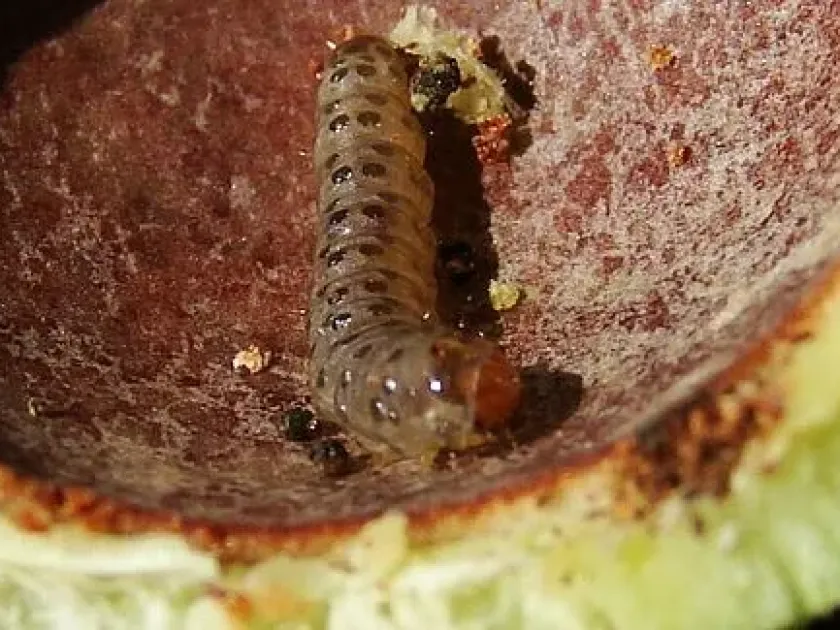
The larvae progress through several instars. Early stages are translucent or pale, while later instars turn a distinctive reddish-pink color, often with a darkened head capsule.
Eggs are laid individually or in small clusters directly on the surface of young nuts or developing flower spikes, ensuring immediate access to food upon hatching.
This species is well-adapted to the macadamia orchard environment, where it can complete multiple generations annually under favorable climatic conditions.
What it damages
The primary damage is caused by the larvae boring into the developing nut. They feed on the kernel, effectively destroying the marketable value of the product.
Beyond nut damage, larvae may also attack tender shoots and emerging inflorescences, which can stunt tree growth and reduce overall yield potential for the current season.
Entry holes made by the larvae serve as infection sites for secondary pathogens, such as fungi, which can lead to rapid decay of the entire nut cluster.
Infested nuts often drop prematurely from the tree. When inspected, these nuts appear hollowed out with the internal content replaced by larval frass.
High infestation levels can result in substantial economic losses, especially if monitoring and control measures are not implemented during the critical stages of nut development.
When it appears
The life cycle of Thaumatotibia batrachopa is heavily influenced by ambient temperatures, with development rates increasing significantly in warmer weather.
Generations tend to overlap, meaning that all life stages—from eggs to pupae—can often be found on the trees simultaneously during the peak growing season.
Adult moth activity typically peaks during the flowering and early nut-set stages, which corresponds to the period when the most vulnerable food sources are available.
During winter months or unfavorable conditions, the pest may survive as late-stage larvae hidden in protective sites such as old nut husks or bark crevices.
The total number of generations per year is dependent on the local climate, but the pest remains a constant threat throughout the productive growing period of the trees.
Signs of infestation
Small entry holes on the nut shell, often accompanied by reddish-brown frass on the exterior, are the most reliable visual indicators of a borer infestation.
Webbing found near the nut attachment point or along flower spikes can indicate the presence of larvae actively feeding in the vicinity.
Premature nut drop is a major sign that the tree is under heavy pressure from the Macadamia nut borer, as the internal feeding disrupts the nut's development.
Monitoring with synthetic sex pheromone traps is the standard industry method for detecting the arrival and population density of adult moths.
Internal examination of suspected nuts will reveal tunnels bored into the kernel, with the larva often located deep inside the damaged tissue.
Control measures
Integrated Pest Management (IPM) is essential for controlling this borer, focusing on early detection and a combination of cultural and biological strategies.
Pheromone traps serve as an early warning system, allowing growers to time insecticide applications precisely to the peak of egg-laying activity.
Cultural practices, such as the removal and destruction of fallen nuts and orchard sanitation, significantly reduce the carry-over population for the next season.
Biological control agents, including Bacillus thuringiensis and naturally occurring parasitoids, are preferred to maintain a balanced orchard ecosystem.
Chemical intervention should be restricted to periods of larval emergence, using selective products to minimize the impact on beneficial predators and pollinators.
Taxonomy
- Latin name
- Thaumatotibia batrachopa
- Order
- Lepidoptera (butterflies)
- Family
- Tortricidae
- EPPO code
- THATBA
Discussion
No discussions yet — be the first.