
Glover spider mite
Tetranychus gloveri
Description
How to identify
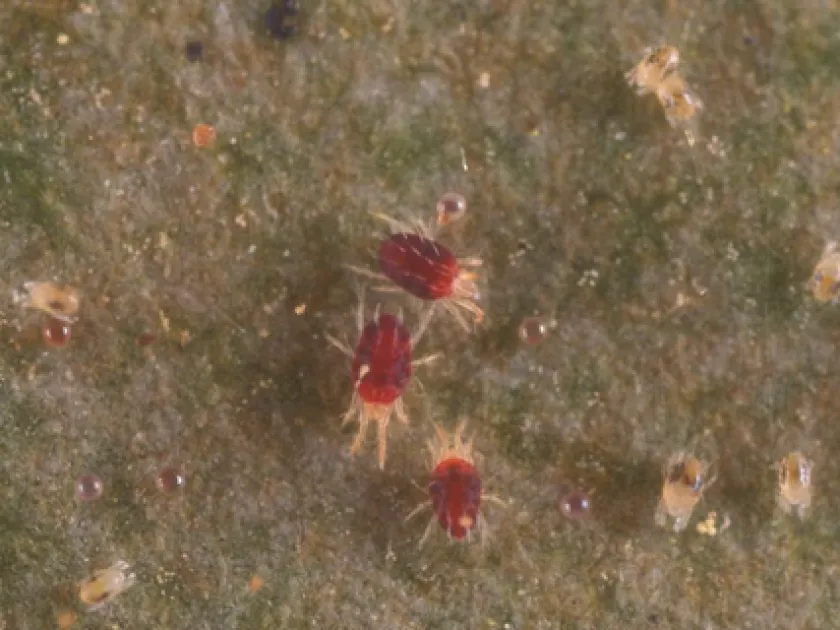
The Glover spider mite (Tetranychus gloveri) belongs to the family Tetranychidae within the order Trombidiformes. These mites are minute, with adult females measuring approximately 0.4–0.5 mm in length.
Their coloration typically ranges from pale yellow to greenish-brown, often featuring dark lateral spots caused by internal contents visible through the cuticle. Males are smaller and possess a more tapered posterior compared to females.
The developmental cycle comprises the egg, larva, protonymph, deutonymph, and adult stages. Under favorable temperatures of 25°C to 30°C, the lifecycle can be completed in just 7 to 10 days.
Females dominate the population and are highly prolific, laying up to 100 eggs during their lifespan, which allows for exponential population growth during warm, dry periods.
Fertilized females overwinter in soil, plant debris, or bark crevices, entering a state of diapause triggered by decreasing daylight and cooler temperatures.
What it damages
This species is a polyphagous pest, affecting a diverse range of agricultural and ornamental plants. It is particularly notorious for damaging citrus crops, cotton, and various greenhouse vegetables.
Mites feed by piercing the epidermal cells of leaves with their chelicerae, sucking out the sap. This activity leads to cell collapse, chlorophyll degradation, and impaired photosynthesis.
Young leaves and shoots are most vulnerable, serving as the primary sites of infestation. High mite densities cause severe foliage stress and can result in premature leaf drop.
The economic impact involves both yield loss and a significant reduction in produce quality. Furthermore, damaged plants show increased susceptibility to secondary viral and fungal infections.
In greenhouse settings, uncontrolled infestations can lead to total crop failure or a decrease in plant productivity by 30% to 50%, posing a serious threat to profitability.
Signs of infestation
The most distinctive sign of a Glover spider mite infestation is the presence of fine, silky webbing on the undersides of leaves, often accompanied by small, active moving dots.
Damage symptoms begin as tiny chlorotic spots (stippling) on the upper leaf surface where the mites have fed. Over time, these spots coalesce, causing the leaf to turn yellow or bronzed.
Severe infestations lead to widespread leaf necrosis, leaf curling, and eventual abscission. This significantly restricts the plant's ability to produce energy and maintain growth.
The presence of mite excrement and cast-off exuviae (molted skins) on the webbing gives the foliage a dusty or dirty appearance, which interferes with gas exchange and respiration.
As the infestation progresses, plants exhibit overall weakness, stunted development, and a faded, dull appearance, even when provided with adequate water and nutrients.
Control measures
Managing the Glover spider mite requires an integrated pest management (IPM) strategy that incorporates cultural, biological, and chemical control techniques.
Cultural practices include rigorous weed control, as many weeds act as alternative hosts, and thorough soil tillage to disrupt overwintering habitats in plant residues.
In greenhouses, maintaining appropriate humidity levels is crucial, as dry, arid conditions significantly accelerate the reproductive rate of Tetranychus gloveri.
Chemical control should be implemented using specific acaricides when infestation thresholds are exceeded. Rotating between chemical classes is essential to manage and prevent pesticide resistance.
Biological control utilizing predatory mites such as Phytoseiulus persimilis offers an effective and sustainable solution, particularly in protected agriculture where chemical use is restricted.
Taxonomy
- Latin name
- Tetranychus gloveri
- Order
- Mites
- Family
- Tetranychidae
- EPPO code
- TETRGL
Discussion
No discussions yet — be the first.