
Wheat stem sawfly
Tetramesa tritici
Description
How to identify
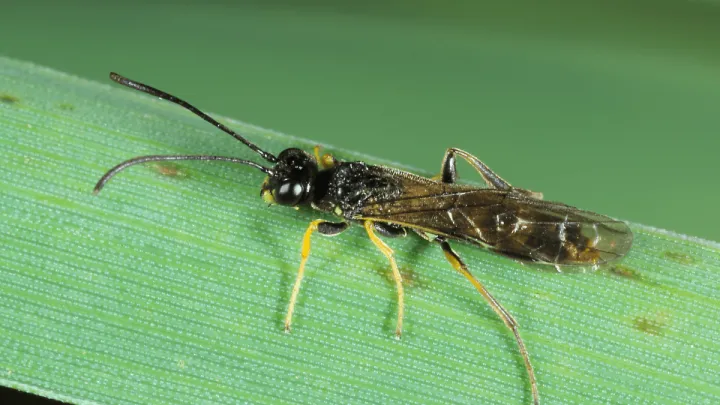
The wheat stem sawfly is a small Hymenopteran insect belonging to the family Eurytomidae. Adult insects are roughly 3-4 millimeters long with a black body and transparent, veined wings.
Their biology is uniquely adapted to cereal production, as females possess a specialized ovipositor designed to pierce plant tissues and deposit eggs securely inside the stem.
Larvae are legless, yellowish-white, and possess a well-defined head. They are obligate stem-borers, meaning their entire larval development occurs within the protected environment of the straw.
The life cycle encompasses four distinct stages: egg, larva, pupa, and adult. There is typically one generation per year, with the larvae overwintering inside the base of the stem.
Adults emerge in the spring, coinciding with the jointing stage of wheat, and are highly active during warm, sunny weather, which facilitates widespread infestation of fields.
What it damages
The primary hosts for this pest include bread wheat and durum wheat, although infestations can occasionally occur in barley and other small grains if conditions are favorable.
Larvae feed by consuming internal stem tissues, which disrupts the transport of water and nutrients, ultimately hindering the development of the grain head.
Stems damaged by larval feeding become structurally weak and brittle, leading to premature lodging, which causes significant harvest losses.
In addition to direct yield reduction, the feeding process creates entry points for fungal pathogens, which can lower the overall quality and safety of the harvested grain.
High infestation levels can result in substantial economic damage, as affected plants produce smaller, shriveled kernels that weigh significantly less than those of healthy plants.
When it appears
Adult emergence typically begins in late spring, following the onset of warmer temperatures, and lasts for several weeks, covering the critical growth stages of wheat.
The peak period of activity corresponds with the heading stage of the crop, as females search for suitable stems to ensure the survival and food supply of their offspring.
Throughout the summer, larvae continue to feed and grow within the straw, eventually preparing for the transition into the pupal stage near the base of the plant.
Pupation occurs within the wheat stubble remaining after harvest, allowing the insect to survive in a dormant state through the hot summer and the upcoming autumn.
Larvae remain in diapause through the winter months, protected from severe cold by the residual straw and soil, until the cycle begins again in the following spring.
Signs of infestation
One of the primary indicators of infestation is the presence of small exit holes in the lower stem, created by adults when they emerge from the plant.
Plants often exhibit stunted growth, yellowing foliage, or premature ripening, which stands out in a field of otherwise healthy, green crops.
A closer inspection of the interior of the stem will reveal larval galleries filled with frass, indicating that the internal tissues have been compromised.
Lodging or broken stems in the field, which occur without obvious wind or rain damage, are strong indicators of a serious infestation of stem sawflies.
Harvested grain quality analysis often shows a decrease in the thousand-kernel weight, which is a latent but critical sign of widespread infestation.
Control measures
Deep plowing in the autumn is the most effective mechanical control method, as it buries the stubble and kills the overwintering larvae residing in the base of the stems.
Crop rotation remains a fundamental strategy, as planting non-host crops interrupts the life cycle and prevents the build-up of local pest populations.
- Planting resistant wheat varieties with thicker, stronger stems.
- Eliminating volunteer wheat and weeds that may harbor the pest.
- Early harvesting to prevent losses associated with lodging.
While chemical control is difficult due to the insect's internal feeding habits, systemic insecticides can be applied during peak adult flight if thresholds are met.
Integrated pest management, combining cultural practices with monitoring, is essential to minimize the reliance on chemicals and ensure long-term sustainability.
Taxonomy
- Latin name
- Tetramesa tritici
- Order
- Hymenoptera
- Family
- Eurytomidae
- EPPO code
- HAROTR
Discussion
No discussions yet — be the first.