
Long-horned wheat jointworm
Tetramesa longicornis
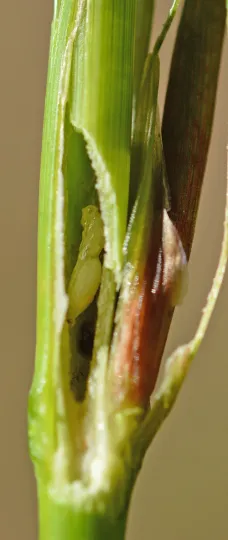
Description
How to identify
The long-horned wheat jointworm (Tetramesa longicornis) belongs to the Eurytomidae family of the Hymenoptera order. These are small, dark-colored chalcid wasps, typically measuring 3–4 mm in length.
The name comes from their notably long antennae. These insects have a slender, shiny body and translucent wings with a characteristic venation pattern typical for the family.
The larvae are legless, white to cream-colored, and possess a well-defined head. They spend their entire developmental cycle concealed within the stalks of cereal plants.
They overwinter as larvae inside the stubble or stems left in the field after harvest, which provides a protected environment against winter weather conditions.
In spring, the larvae pupate within the stems. Upon maturation, the adults chew through the outer wall of the stalk to emerge, leaving behind visible small circular holes.
What it damages
The pest primarily targets small grain cereals, including winter and spring wheat, as well as barley. Occasionally, it may also infest wild grass species.
The larvae feed on the internal tissues of the stem, effectively disrupting the vascular supply of nutrients to the head. This leads to impaired grain filling and general plant stress.
High infestation levels result in significant yield losses and poor grain quality. The damaged plants often exhibit reduced vigor and are prone to lodging.
The disruption of the vascular bundles prevents the translocation of carbohydrates, causing the upper part of the stem to die prematurely or form shriveled kernels.
Because the larvae reside inside the stalk, the damage is often not apparent until the later stages of crop development, making early detection a challenge for producers.
When it appears
Adult emergence typically occurs in late spring or early summer, corresponding with the stem elongation stage of the cereal crop, which is the most critical time for infestation.
There is usually one generation per year. However, the life cycle is strictly synchronized with the phenological development stages of the host plants.
During the summer months, the larvae complete their development within the stalks. As the crop matures, the larvae enter a period of diapause, remaining dormant through the harvest.
The pest is highly sensitive to humidity and temperature, which dictate the speed of development and the timing of emergence for the next generation.
Synchronization of the adult flight with the vulnerable developmental stages of wheat is the key factor enabling the pest to establish itself in crop fields.
Signs of infestation
Identifying an infestation of Tetramesa longicornis is difficult due to its internal feeding habit. Most symptoms appear after significant damage has already occurred.
The presence of tiny circular exit holes on the stems is the most reliable indicator that the pests have completed their life cycle and emerged.
- Premature yellowing or discoloration of the stems before natural ripening.
- Deformed, stunted, or empty heads within a field.
- Lodging of stems due to internal structural damage caused by larval feeding.
- Low test weight and shriveled grain following the harvest.
A physical inspection of the stalks, by splitting them open, often reveals the presence of larval chambers or the larvae themselves, confirming the infestation.
Control measures
Management of the wheat jointworm relies heavily on cultural practices, as chemical control is difficult once the larvae have entered the stem.
Deep plowing of stubble immediately after harvest is a primary control method, as it buries the overwintering larvae, preventing adult emergence in the following season.
Implementing effective crop rotation, specifically avoiding continuous wheat or barley planting, helps break the pest's life cycle and reduces population levels.
Selecting early-maturing wheat varieties or adjusting sowing dates can sometimes help the crop reach a less susceptible developmental stage before the peak adult flight.
If population densities exceed economic thresholds, systemic insecticides applied during the early stem elongation phase can target adults before they lay eggs on the healthy stems.
Taxonomy
- Latin name
- Tetramesa longicornis
- Order
- Hymenoptera
- Family
- Eurytomidae
- EPPO code
- HARODE
Discussion
No discussions yet — be the first.