
Tetramesa calamagrostidis
Tetramesa calamagrostidis
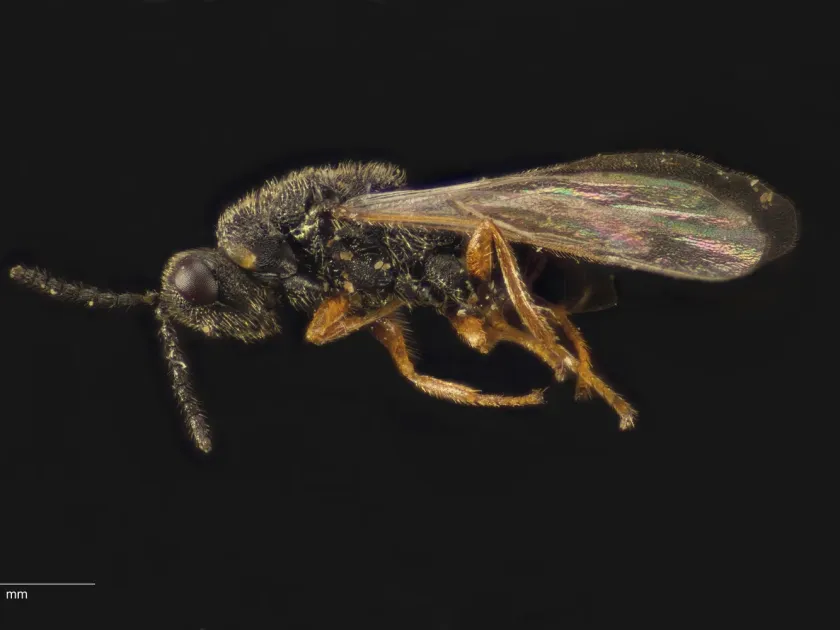
Description
How to identify
Tetramesa calamagrostidis belongs to the order Hymenoptera, family Eurytomidae. These are tiny insects, resembling miniature wasps, whose larvae live a concealed lifestyle inside the stems of grasses and cereal crops.
The adult insect has a slender black body, usually 3–5 millimeters in length. Its wings are transparent with distinct venation, which is characteristic of this family of parasitic hymenopterans.
The larva is legless and slightly curved, with a white or yellowish color and a well-defined head capsule. Throughout its entire developmental cycle, it remains hidden within the plant tissues, making early detection difficult.
The life cycle is closely linked to the phenology of grasses and cereals. The insect passes through egg, larval, pupal, and adult stages, with the pest typically overwintering as a larva inside the damaged stem.
Field diagnosis is often difficult due to the cryptic nature of the damage. Specialists use sweep nets during the adult flight period to monitor population peaks in the field.
What it damages
The primary hosts for this species are wild grasses, particularly Calamagrostis species, but the pest can migrate to cultivated cereals. It poses a significant risk to wheat and other small grain crops.
Larvae feed on the internal tissues of the stem, consuming parenchyma and damaging vascular bundles. This disrupts the transport of water and nutrients from the roots to the head, leading to physiological distress.
Infested plants often show stunted growth and a sickly appearance. In areas where larvae are localized, characteristic swellings or deformations may occur on the stems, making plants prone to lodging.
Damage results in underdeveloped heads, reduced grain weight, and overall yield losses. In cases of high infestation, the economic impact on cereal production can be significant.
Beyond direct damage, stem perforations create entry points for various pathogens, including fungi and bacteria, further degrading the crop's health and lowering overall grain quality.
When it appears
The flight of adult Tetramesa usually coincides with the active stem-elongation phase of host plants. In temperate climates, this occurs from late spring to early summer, when conditions are optimal for adult emergence.
Females lay eggs directly into the tissues of the developing stem, targeting the most succulent sections. This process is weather-dependent, influenced by humidity and average daily temperatures.
Larval development continues throughout the growing season. As the grain matures, larvae finish feeding and prepare to enter diapause, overwintering within the plant debris.
The number of generations per year can vary by climate, though one full generation is most common. A cold spring may delay emergence, shifting the timing of the pest's life cycle.
Monitoring during the jointing stage is critical. At this time, plants are most vulnerable to egg-laying, requiring close attention from agronomists to manage the risk of infestation.
Signs of infestation
The first sign of infestation is the presence of deformed or twisted stems that fail to hold the head upright. Such plants often stand out visually due to their stunted development compared to healthy neighbors.
Close inspection of stems may reveal small exit holes gnawed by adults during emergence. These holes are typically located near the nodes or within the internodes of the stem.
Cutting the stem longitudinally allows for the discovery of the larval chamber or the white larva itself. Tissues inside the stem near the feeding site often appear hollowed or show necrotic signs.
Strong infestations result in uneven ripening across the field. Some heads may remain white or wither prematurely due to disrupted nutrient flow caused by stem damage.
The presence of wild grasses near fields facilitates population buildup. If wild Calamagrostis grows in proximity to cereal fields, the probability of crop infestation increases significantly.
Control measures
Effective management relies on strict adherence to agronomic practices designed to interrupt the pest's life cycle and reduce field populations.
- Deep autumn plowing of stubble to destroy larval overwintering sites.
- Removal of grassy weeds from field margins, especially wild hosts.
- Crop rotation to avoid continuous monocropping of cereals.
- Selection of resistant cereal varieties.
- Spatial isolation of crops from infested perennial grass areas.
Chemical control is challenging because larvae are protected inside the stem, rendering contact insecticides ineffective. Foliar sprays are only useful during the peak adult flight period, before egg-laying begins.
Using yellow sticky traps helps monitor adult flight, allowing for timely application of protective measures. Determining the optimal timing for intervention is essential to prevent mass infestation.
An integrated pest management (IPM) approach, combining agronomic practices with targeted systemic insecticide application, provides the best results for controlling this concealed pest in commercial farming.
Taxonomy
- Latin name
- Tetramesa calamagrostidis
- Order
- Hymenoptera
- Family
- Eurytomidae
- EPPO code
- HAROCA
Discussion
No discussions yet — be the first.