
Pine webworm
Tetralopha robustella
Description
How to identify
The pine webworm (Tetralopha robustella) is a moth belonging to the Pyralidae family. The adult moth has a wingspan of approximately 20–25 mm, with greyish or brown forewings featuring subtle darker markings that provide camouflage on pine bark.
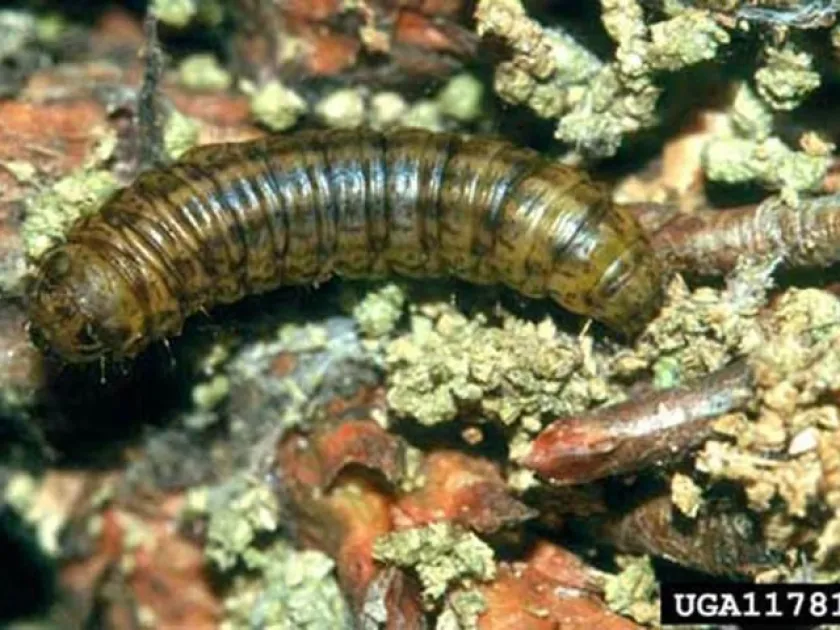
The larvae, or caterpillars, progress through several instars, changing color from light brown to a darker tone with prominent longitudinal stripes. Their bodies are covered with sparse hairs, helping them remain anchored within their nests.
Pupation typically occurs in a tough cocoon located in the soil or leaf litter beneath the host tree. This pupal stage allows the insect to overwinter successfully during cold weather conditions.
The life cycle is univoltine, meaning one generation per year. Moths emerge during the summer months, and females deposit eggs on the needles or young shoots of pine trees.
This species is highly specific to the genus Pinus. Its biological development is strictly synchronized with the growth of pine needles, which serve as the sole food source for the larvae.
What it damages
The pine webworm primarily infests young pine trees and seedlings in nurseries. It favors species such as Scots pine (Pinus sylvestris), although it can inhabit various other pine species.
The caterpillars create characteristic webs that incorporate pine needles, feces, and debris. Inside these nests, larvae feed on the needles by clipping them off at the base.
Heavy infestations can cause significant defoliation, particularly in the lower canopy of the tree. This reduces the photosynthetic capacity, which is vital for the survival and growth of young seedlings.
While mature trees can usually tolerate some level of defoliation, young seedlings may suffer stunted growth or even death if the infestation persists for several consecutive seasons.
Defoliated trees are also more susceptible to secondary infestations by bark beetles or wood-boring insects, further increasing the risk to forest plantations.
Signs of infestation
The most distinctive sign of infestation is the presence of webbed nests attached to the branches. These look like dense, brownish clumps made of needles, silk, and waste particles.
Yellowing and subsequent browning of needles in and around the webs indicate active feeding. If a nest is opened, one can usually find several larvae inside.
Significant amounts of frass (caterpillar excrement) accumulating in the webs and falling to the ground beneath the tree are clear indicators of a high infestation level.
During the flight period, adult moths can be observed near young plantations at dusk, as they are primarily nocturnal or crepuscular insects.
Early visual inspection of seedlings in nurseries is crucial to detect these nests before they become widespread and damage the apical buds of the young trees.
Control measures
For small-scale infestations or individual garden trees, mechanical removal of the webs by hand is a simple and effective control measure.
Biological control using formulations of Bacillus thuringiensis is highly recommended, as it selectively targets the larvae while sparing beneficial predatory insects.
Chemical control using systemic or contact insecticides is effective if applied during the early larval stages, before the protective web nests are fully established.
Good silvicultural practices, such as choosing appropriate planting sites and ensuring healthy tree vigor, can help mitigate the impact of the pest on young stands.
The use of pheromone traps for monitoring is recommended to determine the peak flight timing, ensuring that any necessary interventions are timed for maximum efficacy.
Taxonomy
- Latin name
- Tetralopha robustella
- Order
- Lepidoptera (butterflies)
- Family
- Pyralidae
- EPPO code
- TETPRO
Discussion
No discussions yet — be the first.