
Orange Tethya
Tethya aurantium
Description
How to identify
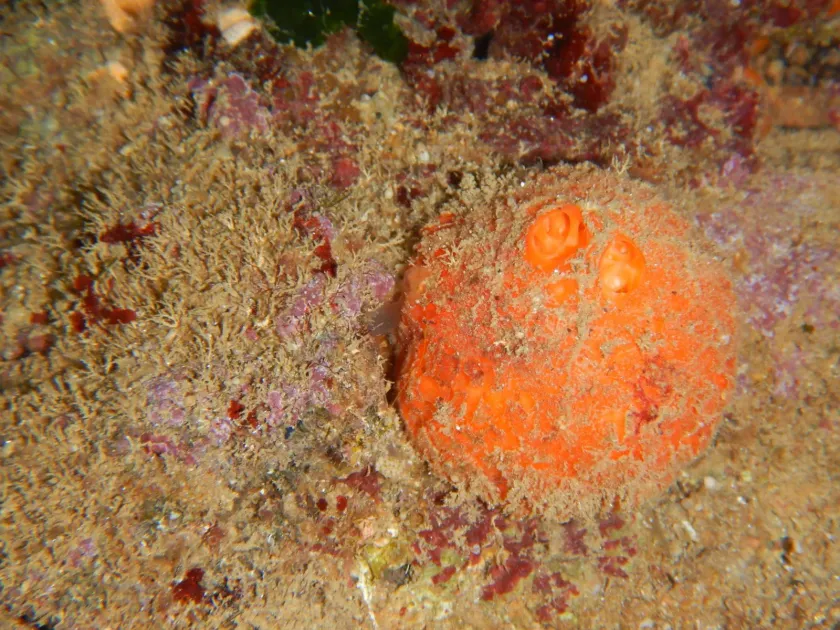
The orange tethya, scientifically known as Tethya aurantium, is a marine sponge belonging to the class Demospongiae. It is easily recognizable by its spherical body shape.
The surface of the sponge is characterized by numerous tubercles, giving it a bumpy texture that resembles the skin of an orange, hence its common name.
Its coloration ranges from vibrant orange to deep red. This pigmentation is a natural adaptation often associated with the depth and environment where it grows.
Internally, the structure is supported by a rigid framework of spicules. These skeletal elements provide the necessary stiffness for the sponge to maintain its shape.
It typically inhabits rocky substrates in coastal areas, where it filters seawater to obtain its nutrients. It is a stationary organism common in marine benthic communities.
What it damages
The orange tethya is not a pest of plants or agricultural crops. It is a marine organism and poses no threat to terrestrial vegetation or farming.
There are no recorded instances of this sponge damaging crops. It thrives only in high-salinity environments, making any interaction with agricultural soil or freshwater impossible.
The biological nature of Tethya aurantium is that of a filter feeder. It consumes organic particles suspended in seawater rather than plant tissues or sap.
The organism does not produce toxins or enzymes that could affect plant physiology. Therefore, it is completely harmless to any agricultural production system.
Misclassification of this marine animal as a pest usually stems from inaccurate naming conventions or confusion with terrestrial pathogenic fungi or insects.
Control measures
No pest control measures are required for the orange tethya in an agricultural context, as it does not interact with plants or soil-based farming systems.
If marine water is utilized in industrial or experimental aquaculture systems, standard physical filtration is sufficient to prevent sponge accumulation.
The use of pesticides or chemical controls against this marine organism is unnecessary and harmful to the delicate balance of aquatic ecosystems.
Proper maintenance of water intake systems, including the use of fine-mesh screens, is the only measure required to keep irrigation or process lines clear of debris.
In conclusion, the orange tethya is an ecologically significant marine species that requires no management or eradication efforts within the agricultural industry.
Taxonomy
- Latin name
- Tethya aurantium
- Family
- Tethyidae
- EPPO code
- TTHYAU
Discussion
No discussions yet — be the first.