
Beet stem weevil
Temnorhinus mendicus
Description
How to identify
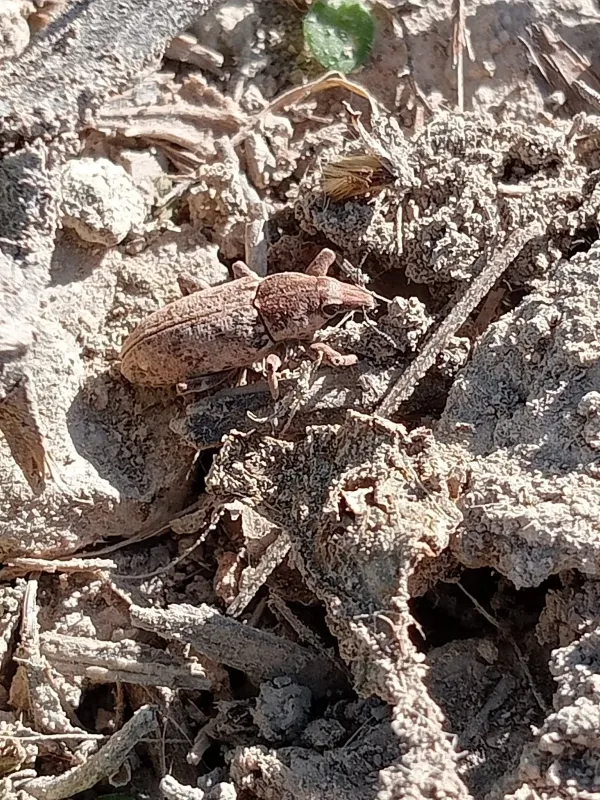
The adult beetle ranges from 8 to 12 mm in length, with a coloration varying from grey to brownish-grey. It is characterized by a long, slightly curved rostrum and a robust body covered in tiny scales.
Systematically, this insect belongs to the order Coleoptera and the family Curculionidae. The larvae are legless, slightly curved, white in color with a dark brown head capsule.
Adults typically overwinter in the soil or under plant debris at depths of up to 15 cm. They emerge in the spring when soil temperatures reach approximately 8–10 degrees Celsius.
Adult beetles are capable of active flight, which allows them to quickly migrate to new sugar beet fields in search of suitable food sources and breeding grounds.
Mating occurs in the spring, after which females deposit eggs into incisions made in the stems or leaf stalks of host plants to ensure the larvae have immediate access to food.
What it damages
The primary hosts for this pest are plants in the Chenopodiaceae family, with sugar, fodder, and red beet being the most susceptible crops affected by the larvae.
Adult beetles cause damage to foliage by consuming leaf edges or creating holes, which reduces the total leaf area available for photosynthesis and weakens the plant.
Larvae are considered the most destructive stage as they bore into stems and leaf stalks, creating tunnels that disrupt the flow of nutrients and water within the plant.
Feeding galleries created by larvae often serve as entry points for secondary fungal and bacterial infections, leading to tissue decay and plant structural failure.
Heavy infestations result in stunted plant growth, wilting, reduced sugar content in roots, and significant overall yield losses for commercial sugar beet producers.
When it appears
The emergence of overwintered beetles typically coincides with the seedling stage of sugar beets, placing young plants at the highest risk of severe damage.
Peak activity for adult beetles occurs throughout May and early June, marking the period of intensive feeding and egg-laying on the developing crop.
Larval development within the plant tissues lasts several weeks, followed by pupation, which usually takes place within the damaged stem or in the nearby soil.
A new generation of adult beetles emerges in late summer, and they may continue feeding for a short period before seeking overwintering sites for the cold season.
Field scouting should commence as soon as the first leaves appear, as early detection is critical to preventing the population from reaching economically damaging levels.
Signs of infestation
Initial signs of infestation include irregular notches along the leaf margins, which are easily visible during regular field inspections performed in the early morning.
Internal damage caused by larvae is indicated by the yellowing and wilting of affected leaves, which eventually collapse or droop toward the ground.
Close examination of the base of the plant often reveals small entrance holes created by the females, surrounded by slightly discolored or necrotic plant tissue.
Stunted growth patterns and poor plant vigor compared to the rest of the field are classic indicators that larvae have successfully colonized the stem tissues.
The use of a shake-down method over a white collection tray is recommended to accurately estimate the density of the adult beetle population in the crop.
Control measures
Agronomic control practices include deep autumn plowing to disturb overwintering sites and strict crop rotation to move host plants away from previously infested fields.
Controlling weeds within the Chenopodiaceae family is essential, as these serve as alternative hosts and reservoirs for the pest population before beet seedlings emerge.
Chemical control should be initiated once the economic threshold is met, typically ranging from 0.5 to 1 adult beetle per square meter of crop area.
It is advised to use systemic or contact insecticides, ensuring thorough coverage and rotating active ingredients to prevent the development of pesticide resistance.
Applications are most effective during dawn or dusk when the beetles are most active on the foliage, significantly increasing the probability of direct contact with the product.
Taxonomy
- Latin name
- Temnorhinus mendicus
- Order
- Coleoptera (beetles)
- Family
- Curculionidae
- EPPO code
- CLEOMN
Discussion
No discussions yet — be the first.