
Telenomus
Telenomus usipetes
Description
How to identify
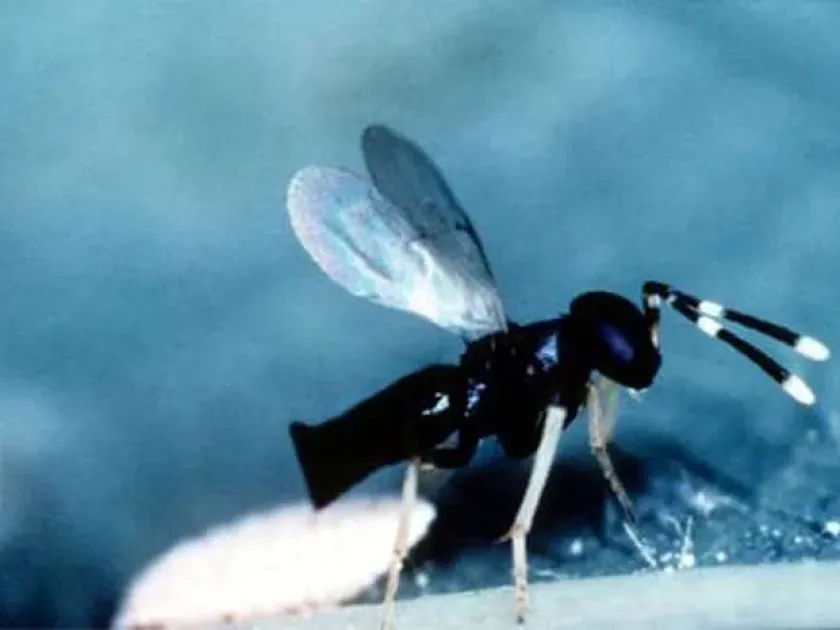
Telenomus (lat. Telenomus usipetes) is a genus of minute insects in the order Hymenoptera, belonging to the family Platygastridae. These tiny parasitoid wasps typically measure between 1 to 1.5 mm in length, making them extremely difficult to spot without specialized equipment or microscopic analysis.
A defining characteristic of these insects is their specialized life cycle as egg parasitoids. Adult wasps possess well-developed wings, allowing them to actively search for host insect egg clusters. Their bodies are typically dark, often with a slight metallic sheen, and are compactly built to navigate through dense vegetation or narrow crevices in plant bark.
It is crucial to note that in agronomy, classifying Telenomus as a "pest" is often context-dependent. Many species within this genus are highly beneficial entomophages used in integrated pest management (IPM). However, in specific agroecosystems, the mass reproduction of certain species might disrupt biological balance, necessitating careful monitoring.
The life cycle of Telenomus involves complete metamorphosis: egg, larva, pupa, and adult. The entire development process, from the parasitoid laying an egg inside the host egg to the emergence of the adult, occurs entirely within the host substrate. This hidden existence makes them elusive inhabitants of agroecosystems.
Species identification requires microscopic examination, as morphological markers such as wing venation and antennal structure are highly variable. In field practice, identification is often achieved by collecting host egg masses and incubating them in controlled conditions to observe the emerging adult parasitoids.
What it damages
Telenomus wasps are obligate entomophages, meaning their survival is inextricably linked to using the eggs of other insects as a food source for their offspring. They parasitize the eggs of various Lepidoptera and Hemiptera, which are common pests of many field and horticultural crops.
The host range includes numerous agricultural pests. When a host egg is parasitized, the developing pest embryo dies, effectively positioning Telenomus as a beneficial biological control agent rather than a direct pest of the crop itself.
However, in certain ecological niches, Telenomus might attack the eggs of beneficial insects or other natural enemies, which can indirectly reduce the efficiency of natural pest regulation. This "secondary damage" occurs when the parasitoid reduces the population of the crop's natural protectors.
The extent of their impact on the agroecosystem depends directly on host density. If the Telenomus targets a major pest, its activity is highly beneficial to the grower. Conversely, if it targets beneficial fauna, a risk assessment regarding biological equilibrium is required to ensure sustainable crop management.
The scale of their influence depends on the synchronization between the wasp's life cycle and the host. If the mass emergence of Telenomus coincides with the oviposition period of major pests, biological suppression can reach 80-90%, serving as a powerful tool in sustainable agriculture.
When it appears
Telenomus activity is strictly tied to temperature regimes and the availability of suitable host eggs in the field. The first individuals emerge in early spring once temperatures stabilize, coinciding with the flight of the first generations of lepidopteran pests.
Throughout the growing season, Telenomus can produce multiple generations, as the developmental cycle of a single generation often lasts only two to three weeks. This allows the parasitoid to rapidly increase its population in response to spikes in host numbers, providing natural control.
In the autumn, as average daily temperatures drop, development slows, and the wasps enter a state of diapause. They typically overwinter inside host eggs or within plant debris, waiting for environmental conditions to become favorable again the following season.
Monitoring seasonal dynamics involves using sticky traps and pheromone lures to record flight peaks. Agronomists use this data to decide if and when to perform insecticide applications, ensuring these treatments do not inadvertently destroy beneficial parasitoid populations.
The maximum efficiency of parasitism is observed during periods of high humidity and moderate temperatures. Under conditions of extreme drought or excessive heat, adult activity drops sharply, leading to a temporary decline in the natural control of pest populations.
Signs of infestation
The primary sign of Telenomus presence in the field is a change in the color of the host egg clusters. Parasitized eggs gradually darken, turning a characteristic gray or black, which distinguishes them from healthy eggs that retain their natural coloration.
Under detailed inspection, one can find tiny, round exit holes on the surface of the eggs. These are created by adult wasps as they emerge from the host egg. Because these holes are extremely small, a magnifying glass or microscope is often required for field diagnostics.
Another indicator is a reduction in the hatching rate of pest larvae. If, upon dissecting the egg masses, one finds empty shells containing remnants of the parasitoid larva’s activity, it confirms that Telenomus is actively working in the plot.
An indirect sign of wasp activity is reduced damage to leaves or fruits, despite the presence of initial pest egg clusters. This occurs because the majority of eggs in a cluster are often sterilized by the parasitoid before the pest larvae have a chance to hatch and begin feeding.
Laboratory diagnosis involves collecting egg samples and placing them in incubators. The subsequent emergence of Telenomus adults is 100% confirmation of the successful functioning of the parasitoid population within the study area.
Control measures
The main strategy for "controlling" (or fostering) Telenomus is to maintain the ecological framework of the fields. Avoiding broad-spectrum chemical insecticide applications allows the population of these beneficial wasps to flourish during their peak activity periods.
When pesticide use is necessary, preference should be given to selective products that act specifically on pests without harming entomophages. The timing of treatments should be carefully planned to minimize contact between the parasitoid and the toxicant.
Creating buffer strips of nectar-producing plants along field edges helps attract and sustain adult Telenomus populations. Adults require supplemental carbohydrate intake (nectar), which significantly extends their lifespan and increases their fecundity.
Agronomic practices such as conservation tillage and leaving a portion of crop residues in the field help Telenomus successfully overwinter. Burning crop residues destroys overwintering sites, leading to a sharp decline in the parasitoid population in the following year.
For large-scale industrial management, augmentation methods can be used. This involves rearing host cultures in laboratories, infecting them with Telenomus, and releasing the wasps into fields during peak pest egg-laying periods to enhance natural suppression effects.
Taxonomy
- Latin name
- Telenomus usipetes
- Order
- Hymenoptera
- Family
- Scelionidae
- EPPO code
- TELNUS
Discussion
No discussions yet — be the first.