
Telenomus truncatus
Telenomus truncatus
Description
How to identify
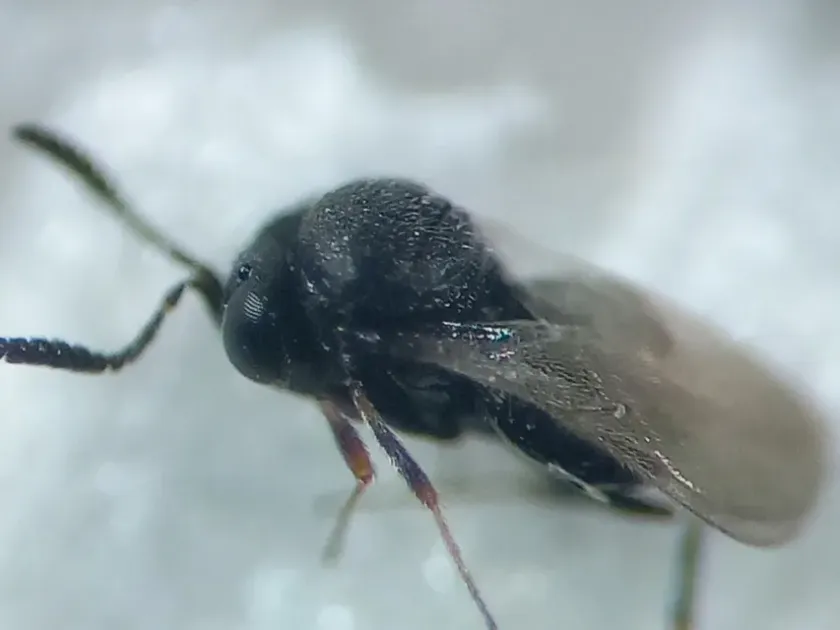
Telenomus truncatus is a species of tiny parasitic wasps belonging to the family Scelionidae, order Hymenoptera. Despite their small size—usually under 1 mm—these insects are highly significant due to their role as effective egg parasitoids of various pest insects.
The adult wasps are typically black or dark brown in color. Their morphology includes characteristic antennae with a clubbed tip, especially in females, which is a key identification feature under high-magnification observation.
These wasps lead a secretive life cycle closely tied to the eggs of their host. They use sophisticated chemical sensors to locate host egg masses laid on leaves or stems of host plants.
Once a host egg is found, the female inserts her own egg inside. The parasitoid larva develops within the host egg, consuming the contents and effectively killing the developing embryo of the pest before it can hatch.
After completing its development, the parasitoid pupates inside the hollowed-out host eggshell and emerges as an adult through a characteristic, precisely circular exit hole.
What it damages
Telenomus truncatus does not cause damage to crops directly, as it is not a phytophagous species. In fact, it is considered a beneficial insect in agriculture, serving as a biological agent for controlling populations of various pests, primarily bugs (Pentatomidae family).
By parasitizing pest eggs, these wasps prevent larvae from hatching and damaging agricultural crops such as cereals, vegetables, and fruit trees. Their activity helps suppress pest outbreaks naturally.
However, from an agronomic standpoint, the "harm" associated with this species can occur if pesticide use disrupts the population balance. When broad-spectrum insecticides are applied, these beneficial parasitoids are often killed, leading to secondary outbreaks of pests.
Farmers must weigh the benefits of biological control against the necessity of chemical treatments. Preserving these parasitoids often reduces the need for frequent and expensive pesticide applications.
Consequently, the presence of Telenomus truncatus is a positive indicator of a healthy and balanced agro-ecosystem capable of providing self-regulation of insect pest populations.
When it appears
The seasonal activity of Telenomus truncatus is temperature-dependent. Adults typically emerge in the spring once temperatures are consistently warm enough to support flight and searching behaviors.
Multiple generations can occur throughout the growing season. The speed of the life cycle is highly sensitive to ambient temperature; warmer conditions facilitate shorter generation times and faster population growth.
Activity peaks during mid-summer, coinciding with the main egg-laying periods of host pest species. This is when the parasitoid provides the most significant reduction in pest density.
As autumn approaches, activity declines. Adults move into sheltered environments, such as leaf litter, bark crevices, or the upper soil layer, to prepare for winter hibernation.
The success of the population for the following year depends on the availability of these overwintering sites, where fertilized females wait for the return of favorable spring weather.
Signs of infestation
The most visible sign of Telenomus truncatus activity is the appearance of parasitized egg masses. These eggs often change color, turning dark or black compared to the lighter, unparasitized eggs of the pest.
Close inspection will reveal tiny, circular exit holes on the surface of the eggshells. These holes are the definitive exit path of the adult wasp after completing its metamorphosis inside the host egg.
If the eggshell is dissected under a microscope, one might find the remains of the parasitoid’s pupa or frass, indicating that the egg was successfully colonized and the pest embryo was destroyed.
A reduction in the number of larvae observed in the field, despite the presence of egg masses, is a strong indicator of successful biological control by the parasitoids.
Monitoring these egg masses during the season allows growers to estimate the level of natural parasitism and make informed decisions about whether chemical intervention is actually necessary.
Control measures
Conservation of Telenomus truncatus is the primary strategy for managing this species, as it is a beneficial insect. Agronomists aim to protect its population rather than eradicate it.
Key practices include reducing the frequency and scope of chemical pesticide applications, particularly during the peak activity months of the parasitoid, to avoid unnecessary mortality.
Implementing ecological infrastructure, such as planting flowering margins and hedgerows, provides nectar sources and shelter, which supports the longevity and fecundity of the adult wasps.
Choosing selective bio-pesticides that are safe for Hymenoptera is crucial when chemical intervention against specific pests cannot be avoided entirely.
Finally, keeping soil tillage minimal and preserving field borders provides safe overwintering sites, ensuring that the parasitoid population remains robust across agricultural landscapes.
Taxonomy
- Latin name
- Telenomus truncatus
- Order
- Hymenoptera
- Family
- Scelionidae
- EPPO code
- TELNTR
Discussion
No discussions yet — be the first.