
Telenomus
Telenomus tetratomus
Description
How to identify
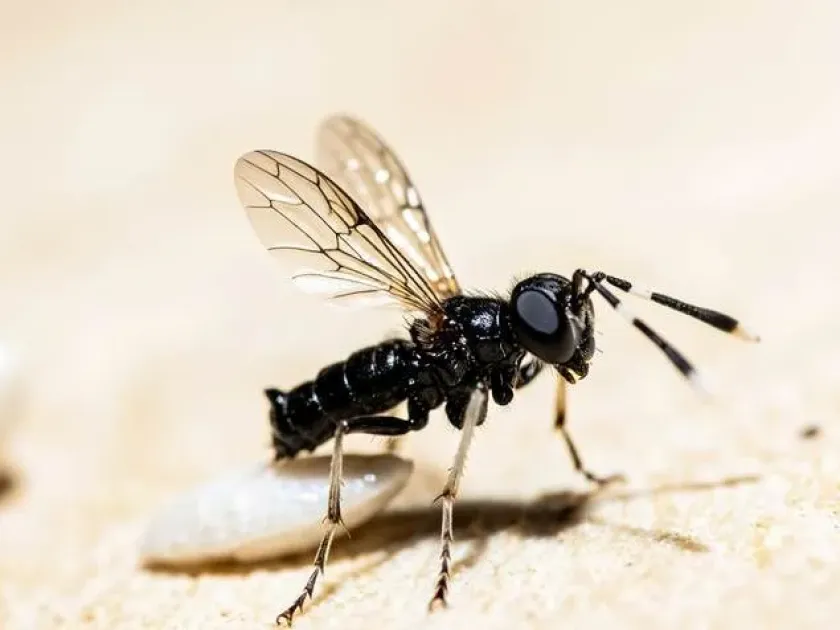
Telenomus tetratomus belongs to the order Hymenoptera and the family Platygastridae. These are microscopic parasitic wasps with a body length that typically does not exceed 1 millimeter.
Externally, adults possess a compact, dark body with distinct wing venation characteristic of the genus Telenomus. The head and thorax are robustly developed, and the antennae consist of several segments, enabling them to locate host eggs effectively.
The development of the insect occurs entirely within the host egg, making larval detection by the naked eye virtually impossible without specialized equipment.
The biology of this species is closely linked to parasitism on the eggs of various insects, particularly those affecting forest and agricultural crops.
To identify the species in field conditions, entomologists utilize pheromone traps or conduct systematic collections for subsequent microscopic examination.
What it damages
Although Telenomus species are often described as beneficial entomophages that regulate pest populations, mass outbreaks or ecosystem imbalances can sometimes affect other beneficial insect populations.
Their primary biological activity involves parasitizing the eggs of pests such as the gold-tail moth or the gypsy moth, making them a crucial link in regulating Lepidoptera populations.
The insect does not directly damage plant tissues, as it is an egg parasitoid and does not feed on the vegetative parts of crops.
The economic significance of this species lies in its capacity to serve as an agent of biological control, suppressing the reproduction of dangerous pests in agricultural shelterbelts.
Indirectly, the pest affects yield only if the suppression of non-target beneficial insects or pollinators leads to outbreaks of other secondary pests.
When it appears
The activity of Telenomus tetratomus adults begins as the soil warms in spring, coinciding with the emergence of the first generation of hosts from diapause.
The peak density of the parasite usually aligns with the massive egg-laying period of target pest species on the leaves and branches of cultivated plants.
Multiple generations of the wasp can develop throughout the summer season, ensuring continuous regulation of host populations.
With the onset of autumn cold, the adults of the final generation enter diapause, surviving adverse conditions in the soil or under bark.
Environmental factors, such as high humidity and moderate temperatures, are critical for the successful completion of the lifecycle of this entomophage.
Signs of infestation
The primary sign of host egg infestation by Telenomus is the darkening or alteration of the natural coloration of the host egg clusters.
Upon close inspection, microscopic circular exit holes can be seen on the egg surface, through which the adult wasp emerges after completing its development cycle.
The absence of mass caterpillar hatching from eggs previously laid by pests serves as an indirect indicator of parasite activity.
A reduction in the percentage of leaf damage by caterpillars in areas with a high density of Telenomus indicates its effective role as a natural enemy.
When surveying trees and shrubs, one should pay attention to the integrity of egg clusters, which appear "hollowed out" from the inside.
Control measures
The use of broad-spectrum insecticides is highly discouraged, as they destroy natural populations of Telenomus, which often leads to secondary pest outbreaks.
To preserve this entomophage in agroecosystems, it is recommended to use selective pesticides that are safe for beneficial Hymenoptera.
The creation of "buffer zones" with nectar-producing plants around fields promotes the attraction and reproduction of Telenomus adults, ensuring natural crop protection.
Agronomic practices aimed at limiting pest overwintering (such as bark cleaning or soil tilling) must be carried out with consideration for preserving habitats for beneficial fauna.
- Restriction of chemical pesticides during parasite activity periods
- Planting strips of nectariferous plants to support adult wasps
- Biological monitoring of host and parasite density
- Timely agronomic management of forest edges and shelterbelts
Taxonomy
- Latin name
- Telenomus tetratomus
- Order
- Hymenoptera
- Family
- Scelionidae
- EPPO code
- TELNVE
Discussion
No discussions yet — be the first.