
Telenomus remus
Telenomus remus
Description
How to identify
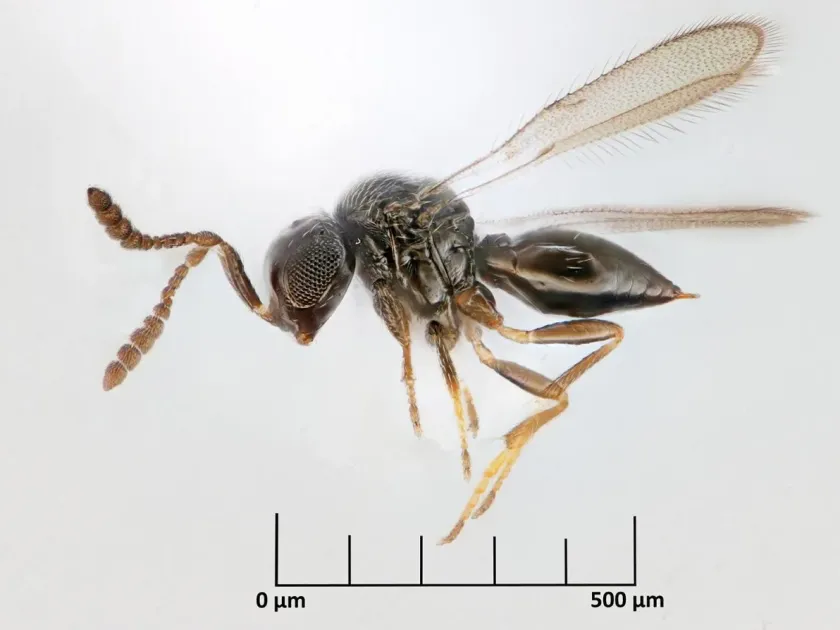
Telenomus remus is a minute parasitic wasp belonging to the order Hymenoptera and the family Scelionidae, specialized in parasitizing lepidopteran eggs.
The adult wasp is extremely small, typically measuring less than one millimeter in length, with a black body and inconspicuous wing venation.
Females are highly efficient at locating egg masses of host insects, using chemical cues emitted by the moth and the host plant itself.
The life cycle involves the wasp laying its own eggs inside the host's egg, where the larvae develop and consume the host's embryo.
This species is highly regarded in biocontrol for its rapid reproductive rate and ability to adapt to various climatic conditions, particularly in warmer regions.
What it damages
It is crucial to define Telenomus remus as a beneficial biological control agent rather than a crop pest, as it actively combats harmful insects.
It specifically targets eggs of the Noctuidae family, most notably the fall armyworm (Spodoptera frugiperda) and the cotton bollworm (Helicoverpa armigera).
By preventing the hatching of larvae, the parasitoid effectively protects crops like corn, cotton, soybeans, and various vegetables from severe defoliation.
Without the activity of this parasitoid, heavy infestations of armyworms can lead to significant yield losses and even complete crop destruction.
Integrating this wasp into farming practices minimizes the environmental footprint by reducing the need for broad-spectrum chemical pesticides.
When it appears
The activity and population growth of Telenomus remus are heavily influenced by temperature and the availability of suitable host eggs in the field.
Optimal development occurs at temperatures ranging between 25 and 30 degrees Celsius, facilitating a generation turnover every 10–12 days.
During the peak growing season, when moths are actively laying eggs, the population of Telenomus remus can grow exponentially if conditions are favorable.
In temperate climates, the species may struggle to survive winter, necessitating laboratory mass-rearing and seasonal augmentation releases.
Strategic timing of releases is vital to ensure the parasitoid population coincides with the onset of the pest's oviposition cycle.
Signs of infestation
The primary sign of Telenomus remus activity is the darkening of host egg masses, which turn from their natural color to a distinct black.
Instead of larvae emerging from the eggs, small holes indicate where the adult wasps have emerged after completing their development inside the host egg.
Field observers can confirm successful parasitism by collecting egg masses and observing the emergence of the wasps under laboratory or field conditions.
A significant reduction in the number of newly hatched larvae on crop leaves is a strong indicator that the parasitoid is effectively suppressing the pest population.
Quantitative assessments involve examining randomly sampled egg masses to determine the percentage of parasitism across the monitored area.
Control measures
Effective use of Telenomus remus involves inundative release strategies where mass-reared wasps are introduced into infested fields.
Farmers must strictly avoid using harmful chemical insecticides during the release period to protect the fragile parasitoid population from toxicity.
Successful implementation requires careful monitoring of pest population dynamics to sync wasp releases with the peak oviposition periods of moths.
Field margins and ecological corridors can be maintained to support the survival and dispersion of beneficial insects within the farming system.
Integrated Pest Management (IPM) programs rely on these wasps as a corner-stone of sustainable agriculture to maintain crop yields while promoting biodiversity.
Taxonomy
- Latin name
- Telenomus remus
- Order
- Hymenoptera
- Family
- Scelionidae
- EPPO code
- TELNRE
Discussion
No discussions yet — be the first.