
Telenomus
Telenomus phymatae
Description
How to identify
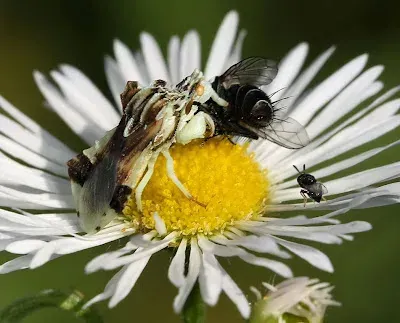
Telenomus phymatae is a minute parasitic wasp belonging to the order Hymenoptera and the family Scelionidae. These insects are known as egg parasitoids.
The adults are extremely small, typically measuring less than 1 mm in length, making them very difficult to observe without magnification equipment in the field.
They possess a dark, robust body with well-developed wings, typical of the family. Morphology identification often requires high-power microscopy to distinguish between species.
Their primary biological role is to locate the egg masses of specific hosts, which they parasitize by laying their own eggs directly into the host's eggs.
These wasps are highly specialized, having evolved to track down the chemical signatures or specific habitats of their target hosts to ensure reproductive success.
What it damages
This species does not cause direct physical damage to crops, as they do not feed on plant tissues, leaves, or roots at any stage of their life cycle.
The target hosts for Telenomus phymatae are primarily the eggs of ambush bugs (family Phymatidae), which are predatory insects found in many agricultural environments.
While the parasitoid is beneficial for controlling certain pest populations, it can also reduce the efficacy of predatory bugs that might be helping to control other pests.
They are found on a variety of crops where the host ambush bugs reside, including vegetables, grains, and perennial plants in the field.
Economic damage to the crops is nonexistent; the impact is purely ecological, affecting the intricate predator-prey dynamics within the local farm ecosystem.
When it appears
Activity begins in the spring, once temperatures rise enough to trigger the reproductive cycles of both the host ambush bugs and the parasitoid itself.
The life cycle is closely synchronized with the host. Multiple generations can occur within a single growing season, depending on the climatic conditions of the area.
Warm and humid weather often favors rapid development, allowing the wasp population to mirror the fluctuations of the ambush bug population.
As the season approaches winter, the wasps enter a state of diapause, overwintering in protected sites, often inside the shell of the host egg or in soil debris.
The phenology of the wasp is essential for pest management researchers, as the timing of their activity dictates the optimal window for certain integrated pest management strategies.
Signs of infestation
Detection of the wasp in the field is nearly impossible due to its size and its non-intrusive behavior regarding plant health.
Field diagnosis usually involves collecting egg masses from foliage and examining them under a microscope to detect the presence of parasitoid larvae or pupae.
Exit holes on the host egg surface are a definitive sign that a parasitoid has completed its development and emerged as an adult.
A reduction in the emergence rate of the host ambush bugs in areas without pesticide use often indicates the presence of an active population of Telenomus.
In research contexts, entomologists use sentinel egg masses placed on plants to monitor the activity and parasitism rates of the wasps in the field.
Control measures
Because these wasps act as natural biological regulators, active control measures against them are generally unnecessary and counterproductive.
In integrated pest management, the goal is to conserve these populations by minimizing the use of broad-spectrum insecticides that kill beneficial insects.
If chemical control is necessary for other pests, opting for selective chemicals with low residual effects is recommended to protect the parasitoids.
Maintaining wild flower strips and non-cropped areas can provide essential habitats for these wasps, ensuring their survival and long-term activity.
- Use of selective insecticides to minimize non-target effects.
- Monitoring of beneficial insect populations prior to spray decisions.
- Preservation of natural field margins to support parasitoid populations.
Taxonomy
- Latin name
- Telenomus phymatae
- Order
- Hymenoptera
- Family
- Scelionidae
- EPPO code
- TELNPM
Discussion
No discussions yet — be the first.