
Telenomus
Telenomus flaviventris
Description
How to identify
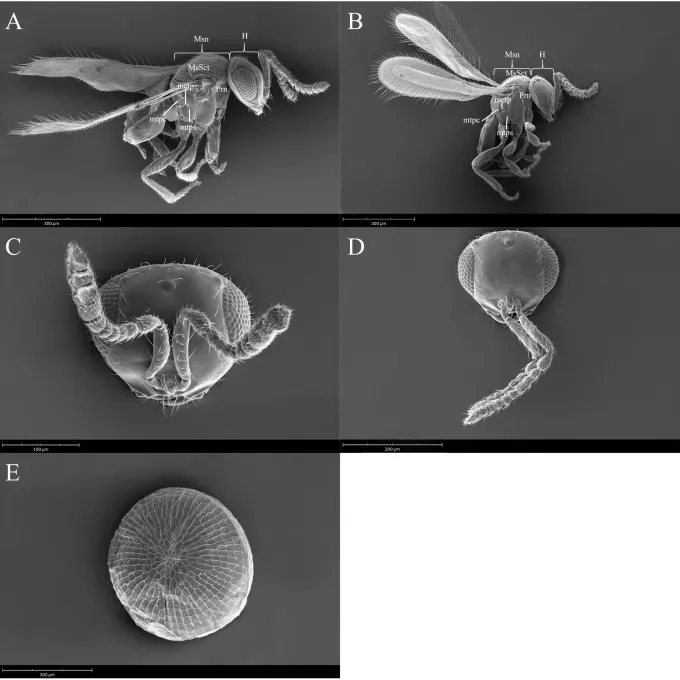
Telenomus flaviventris is a tiny insect belonging to the order Hymenoptera and the family Platygastridae. In agricultural settings, it is recognized not as a pest, but as a specialized egg parasitoid, serving as a critical natural control agent for various agricultural pests.
These wasps are minute, typically measuring around 1 mm in length. Their dark bodies make them extremely difficult to spot in the field without magnification. Despite their small size, they possess highly developed sensory organs that allow them to detect the egg masses of host insects.
The biology of Telenomus is strictly tied to its host. The female wasp locates the eggs of shield bugs (Pentatomidae) and inserts its own egg directly into the host's egg. The entire life cycle of the wasp occurs within the host egg.
The developing wasp larva consumes the host embryo from within, effectively neutralizing the pest before it can hatch. This parasitoid behavior makes them a key component in integrated pest management systems.
Telenomus species are known for their high efficiency and rapid generation time, often out-reproducing the host pests they regulate, which ensures a strong suppression of pest populations throughout the growing season.
What it damages
It is crucial to clarify that Telenomus flaviventris is absolutely not a plant pest. It does not feed on leaves, stems, or fruits of crops. Instead, its activity is focused solely on preying upon the eggs of harmful shield bugs.
The pests controlled by Telenomus are the ones responsible for agricultural damage, such as piercing the tissues of grains, legumes, and fruits, which causes deformity and reduces harvest quality.
By killing the pests at the egg stage, Telenomus prevents the damage that would otherwise be caused by nymphs and adult bugs. This makes it an invaluable ally for farmers looking to protect their crops.
Maintaining a healthy population of these parasitoids contributes to a significant reduction in the overall pest load on a farm. Their presence can often mitigate the need for aggressive chemical interventions.
Consequently, farmers should prioritize the conservation of these insects. Losing these natural predators often leads to uncontrolled outbreaks of shield bugs, requiring more expensive and disruptive chemical solutions.
When it appears
The seasonal appearance of Telenomus is perfectly synchronized with the phenology of its hosts. As soon as shield bugs begin laying eggs on crops in the spring, the adult wasps emerge to begin their search for hosts.
Population density typically peaks in mid-summer, coinciding with the mass egg-laying periods of target pests in major field crops. This is the period when their regulatory impact is most visible.
Their rapid generation time, influenced by ambient temperatures, allows them to produce several generations per season. This provides continuous pressure against pests throughout the most vulnerable stages of the crop.
As temperatures drop toward autumn, the activity of these wasps wanes. They enter a dormant state, typically overwintering as pupae or adults in debris, soil, or sheltered habitats around the field.
Field margins, hedgerows, and areas with undisturbed organic matter serve as essential overwintering refuges, which are necessary for the wasp population to survive until the next growing season.
Signs of infestation
The presence of Telenomus is identified through the condition of pest egg masses found on the foliage. Under close observation, parasitized eggs may show discoloration or structural changes compared to healthy pest eggs.
A hallmark sign of Telenomus activity is the presence of tiny, clean-cut exit holes on the surface of the pest eggs. These holes represent the point where the adult wasp emerged after completing its development.
When scouting fields, finding a high percentage of pest eggs exhibiting these exit holes is a clear indicator that a natural biological control program is successfully functioning within that plot.
Field technicians should be trained to distinguish between naturally unviable eggs and eggs that have been successfully parasitized by these wasps, as this data informs management decisions.
Laboratory dissection of egg clusters is the most accurate method to confirm the parasitism rate, which helps in determining whether chemical application is necessary or if the population can be left to the natural predator.
Control measures
Since Telenomus flaviventris is a beneficial insect, "control" in this context refers to conservation and population management rather than eradication. The primary goal is to foster an environment where they can thrive.
The most important measure is to minimize or eliminate the use of broad-spectrum insecticides. Such chemicals are highly toxic to parasitoid wasps and will disrupt the natural balance, often leading to secondary pest outbreaks.
Promoting biodiversity by planting flowering buffer strips or maintaining natural field edges provides necessary nectar sources for adult wasps, which increases their longevity and search efficiency.
When pesticide application is unavoidable, choose selective compounds that have minimal impact on parasitoids and apply them during times when the wasp population is least exposed.
- Reduce frequency of chemical applications.
- Preserve undisturbed field borders for overwintering.
- Monitor pest egg masses to time agricultural practices.
- Integrate biological control methods into farm management.
Taxonomy
- Latin name
- Telenomus flaviventris
- Order
- Hymenoptera
- Family
- Scelionidae
- EPPO code
- TELNFL
Discussion
No discussions yet — be the first.